

What Is a Leather Edge Oil Fatigue Testing Machine?
In the luggage, footwear, and leather goods manufacturing industries, leather edge paint is an important material used to finish leather edges and enhance their appearance and durability. Its quality directly affects the overall appearance, texture, and service life of finished products. To scientifically evaluate the resistance of leather edge paint to repeated rubbing and its resistance to cracking during actual use, the Leather Edge Paint Fatigue Tester has been developed. The equipment simulates repeated friction and loading under real-world conditions, providing accurate and reliable test data for product quality control.
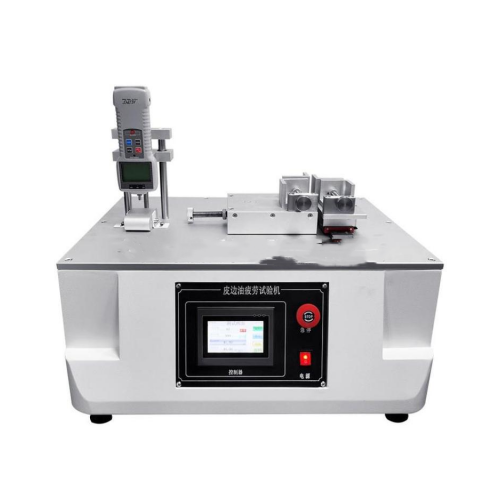
What Is a Leather Edge Paint Fatigue Tester
First, it is important to understand what leather edge paint is. Leather edge paint is a colored, semi-liquid material typically formulated with polyurethane resin and other components. It is mainly applied to the edges of leather, synthetic leather, or artificial leather to seal exposed edges, improve appearance, and help prevent delamination.
During daily use, areas such as luggage handles and leather belts are frequently subjected to repeated bending and friction. If the edge paint has insufficient adhesion or poor flexibility, it can easily crack or peel off, seriously affecting the appearance and durability of the finished product.
The Leather Edge Paint Fatigue Tester is specifically designed to address these issues. It is mainly used to evaluate the fatigue resistance of edge coatings applied to leather, synthetic leather, and similar materials. In accordance with applicable domestic and international testing standards, the tester performs standardized reciprocating flexing and rubbing tests on specimens to evaluate the durability of the edge paint under normal-temperature conditions.
Main Technical Parameters and Functional Features
Modern Leather Edge Paint Fatigue Testers are designed with a focus on testing accuracy and user-friendly operation. Their main technical features include:
Control System:
Equipped with a large LCD display or color touchscreen, the tester supports menu-based operation. The test count, test time, and cumulative operating time can be precisely set. An eight-digit counter display is also provided for convenient recording and monitoring of test data.
Safety Protection:
Most models are equipped with a fully transparent acrylic protective cover, which allows operators to observe the testing process while providing effective safety protection. Some high-end models feature an automatic shutdown function when the cover is opened, further enhancing operator safety.
Convenient Adjustment:
The stroke adjustment mechanism typically uses an eccentric wheel or a front-access design, allowing test parameters to be adjusted quickly without the need for complicated tools.
Alarm Indication:
When the test is completed, the system can alert the operator with an audible alarm. The alarm sound can be enabled or disabled according to laboratory requirements, making the tester suitable for different working environments.
Additional Functions:
Some integrated models are also equipped with a strap bending force testing device with a high-precision force sensor, allowing the bending mechanical performance of straps to be evaluated simultaneously.
Industry Value of the Leather Edge Paint Fatigue Tester
The core value of the Leather Edge Paint Fatigue Tester lies in its ability to transform the subjective experience of whether edge paint will crack or peel into quantifiable and traceable test data through standardized testing methods. This provides direct support for quality control and product improvement in the luggage, leather goods, and leather products industries.
1. Quality Control
Core Function:
By simulating the repeated flexing and rubbing that leather edges may experience during everyday use, the tester can help identify cracking, peeling, and other potential defects in edge coatings before products leave the factory, reducing the risk of non-conforming products reaching the market.
Industry Significance:
Similar to other luggage performance requirements, such as vibration impact and seam strength, edge paint durability is an important aspect of overall product quality evaluation. Standardized edge paint testing helps manufacturers establish more consistent quality-control procedures.
2. Compliance and Risk Control
Regulatory Basis:
During product inspections, luggage and leather goods may be evaluated according to applicable national or industry standards, with requirements covering various aspects of product performance and durability.
Commercial Value:
Compliant test results and third-party inspection reports can provide objective evidence of product quality when manufacturers are dealing with retailers, distributors, and other commercial channels. They can also help companies identify potential quality risks before products enter the market.
3. Brand Value and Competitiveness
Data-Driven Marketing:
Quantitative test results, such as the number of flexing or rubbing cycles completed without visible cracking under specified test conditions, can provide more convincing technical evidence than general claims such as “high quality.” Such data can help brands demonstrate product durability and differentiate their products in competitive markets.
Long-Term Value:
Consistent durability testing helps manufacturers improve product reliability and establish more substantiated quality commitments. By reducing premature coating failure and improving product consistency, companies can strengthen customer confidence and support long-term brand development.
4. Driving Industry Upgrading
Improving Manufacturing Processes:
Higher and more consistent testing requirements can encourage manufacturers to improve edge-paint formulations, coating processes, and production controls, gradually shifting the industry from experience-based manufacturing toward data-driven quality management.
Contribution to Standardization:
Companies that establish comprehensive internal testing procedures and quality-control requirements can improve manufacturing consistency and contribute practical data and experience to the development and refinement of industry testing practices and standards.
Conclusion
In summary, the Leather Edge Paint Fatigue Tester is not only an important tool for quality control of leather products, but also a technical foundation for improving product value, durability, and consumer confidence. As testing technologies continue to advance, the equipment is expected to provide increasingly sophisticated capabilities for automated data acquisition, analysis, and traceability, helping leather goods manufacturers move toward higher-quality and more data-driven production.