

What is an AATCC Viewing Board?
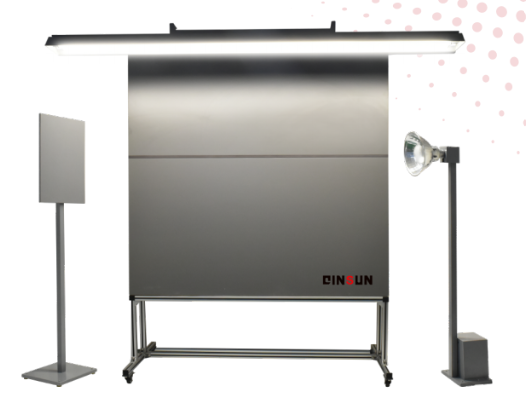
The AATCC Viewing Board is a standardized professional lighting device specifically designed for the visual evaluation of textile appearance quality. Its core purpose is to assess various visual characteristics of fabrics—such as surface smoothness, crease retention, and stripe visibility—under strictly controlled and uniform lighting conditions. This article will provide a systematic overview from the perspectives of its functions, operating procedures, and significance, offering comprehensive and clear reference for practitioners and researchers in the field, and supporting practical applications and scientific studies.
Functions and Applications of the AATCC Viewing Board
The AATCC Viewing Board is a specialized instrument widely used in the textile industry for standardized evaluation of fabric appearance performance. Its functions and applications are as follows:
Main Functions
Provision of a standardized lighting environment:
The device is equipped with AATCC-compliant Cool White fluorescent lamps (typically 8-foot or 4-foot tubes), ensuring that visual assessments are conducted under consistent and controlled illumination conditions.
Evaluation of multiple fabric appearance properties:
It is suitable for assessing post-laundering fabric characteristics such as fabric smoothness, seam smoothness, crease retention, wrinkle recovery, and stripe uniformity.
Standard-based rating support:
By comparing specimens with AATCC reference standards such as three-dimensional wrinkle recovery replicas or uniformity grading scales, subjective visual evaluations can be converted into more standardized and quantifiable results.
Core Applications
Quality control:
Used in textile manufacturing processes for batch-to-batch consistency inspection, ensuring that product appearance meets internal standards or customer requirements.
Research and development support:
Assists researchers in comparing the effects of different fiber types, weaving techniques, or finishing treatments on fabric properties such as wrinkle resistance and smoothness.
Trade and certification:
Provides a unified visual evaluation basis for buyers and sellers, reducing disputes caused by differences in subjective judgment and improving communication consistency across the supply chain.
Industries Applicable to the AATCC Viewing Board
The AATCC Viewing Board is widely used across multiple sectors in the textile and related industries for standardized visual evaluation of fabric appearance. Its key application areas include:
Textile Industry
It is used to evaluate fabric appearance properties after repeated home laundering, such as smoothness, wrinkle recovery, and seam flatness. It also supports visual assessment of color difference, uniformity grading, and Barré pattern analysis.
Apparel and Garment Manufacturing Industry
The device is suitable for assessing garment appearance issues such as wrinkling, seam impressions, and visible stains or oil marks. It is used in accordance with AATCC standards (e.g., AATCC 124).
Third-Party Testing and Quality Control Institutions
It is widely adopted in textile testing laboratories worldwide to ensure that evaluation results comply with AATCC international standards, supporting consistent quality verification in global trade.
Research Institutions and University Laboratories
It is used in the study of functional textiles (such as antibacterial, waterproof, and UV-resistant fabrics), particularly for analyzing the relationship between fabric appearance and functional performance, as well as for developing and validating new testing standards.
Dyeing and Finishing Industry
It is applied to evaluate how dyeing fastness and finishing processes (such as wash resistance, light resistance, and abrasion resistance) affect the visual appearance of textiles.
Testing Principle of the AATCC Viewing Board
The AATCC Viewing Board is based on a standardized visual evaluation system designed to assess the appearance characteristics of textile materials under controlled lighting conditions. Its testing principle is mainly reflected in the following aspects:
Color Stability Evaluation
The test evaluates the color changes of materials after exposure to specific lighting conditions by simulating real-world usage environments. This is essential for ensuring consistent product appearance during actual application and use.
Light Simulation
The testing system uses standardized light sources—such as daylight simulators or ultraviolet lamps—to replicate natural sunlight or artificial lighting conditions. This allows for the assessment of a material’s sensitivity and response to light exposure.
Visual Assessment
Using a dedicated Viewing Board, experienced evaluators perform side-by-side visual comparisons of the material before and after light exposure. Based on these observations, the color stability and overall appearance changes of the sample are determined in accordance with standardized rating methods.
In summary, the AATCC Viewing Board relies on controlled illumination, simulated environmental exposure, and standardized human visual evaluation to ensure consistent and reliable assessment of textile appearance and color performance.
Operating Procedure of the AATCC Viewing Board
Equipment Installation and Calibration
The AATCC Viewing Board should be securely mounted on a wall or installed on a mobile stand to ensure stability during use. It is equipped with AATCC-standard Cool White fluorescent lamps, either 8-foot (2400 mm) or 4-foot (1200 mm) tubes, in compliance with Section 12.4 requirements, to provide uniform and standardized illumination.
Environmental Setup
The observation area should be a darkroom or a low-ambient-light environment to eliminate interference from external light sources. The illumination level should be no less than 100 lx to ensure consistent visual evaluation conditions.
Sample Preparation
Samples should be flat and free of wrinkles, typically in the form of fabric swatches, or full garments when evaluating crease retention performance.
For Barré (stripe effect) evaluation, the fabric must be mounted on a testing frame, kept under tension, and positioned at an angle of 45° ± 5°.
Observation and Grading
Observers should stand approximately 1 meter (1 yard) away from the sample, maintaining an appropriate viewing angle relative to the fabric surface.
For Barré evaluation, the AATCC Uniformity Reference Scale is used for visual comparison, with a grading range from 9 (no visible stripes) to 1 (severe stripe formation).
For colorfastness or staining assessments, grading is performed using the AATCC Grey Scale or Chromatic Transference Scale, where a rating of 4–5 is generally considered acceptable.
Recording and Reporting
All evaluation conditions—including lighting, viewing angle, and sample status—should be documented along with the grading results and any observed anomalies.
When multiple observers are involved, the final result should be averaged to improve evaluation accuracy.
Important Notes
Grading must not be performed while the sample is in motion (e.g., during Barré testing, the frame must remain stationary).
Hand contact with the testing frame should be avoided to prevent contamination or interference with evaluation results.
For third-party inspection purposes, color difference within the same batch or roll is typically required to meet at least AATCC Grey Scale Grade 4.
Maintenance Recommendations for the AATCC Viewing Board
To ensure the accuracy and consistency of textile appearance evaluations, systematic maintenance of the AATCC Viewing Board is essential. Maintenance should cover environmental control, hardware upkeep, and operational management.
Observation Environment Maintenance
The Viewing Board should be installed in a dedicated evaluation area with strictly controlled lighting conditions.
Space and lighting control:
The evaluation area should be a darkroom environment, using only the designated overhead lighting of the Viewing Board. It is recommended that the side walls be painted matte black (gloss level below 85°, value under 5) or equipped with blackout curtains to eliminate interference from reflected light.
Viewing angle and distance:
Depending on the test standard (e.g., AATCC TM 178), the viewing geometry should be properly controlled. For fabric evaluation, the sample frame should be positioned at an angle of 45° ± 5°, and the observer should maintain a distance of approximately 1 meter from the lower edge of the sample.
Hardware Maintenance
Lighting system maintenance:
Light source type and specification: The Viewing Board must use Cool White fluorescent lamps with standardized dimensions of 2400 mm (8 ft) or 1200 mm (4 ft), depending on the specific AATCC test method.
Light consistency: Lamps should be inspected and replaced regularly to ensure uniform brightness and to prevent aging or color shift. The AATCC Committee RA61 is currently evaluating the equivalence of LED lighting systems, which may serve as a future energy-efficient alternative.
Special lighting equipment: For specific tests such as wrinkle recovery evaluation, dedicated lighting systems (e.g., 500 W DXC (RFL-2) floodlights with reflectors and light shields) must be used and installed according to standard positioning diagrams.
Equipment body and support structure:
Installation method: The Viewing Board may be wall-mounted or installed on a mobile stand. Mobile stands should be used when relocation between laboratory or factory sites is required.
Cleaning and maintenance: The surface of the Viewing Board should be cleaned regularly to remove dust and stains that may affect visual assessment. All mounting components should be checked for tightness and stability.
Operational and Calibration Maintenance
Standard sample (reference replica) management:
Properly store and regularly inspect AATCC standard replicas used for smoothness, seam smoothness, and wrinkle recovery evaluation. These include three-dimensional smoothness replicas, photographic seam smoothness standards, and wrinkle replicas. Ensure they remain clean, undamaged, and are not used directly as photographic references for grading.
Observer standardization:
Key evaluations should be conducted by at least three trained observers to minimize subjective bias. Observers must be familiar with standardized terminology (e.g., “simple,” “complex,” “striped” patterns, as well as yarn appearance descriptors such as “fine,” “bulky,” “light shade,” and “dark shade”) to ensure consistency and professionalism in evaluation.
Process documentation:
Each evaluation must be documented in detail, including light source type, equipment settings, viewing conditions, and any deviations from standard procedures. All modifications should be clearly stated in the final report.
Significance of the AATCC Viewing Board
The AATCC Viewing Board plays a critical role in textile quality evaluation, and its importance can be reflected in the following aspects:
1. Standardized Appearance Evaluation Environment
The AATCC Viewing Board is designed in accordance with multiple AATCC test methods (such as AATCC 124) to evaluate fabric smoothness, wrinkle recovery, and other appearance properties under controlled lighting and viewing conditions. It ensures that evaluations conducted by different laboratories and operators remain consistent and comparable.
Standard light source: Uses specified Cool White fluorescent lamps (e.g., 8 ft or 4 ft), in compliance with AATCC lighting requirements.
Controlled environment: Side walls are recommended to be painted matte black or equipped with blackout curtains to eliminate the influence of ambient light reflections on grading results.
2. Supports Objective Quantification of Key Performance Indicators
The device is mainly used to evaluate the following critical textile performance properties:
Wrinkle recovery: Assessed by comparison with three-dimensional reference standards (WR-1 to WR-5), providing a smoothness rating on a 1–5 scale, where 5 indicates the smoothest appearance.
Post-laundering appearance retention: Used to evaluate changes in fabric smoothness and crease retention after multiple wash cycles.
Seam appearance: Suitable for assessing the flatness and visual quality of stitched areas after treatment.
3. A Globally Recognized Authoritative Tool
AATCC is one of the most influential nonprofit standardization organizations in the global textile industry. Its standards are widely adopted by testing laboratories, brands, and manufacturers worldwide. As a standardized supporting device for implementing these methods, the AATCC Viewing Board is an essential tool in textile export processes and international certification systems (including ISO and ASTM references to AATCC methods).
4. Driving Industry Consistency and Technological Innovation
AATCC is actively advancing research through its RA61 committee on the impact of LED lighting on visual evaluation results, aiming to improve energy efficiency without compromising assessment consistency. This demonstrates that the Viewing Board is not only a traditional instrument but also an evolving benchmark platform for industry development.
In summary, the AATCC Viewing Board is an indispensable tool in ensuring consistency and reliability in textile appearance evaluation. It provides an internationally recognized standardized platform for color and appearance comparison across global supply chains, strongly supporting compliance and smooth international trade in textiles. At the same time, it continuously contributes to the evolution of testing methodologies and technical standards through ongoing application feedback, making it a core instrument for both quality control and research innovation in the textile industry.We sincerely welcome industry professionals, partners, and interested users to contact us for further information, technical specifications, application cases, and service support regarding this equipment.