

How to Use a Textile Far-Infrared Emissivity Tester?
The Textile Far-Infrared Emissivity Tester is a precision instrument specifically designed to evaluate the far-infrared emissive performance of textile materials. The instrument utilizes advanced infrared spectroscopy technology combined with a digital signal processing system to efficiently and accurately measure emissivity data of textiles within the infrared wavelength range. This enables users to comprehensively understand the behavior of textiles under infrared radiation, providing essential technical support for textile quality control, process optimization, and product research and development.The design and development of this instrument aim to scientifically and accurately evaluate the radiation performance and energy transfer characteristics of various textile materials in the far-infrared spectrum. It meets the increasingly stringent demands of modern functional textiles in terms of innovative research, manufacturing quality control, and industry market regulation.
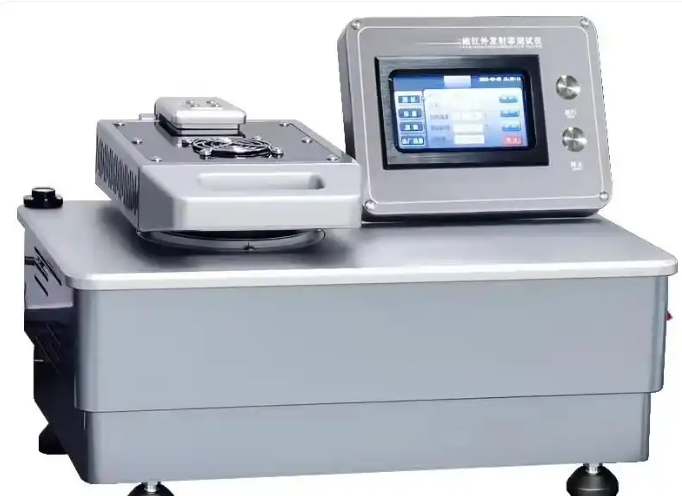
Detailed Explanation of the Testing Principle and Operating Procedure of the Textile Far-Infrared Emissivity Tester
1. Explanation of the Testing Principle
The core principle of this testing instrument is based on far-infrared radiation measurement technology. Specifically, under identical constant temperature conditions, the instrument simultaneously measures the far-infrared radiation energy emitted by the textile sample being tested and by a standard blackbody plate with a known high emissivity. Precision sensors capture the radiation intensity values of both sources.
The instrument then automatically calculates the ratio between the radiation intensity of the sample and that of the standard blackbody. According to Planck’s law of blackbody radiation, this ratio corresponds to the far-infrared emissivity (ε) of the material, which reflects its thermal radiation efficiency.
2. Description of the Operating Procedure
Sample Preparation
According to national standards or industry testing specifications, a circular textile specimen should be cut using a standard sampling tool. The sample diameter is generally not less than 60 mm. The sample surface must remain clean, free from wrinkles, stains, or coating damage to avoid affecting radiation measurement accuracy.
If the sample consists of a multilayer composite structure, all layers should remain uniformly flat with no bubbles or delamination.
Equipment Preheating and System Calibration
First, connect the main power supply and start the testing system to initiate the preheating program. Set the heating plate temperature precisely to (34 ± 0.1) °C and monitor the temperature control system to ensure stability and control deviation within 0.1%.
Next, use a standard blackbody plate with an emissivity not lower than 0.95 to calibrate the instrument. This step eliminates system errors and ensures a consistent reference baseline for subsequent measurements.
Placement of the Standard Blackbody Plate and Thermal Equilibrium
Place the standard blackbody plate flat in the center of the heating plate, ensuring full contact with the surface. Wait approximately 5–10 minutes until the blackbody plate reaches complete thermal equilibrium with the heating plate. During this period, avoid any external vibration or temperature disturbance.
Measurement of the Blackbody Reference Radiation Value
Activate the far-infrared radiation detection device, whose spectral response bandwidth must cover the typical far-infrared range of 5–14 μm. Once the blackbody temperature becomes stable, collect radiation intensity data multiple times and record the average stable value as the reference radiation baseline.
Replacement with the Textile Sample
Carefully remove the standard blackbody plate and promptly place the prepared textile sample onto the same position on the heating plate. Ensure the sample fully covers the heating plate with no air gap between them.
The replacement process should be performed quickly to minimize environmental temperature influence.
Collection of Sample Radiation Intensity
Continuously monitor the surface temperature of the sample. Once it reaches and stabilizes at the same temperature as the heating plate setting, use the same far-infrared measurement system to record the radiation intensity of the textile sample.
To reduce random error, multiple measurements should be performed and the average value recorded.
Calculation of the Far-Infrared Emissivity
The emissivity is calculated using the following formula:
[ε = I_{sample} / I_{blackbody}]
Where:
I_sample represents the radiation intensity of the measured textile sample
I_blackbody represents the radiation intensity of the standard blackbody under the same conditions
The instrument's built-in algorithm automatically completes the comparison and calculation process.
Data Recording and Report Output
The testing system automatically displays the emissivity result. The value typically ranges from 0.1 to 0.99. with an instrument indication error controlled within ±0.02.
Users can:
Transmit data to a computer in real time via wireless Wi-Fi
Print a paper report using the built-in wireless printer
Export test data as CSV or Excel files for further analysis and archiving
3. Additional Notes and Precautions
Environmental Control During Testing
Testing should be conducted in an indoor environment with stable temperature and humidity. Direct sunlight exposure to the testing area should be avoided. The instrument should be placed away from air-conditioning vents, open windows, or any locations that may cause airflow or sudden temperature fluctuations.
Recommended environmental conditions:
Temperature: 20–25 °C
Relative Humidity: 40%–60%
Special Surface Treatment Recommendations for Samples
For textile materials with strong mirror-like reflection or glossy surfaces, it is recommended to apply low-reflectance adhesive tape or spray a uniform matte coating before measurement. This helps suppress signal deviations caused by surface reflection and improves measurement accuracy and repeatability.
Equipment Maintenance and Periodic Calibration
In addition to routine inspection before each test, the instrument should be periodically verified according to textile testing standards.
Users are advised to:
Send the instrument for professional calibration, or
Conduct interim verification using standard reference samples
A comprehensive calibration every six months is recommended to ensure long-term reliability and validity of measurement data.
Industry Advantages
The Textile Far-Infrared Emissivity Tester offers several key technological advantages in the functional textile industry, particularly in terms of measurement accuracy, detection efficiency, standardization, and practical application adaptability.
The main advantages include the following:
1. High-Precision Measurement Capability Enhancing Product Credibility and Market Acceptance
The measurement error is strictly controlled within ±0.1%, which is significantly superior to the traditional thermal imaging method (typically around ±5%).
The instrument can accurately identify emissivity differences as small as 0.02. providing reliable and repeatable data support for product performance classification, material research, and process optimization.
2. Full Coverage of the Human Body Thermal Radiation Band (5–14 μm)
The equipment covers the 8–14 μm spectral range, which corresponds to the primary thermal radiation wavelength range of the human body. This prevents functional evaluation errors caused by mismatched spectral bands.
It enables accurate evaluation of various textiles such as:
Thermal underwear
Sports protective gear
Medical textile products
under real application conditions.
3. Non-Destructive Testing and High Efficiency Suitable for Modern Production Lines
Testing does not require cutting or damaging the sample, preserving the integrity of the textile material.
A single test typically takes about 30 seconds, making the instrument particularly suitable for:
Online sampling inspection
Large-scale quality control
Automated production environments
This greatly improves inspection efficiency and overall production capacity.
4. Promoting Industry Standardization and Market Regulation
According to relevant national standards, textiles can only be recognized as “far-infrared functional textiles” when their emissivity is not lower than 0.88.
This instrument provides objective and reliable testing evidence for:
Market regulatory authorities
Third-party testing laboratories
Enterprise quality control departments
It plays an important role in protecting consumer rights and maintaining fair market order.
5. Support for Multi-Functional Integration and Comprehensive Performance Analysis
In addition to basic emissivity testing, the system can also integrate other functional evaluation methods such as:
Far-infrared radiation temperature rise testing
Provides a direct reflection of the warming performance of textiles during practical use.
Washing durability testing
Evaluates the retention of functional performance after repeated washing.
Spectral emissivity curve analysis
Analyzes radiation characteristics across different wavelength bands, providing valuable insights for material improvement.
The far-infrared emissivity tester is not only a core tool for enterprise product research and quality control, but also an important infrastructure for regulating market behavior, protecting consumer rights, and promoting technological innovation and standard upgrading across the entire functional textile industry.
In summary, the Textile Far-Infrared Emissivity Tester, as a key textile testing instrument, plays an irreplaceable role in the accurate measurement and comprehensive evaluation of textile infrared emissivity performance.During the instrument design process, multiple technical parameters must be thoroughly considered, including but not limited to:Measurement range、Measurement accuracy、Long-term operational stability、User operation convenience.Only testing equipment that meets high standards in all these aspects can operate reliably and efficiently in real testing environments, thereby providing solid data support and technical assurance for quality monitoring, product development, and performance optimization in the textile industry.