
Tel:+86-21-6780 0179
Fax:+44(0) 207 398 0999
Email:market@qinsun-lab.com
Fabric Cooling Sensation Tester
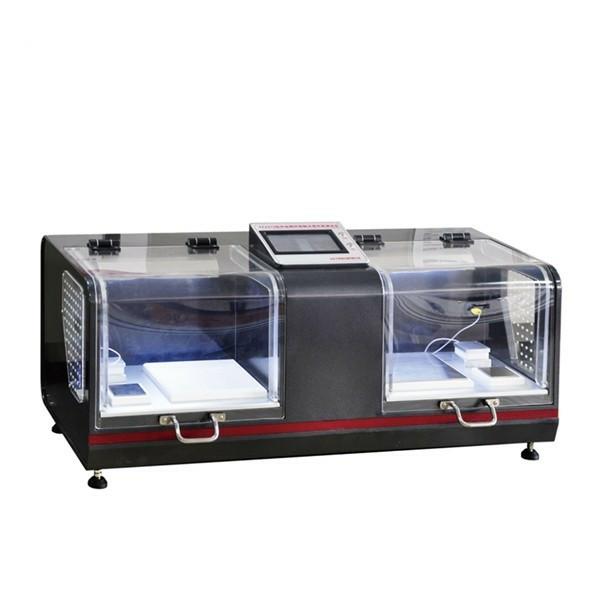
The Fabric Cooling Sensation Tester is a precision scientific instrument designed to quantify the "cool-to-the-touch" feeling of textiles and sheet materials. You can utilize this equipment to provide objective, data-driven evaluations of the thermal comfort provided by functional summer garments, bedding, and high-performance synthetic fibers, ensuring your products meet consumer expectations for localized cooling relief.
Applications
Fabric Cooling Sensation Tester is used to evaluate the instant cooling sensation upon skin contact for textiles and sheet materials, such as nightwear, bedding, and undergarments.
Standards
GB/T 35263-2017 Textiles - Testing and Evaluation of Instant Cooling Sensation Performance
CNS 15687 Test Method for Instant Cooling Sensation Performance of Fabrics
FZ/T 50048-2020 Test Method for Instant Cooling Sensation Performance of Filament Chemical Fibers
FZ/T 73067-2020 Knitted Garments with Contact Cooling Sensation
FZ/T 62042-2020 Bedding Made from Cooling Fabrics
JIS L1927-2020 Textiles - Test Method for Determining Cooling Sensation Properties
FTTS-FA-019 Fabric Instant Cooling Sensation Verification Specification
T/CTCA 4-2018 Bamboo-Woven Cooling Mattress
Features
1. Desktop model.
2. Color touchscreen display with an elegant and stylish appearance. Menu-driven operation offers smartphone-level convenience.
3. Core control components utilize STMicroelectronics' 32-bit multifunctional motherboard.
4. Automatic testing with automated calculation of test results.
5. Heating plate and thermal detection plate both employ high-precision sensors.
Parameters
| Item | Specifications |
|---|---|
| Heated Plate & Bamboo Mat Probe Temperature | 20°C ~ 40°C |
| Temperature Resolution | 0.01°C |
| Temperature Sensor Response Time | 0.1s |
| Fabric Probe | Copper plate area: 9 cm², pressure: (0.1±0.01) N/cm² |
| Bamboo Mat Probe | Mass: 1.1 kg, heat flow meter dimensions: 100mm×50mm, measurement accuracy: 2% |
| Contact Coolness Coefficient (QMAX) Resolution | 0.001 J/cm²·s |
| Sample Size | Fabric: 200mm×200mm; Bamboo mat: 400mm×200mm |
| Test Environment Requirement | (20±0.5)°C (constant temperature and humidity chamber) |
| Power Supply | AC220V±10% 50Hz 100W |
| Instrument Dimensions (L×W×H) | 1000×580×446 mm |
| Weight | Approximately 40 kg |
Accessories
Fabric Probe: Copper plate with pressure control for consistent contact.
Bamboo Mat Probe: Simulates larger bedding or mattress samples.
Power Supply Cable: AC 220V compatible.
Calibration Kit: For temperature sensor verification and periodic validation.
Instruction Manual and Software Interface for test operation.
Test Procedures
1.Preparation: Ensure the instrument is on a stable desktop surface. Connect to power supply and allow it to reach ambient operating temperature.
2.Sample Placement: Place fabric or bamboo mat samples on the designated heated plate or probe area. Confirm proper alignment for uniform contact.
3.Parameter Configuration: Input desired test temperature (20–40°C) and measurement duration on the touchscreen interface.
4.Test Initiation: Start the automatic test. The system will heat the plate and record thermal response of the material, calculating the QMAX coefficient.
5.Data Recording: Test results are displayed on the screen in real-time and can be saved or exported for further analysis.
6.Completion: Remove the sample once the measurement is complete. Power off or proceed to the next test sample.
FAQ
1.What is the main purpose of the Fabric Cooling Sensation Tester?
It objectively quantifies the “cool-to-the-touch” effect of textiles and sheet materials to evaluate thermal comfort performance.
2.Which types of samples can be tested?
The tester supports fabrics, bedding, bamboo mats, nightwear, undergarments, and functional high-performance fibers.
3.How precise is the temperature measurement?
The system provides a 0.01°C resolution with a sensor response time of 0.1 seconds, ensuring accurate QMAX calculation.
4.Can the device test both small and large samples?
Yes, fabric samples up to 200 × 200 mm and bamboo mat samples up to 400 × 200 mm can be accommodated.
5.Is the test process fully automated?
Yes, the instrument automatically heats the plate, measures thermal response, calculates the contact coolness coefficient, and records the data.