
Tel:+86-21-6780 0179
Fax:+44(0) 207 398 0999
Email:market@qinsun-lab.com
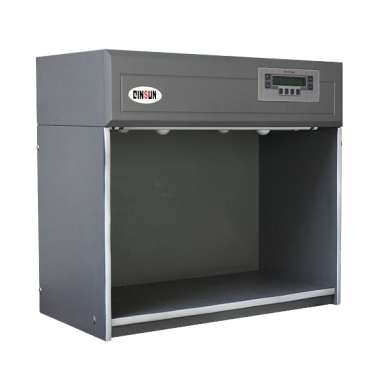
Textile color matching light box
Product Information
Thelaboratory color matching boxcan accommodate up to 4 light sources. The light sources can be specified by you, to meet your own specific needs and requirements. A typical cabinet includes UV and F with a choice of two other light sources - usually D65 and one 'point of sale' light source such as 840. 830 or Cool White. If required, A or H can be supplied instead of F.
You can stipulate the voltage you require and can also ask for the cabinet to be fitted with a Diffuser and or Dimmers(dependent upon lamp options you select). The cabinets are normally supplied painted with a neutral matt grey -Munsell N5. but it can also be supplied with alternatives of paint colours, Munsell N7or Ref G5574 if required to comply with a particular customer specification.
Color Viewing Booth Technical Parameters
Overall dimension: 420mm*710mm*545mm(L×W×H)
Viewing area dimension: 380mm × 680mm × 335mm(L×W×H)
Weight: 25kg
Power: 220V/50Hz
Light source:
1. D65--Artificial Daylight, Color temperature: 6500K, Power: 18W
2. TL84/P15--Europe, Japan, China store light source, Color temperature: 4000K, Power: 18W
3. A--Incandescent lamp, household light source, Color temperature: 2856K, Power: 35W
4. H--Tungsten halogen lamp, household light source, Color temperature: 2300K, Power: 75W
5. UV--Ultra-Violet , Color temperature: 3000K, Power: 18W
Optional Configuration
We also have a selection of accessories specifically designed for our CAC cabinet range including Benches, Workstations and Cupboards. Tables, both Tilting and Fixed Angle, are also available.
FAQs
1. What is a Textile Color Matching Light Box?
It is used to evaluate and compare textile colors under standardized lighting conditions.
2. Why is a light box important for color matching?
It provides consistent illumination and reduces color differences caused by different light sources.
3. What light sources can be used?
Common options include D65. TL84. CWF, A, and UV light sources.
4. What materials can be tested?
It is mainly used for fabrics, yarns, garments, leather, plastics, paper, and other colored materials.
5. Who typically uses a color matching light box?
Textile manufacturers, dyeing factories, garment companies, laboratories, and quality-control departments.