
Tel:+86-21-6780 0179
Fax:+44(0) 207 398 0999
Email:market@qinsun-lab.com

Fiber Oil Extractor
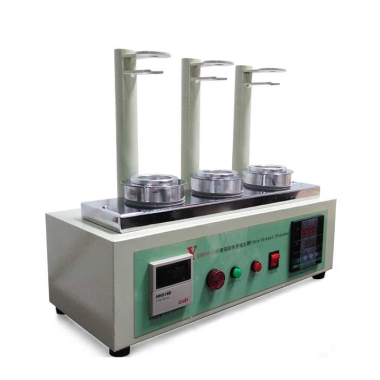
The Fiber Oil Extractor, also known as the Rapid Grease Extraction Apparatus, is designed for rapid and accurate determination of grease or finish content in wool, synthetic fibers, yarns, or fabrics. Using solvent percolation and evaporation, the apparatus delivers fast results suitable for quality control and processing purposes in textile production. Multiple extraction units can operate simultaneously for higher throughput.
Testing Standards
Edana method ERT 155
Application
Rapid Grease Extraction Apparatus is designed to determine the grease or finish content of wool or synthetic samples by solvent percolation and evaporation. Suitable for fiber, yarn or fabric. Available with 1. 2 or 3 extraction units.
Product Information
The Rapid Grease Extraction Apparatus was developed specifically for obtaining the oil content of tops and similar materials sufficiently quickly for the results to be available at the time of processing.
The principle of extraction is percolation of a solvent through the wool sample in a simple metal tube. The extract, as it drips from the tube, is collected by a light aluminium tray held between two metal rings mounted on a temperature-controlled hot-plate.
Features
1.The instrument consists of pedestal, extraction tub, weight, plunger, cotton wool plug, tray, and the hot-plate.
2.The tube should be positioned in the hole in the lower support member of the apparatus, and the plunger boss placed in the hole in the upper support member.
3.In use the plunger is placed through the boss and down into the tube. The weight is then located on top of the plunger.
Testing Method
Before starting a series of tests, the hot-plate is allowed to warm up to a suitable temperature (set by the power regulator knob). The correct temperature has been obtained when the solvent evaporates from the dish almost as quickly as fresh solution filters through to replace it. This prevents flooding of the tray and losing oil to the brass ring.
The temperature must not be too high, however, or the solvent will evaporate violently as the drops of solution hit the hot tray.
Before each test a pre-weighed aluminium tray is placed on the hot-plate brass ring. The tray location ring is then placed on the tray to secure it and to maintain a good thermal contact with the lower ring. The bottom of the tray must not touch the hot-plate.
This test method is most suitable for extracting loose wool or combed slivers, but it may also be used for yarn. It is not suitable for fabric unless it is first disintegrated into yarn to facilitate uniform packing in the extraction tube.
Technical Parameters
1.Range of temperature: ambient temperature-250℃;
2.Loading mode: aggravate weights;
3.Timing range: 1-9999min;
4.Accuracy of temperature control: ±1℃;
5.Number of specimens: 3;
6.Extracting solvent: Petroleum ether, ether and dichloromethane;
7.Outside dimension: 170×170×380mm(L×W×H);
8.Weight: 4.4kg(9.7lb);
9.Power supply: AC220V, 720W;
10.Power dissipation >: 175W.
Product Display
FAQs
1. What is a Fiber Oil Extractor?
It is used to extract oil and other finishes from textile fibers for analysis.
2. What can be tested with this machine?
It is mainly used for synthetic fibers, textile fibers, yarns, and related materials.
3. Why is oil extraction testing important?
It helps determine the oil or finish content on fibers and supports quality control.
4. How does the Fiber Oil Extractor work?
The fiber sample is treated with a suitable solvent to extract the oil, which is then measured.
5. Where is it commonly used?
It is commonly used in textile factories, fiber manufacturers, and testing laboratories.