
Tel:+86-21-6780 0179
Fax:+44(0) 207 398 0999
Email:market@qinsun-lab.com
Sweating Guarded Hot Plate Tester STD-AG48
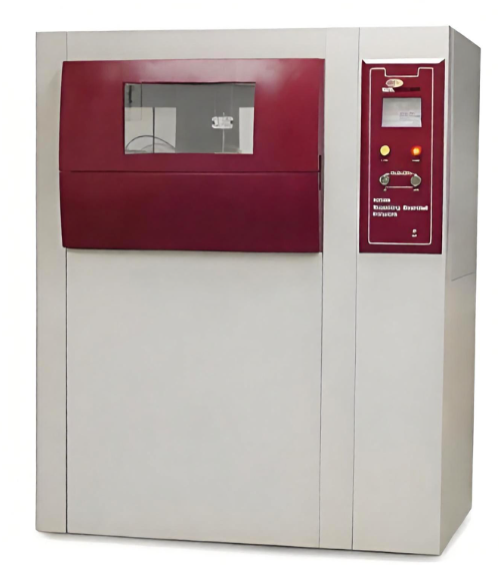
The Sweating Guarded Hot Plate Tester STD-AG48 is used to evaluate the thermal resistance and water-vapor resistance of textile materials under controlled temperature and humidity conditions.
Test Principle
Under standard test environment, heat the fixed aluminum or copper plate and keep a fixed temperature, test the heating power, then test the power of the same situation after covering the sample cloth, to get the hermal and evaporative of clothing material.
Features
With a heat plate fully simulated human skin mechanism, Easy to clean.
Automatic water supply system, can ensure the stability of the water supply and does not leak do not require any adjustment.
Instrument can automatic adjustment of PID control parameters based on sample thickness to achieve the test conditions.
Wind speed continuously adjustable from 0-1.2m/s, to meet variety test standard for thermal resistance, wet resistance and heating performance test.
The width of the thermal protection ring is 127mm to ensure that the heat flow is transmitted only from the test sample
Can connect WIFI with computer.
Standards
GB/T11048. ISO11092. ASTMF1868-09. BS 8515. ASTM D 1518-2014. JIS L1096-2010. ASTM F 1868-02
Key Specification
Model | STD-AG48 Sweating Guarded Hot Plate Tester |
Thermal resistance (RCT) range | 0.002~2.0 m2.K/W |
Wet resistance (RET) range | 0~1000 m2.Pa/W |
Test board temperature range | 30℃~40℃, adjust |
Temperature precision | ±0.03℃ |
Wind speed | 0-1.2m/s, continuous adjustable |
Wind speed precision | ±1% |
Test sample thickness | 0-50mm |
Test plate area | 254mm×254mm |
Sample area | 512mm×512mm |
Thermal ring width | 127mm |
Power supply | AC220V, 50/60HZ |
Dimension | 73×61×35cm |
Weight | 60Kg |
FAQs
1. What is the STD-AG48 used for?
It is used to evaluate the thermal and moisture-transfer performance of textiles.
2. What properties does it measure?
It measures thermal resistance and water-vapor resistance.
3. What materials can be tested?
It is mainly used for fabrics, clothing materials, and other textile assemblies.
4. Why is this test important?
It helps assess the comfort and moisture-management performance of textiles.
5. Where is the tester commonly used?
It is commonly used in textile factories, garment manufacturers, and testing laboratories.