
Tel:+86-21-6780 0179
Fax:+44(0) 207 398 0999
Email:market@qinsun-lab.com
Wet Penetration Tester
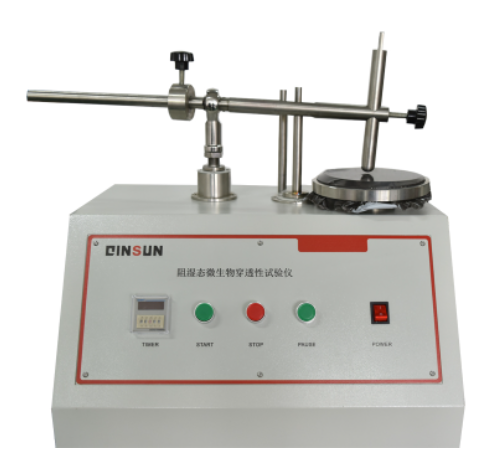
The Wet Penetration Tester is designed to evaluate the resistance of protective clothing and barrier materials to bacterial penetration under wet conditions. By applying controlled pressure and mechanical friction to the sample, the tester simulates real-world usage scenarios. Microbial penetration is quantified through culture and colony counting, providing an objective measure of material barrier performance.
Application
Protective Clothing Tester Wet Microorganism Bacterial Penetration Resistance Tester Apparatus: used to measure the penetration performance of bacteria in the liquid when the material is subjected to mechanical friction (the shielding performance of the liquid against bacterial penetration by the mechanical friction chamber)
Standards
(1) EN ISO 22610 – Clothing for protection against infectious agents — Determination of resistance to penetration by liquids.
(2) EN 14126 – Protective clothing — Performance requirements for protective clothing against infective agents.
(3) YY/T 0506.6 – Surgical drapes, gowns, and clean air suits — Test method for resistance to wet microbial penetration.
Features
Automatic stop as preset counters.
High stable testing performance from precise structure design.
Stainless steel body provides high corrosion resistant performance.
Adjustable loading pressure.
Technical Parameters
| Item | Specification |
|---|---|
| Rotary Speed | 60 rpm |
| Applied Pressure | 3 ± 0.02 N |
| Eccentric Speed | 5–6 rpm |
| Timer Range | 0–99.99 min |
| Loading Weight | 800 ± 1 g |
| Power Supply | 220 V, 50 Hz |
| Dimensions | 550 × 300 × 450 mm (21.65 × 11.81 × 17.72 in) |
| Net Weight | 27 kg |
Principle
Place the specimen on AGAR plate. A piece of the same specification is placed on the specimen. Cover with a high density polyethylene film about 10 microns thick. The three layers of material using the cone steel ring (the test material below, the mushroom center, high density polyethylene film on top) are stuck together. Place the ring on the AGAR plate on the turntable. The experiment means that the material can be applied to the material in a way that can be moved on the surface of the whole plate, so that the material is subjected to the combination of pressure and friction.
This model can simulate the force condition of the barrier material in the actual application and the microorganism penetration under the wet conditions.
The microbes on the microbial migrate to the surface of the AGAR plate after penetrating the experimental material. Through the culture and colony count of AGAR plate, the penetration performance of the test material can be quantitatively evaluated.
Maintenance Information
(1) Clean the rotary plate, steel ring, and agar plate placement area after each test.
(2) Regularly inspect the rotary mechanism and pressure application system for accuracy.
(3) Keep the instrument body and rotary table clean and corrosion-free.
(4) Verify timer and electrical system functionality periodically.
(5) Store the tester in a clean, dry laboratory environment.