
Tel:+86-21-6780 0179
Fax:+44(0) 207 398 0999
Email:market@qinsun-lab.com

Spinneret Inspection Microscope
Introduction
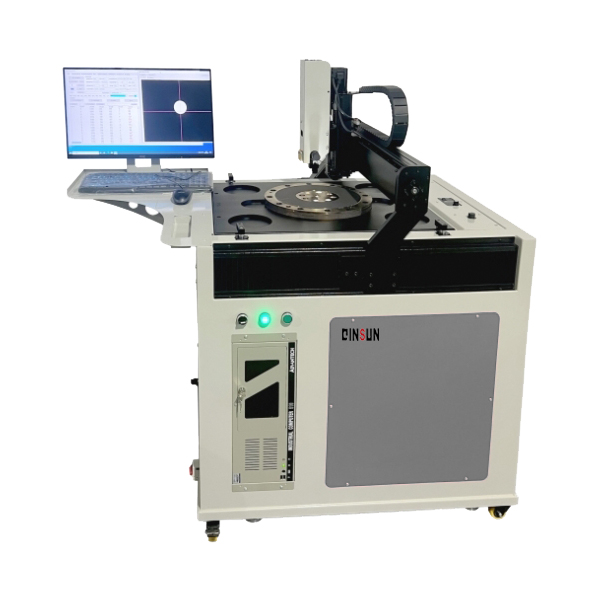
① Mechanical Components Overview
1. This machine employs an X-Y-Z three-axis motion control platform with AC servo systems for positioning. Each axis features a precision ball screw drive, ensuring low noise, high accuracy, and repeatability within ±0.01mm.
2. The high-resolution lens offers minimal distortion and superior resolution, eliminating the need for lens changes when switching magnification levels.
3. The camera utilizes a high-frame-rate, high-resolution monochrome industrial camera, ensuring undistorted image capture and thereby guaranteeing measurement accuracy.
4. The machine employs high-strength metal loading fixtures and a work surface, offering excellent load-bearing capacity and facilitating easy replacement of spinneret fixtures. (Machined via grinding to ensure flatness).
5. Equipped with a display monitor for convenient observation of the testing process and progress.
② Electrical System Overview
1. Utilizes reliable image processing algorithms to detect microhole parameters including diameter, area, roundness, and contamination rate (specific parameters customized per client requirements), automatically recording locations of non-compliant microholes.
2. Spinneret template calibration files are configured by users inputting spinneret parameter settings.
3. Lenses feature auto-focus functionality to enhance inspection efficiency.
4. Test data is stored in a database for convenient recording and analysis.
5. Optimized algorithms and path planning increase single-hole detection speed to approximately 0.2-0.7 seconds per hole. Detection rate varies based on spinneret specifications (directly related to hole pitch).
6. Flexible operation allows detection of different spinnerets by simply loading corresponding template files.
7. Equipped with an original Advantech industrial control computer featuring X, Y, Z axis control cards, I/O cards, and an adjustable light source controller. Includes an industrial control computer keyboard and mouse for rapid data transmission.
8. Features a long-life LED bottom light source and a full-coverage spinneret loading fixture. The light source uniformly illuminates the spinneret's micro-holes, enabling the lens to capture and display high-quality images on the monitor.
9. Incorporates an integrated design for enhanced aesthetics. Utilizes high-strength metal loading fixtures and work surfaces, offering excellent load-bearing capacity and convenient spinneret fixture replacement.
Applications
The Spinneret Inspection Microscope is an instrument used to detect the size of spinning holes and whether they are blocked in various types of chemical fiber spinnerets (spinning plates or spinneret plates).
The instrument automatically performs a “comprehensive examination” of all spinneret holes, including: - Automatic recording of each hole's position coordinates - Inspection and recording of coordinates for abnormal holes - Manual handle operation for air-blow cleaning during abnormal hole clearance - Localization via coaxial light beam projection onto spinneret micro-holes or stamp marking for non-compliant holes.
Common types of synthetic fibers include industrial yarns, turf yarns, island fibers, BCF, POY, DTY, specialty fibers, carbon fibers, aramid fibers, and nylon (polyamide). This inspection system measures conventional spinneret micro-hole diameter, area, roundness, contamination rate, and qualification status. Customized micro-hole inner wall tomography scanning functionality is also available.
Features
Intelligent Automation: You only need to load the spinneret and set the parameters; the system handles auto-focus, coordinate tracking, and hole-by-hole scanning without manual intervention.
Tomographic Scan Mode: Unlike standard surface inspections, this system offers a "fault scanning" feature. It divides the capillary length into multiple zones to detect internal fouling that surface depth of field might miss.
Integrated Remediation: The system provides built-in tools for immediate action, including air-jet cleaning for blockages and stamp marking or coaxial light targeting for failed holes.
Dual-Interface Analysis: You can toggle between a raw Data Interface for numerical analysis and a Graphical Interface for real-time visual inspection of the hole's physical state.
Robust Industrial Build: Designed as an all-in-one unit with an integrated Advantech industrial computer and a high-strength metal fixture table to ensure vibration-free, precision movement.
Parameters
| No. | Item | Specifications |
|---|---|---|
| 1 | Detection System | - Detection area: 500mm (L) × 600mm (W), customizable per user requirements- Detection stage dimensions: 965mm (L) × 905mm (W) × 135mm (H), customizable per user requirements |
| 2 | Design | Integrated design of electrical cabinet and main unit |
| 3 | Detection Items | Micro-hole diameter, area, porosity rate, contamination rate, special-shaped hole dimensions, etc. |
| 4 | Detection Speed | 0.2–0.7 seconds per hole (speed depends on hole spacing) |
| 5 | Detection Accuracy | ±0.01 mm |
| 6 | Detectable Micro-hole Range | 0.01mm–5mm (customizable beyond this range) |
| 7 | Max Nozzle Plates per Detection | Depends on plate size (e.g., up to 30 plates of φ88mm diameter can be loaded) |
| 8 | Motion Control Unit | X-Y-Z 3-axis control platform, equipped with 3 sets of servo motors and 3 ball screws |
| 9 | Camera | High-speed industrial camera, low noise, no motion blur |
| 10 | Light Source | Dual upper and lower light sources; switching between light sources enables different detection functions |
| 11 | Lens | Continuous zoom lens, low distortion, high detection accuracy |
| 12 | Software | Simplified Chinese detection software; supports customization for other languages (English, Traditional Chinese, Russian, etc.) |
| 13 | Equipment Dimensions (L×W×H) | 1362mm × 865mm × 1475mm |
| 14 | Weight | 189 kg |
FAQ
1.How accurate is the micro-hole detection?
The system achieves ±0.01 mm measurement accuracy using high-speed imaging and servo-controlled precision positioning.
2.Can it detect internal contamination along the entire hole length?
Yes, the tomographic scan mode segments the hole length, providing a detailed contamination profile for each section.
3.How quickly can a single hole be inspected?
Inspection speed ranges from 0.2–0.7 seconds per hole, depending on hole pitch and template configuration.
4.Does the microscope support multiple spinneret types?
Yes, by loading the corresponding template file, you can inspect different spinneret geometries without hardware changes.
5.What remediation options are available for blocked holes?
The system provides air-blow cleaning, coaxial light guidance for localization, and stamp marking for persistent non-compliance.
6.Can the inspection data be exported for analysis?
Yes, all numerical and graphical data is stored in the industrial PC database and can be exported for quality analysis or traceability.