
Tel:+86-21-6780 0179
Fax:+44(0) 207 398 0999
Email:market@qinsun-lab.com
Geosynthetic acid and alkali aging tester
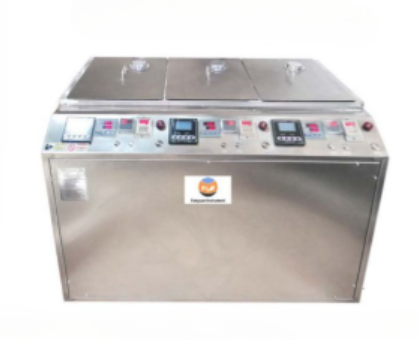
The geosynthetic materials acid and alkali resistance aging test chamber is used for performance testing of various geosynthetic materials against acid and alkali solutions. This machine features a stirring function, allowing the solution in the container to be continuously stirred while being heated. This ensures thorough mixing of the solution in the container, leading to more accurate experimental results.
Application
Test method for acid-resistant lye properties of various geosynthetic materials; The machine has stirring function, the solution in the container can be stirred continuously while heating, so that the solution in the container can be fully mixed, so that the experimental results are more accurate.
Standards
IS0 12960-2020: Petroleum products - Determination of asphaltene content - Gravimetric method
Q/CR549.7-2017: Geosynthetics in railway engineering - Part 7: Waterproof materials
JTG E50-2006: Test methods of geosynthetics for highway engineering
SL/T235-2012.8: Test specification for geosynthetics
Features
PID digital display temperature control mode, so as to ensure the accuracy of temperature control, the temperature of the solution in the container remains constant;
The acid-base three-compartment design was adopted, and the acid-base experiment was carried out at the same time.
Experimental cabin special material design, corrosion resistance, acid and alkali resistance;
Each lab is equipped with an independent PH testing device;
Each laboratory module is independently controlled;
Equipped with drainage device.
Parameters
| Description | Details |
|---|---|
| Display mode | LED |
| Temperature range | Room temperature to 80 °C |
| Loop mode | Internal loop |
| Volume | 27L |
| Temperature control accuracy | ±0.1 °C |
| Digital display resolution | 0.1℃ |
| Cover plate | (No specific details provided, just listed as an item) |
| Working slot size | 400200340mm |
| Size | 1050700600mm |
| Weight | About 60KG |
| Power supply | 220V |
| Heating power | 1600W (per tank) |
Accessoriess
Test chamber body: Used to contain the sample and solution, usually designed with special corrosion-resistant and acid-alkali resistant materials.
Stirring device: Ensures thorough mixing of the solution during heating, leading to more accurate experimental results.
Temperature control system: Includes a PID digital display temperature controller for precise control and maintenance of the solution temperature within the container, with a temperature control accuracy of up to ±0.1℃.
Experimental chamber: Typically designed as a three-compartment system for acid and alkali experiments, including a clean water compartment, an alkaline solution compartment, and an acidic solution compartment.
Sample holder: Used to fix the sample and prevent it from moving or deforming during the experiment.
Drainage device: Facilitates the drainage of the solution after the experiment for equipment cleaning and maintenance.
Heating element: Such as a heating tube, provides the necessary heat to the solution to reach the set experimental temperature.