
Tel:+86-21-6780 0179
Fax:+44(0) 207 398 0999
Email:market@qinsun-lab.com
Anti-drill tester (Friction method)
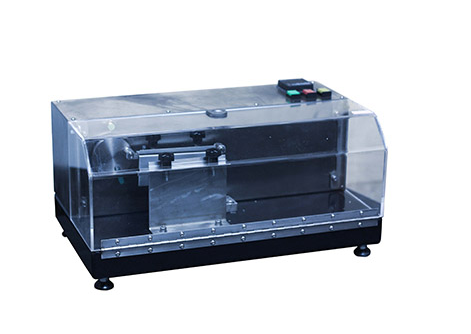
The Anti-Drill Tester (Friction Method) is designed to evaluate the drill and friction resistance of materials such as composites, polymers, and ballistic fibers. It simulates high-friction drilling forces to quantify material durability, penetration resistance, and heat generation, providing critical data for security textiles, armored components, and industrial materials. The instrument combines precision monitoring, automation, and standardized testing to ensure reliable results in compliance with global abrasion and ballistic material standards.
Application
The tester is suitable for assessing material durability in security textiles, automotive composites, aerospace CFRP panels, and industrial components like hoses and conveyor belts. It helps R&D, quality control, and production departments verify friction and penetration resistance under controlled conditions.
Standards
ASTM D3884 – Textile abrasion resistance
ISO 9352 – Friction and wear testing
NIJ 0108.01 – Ballistic-resistant materials
GB/T 29423 – Chinese abrasion resistance standard
Feature
(1) Adjustable RPM and pressure simulate real-world drilling and abrasion conditions.
(2) Standardized abrasive media (SiC-coated belts/discs) for consistent testing.
(3) Real-time penetration depth monitoring with laser sensor (±0.1mm).
(4) Thermal imaging tracks friction-induced heat.
(5) AI-based wear pattern analysis for predictive material assessment.
(6) Programmable multi-stage friction cycles with motorized sample rotation.
(7) Automatic reset and safety shutdown after testing.
(8) Compact laboratory/bench design for easy installation.
Technical Specifications
| Parameter | Specifications |
|---|---|
| Friction Head | Rotating abrasive disc, 120mm diameter, SiC-coated |
| Rotation Speed | 100–1000 RPM, programmable, ±5 RPM |
| Pressure Control | 5–50 N, adjustable via pneumatic system |
| Abrasive Media | Standardized silicon carbide belts, Grit 80–400 |
| Temperature Measurement | Thermocouple, 0–500°C, ±1°C accuracy |
| Sample Size | 100 × 100 × 30 mm (adjustable clamping) |
| Power Supply | 220V/50Hz, 1.5 kW |
| Dimensions | 800 × 600 × 1200 mm (L×W×H) |
Accessories
Included: Friction head with SiC disc, standardized abrasive belts, thermocouple, power cable, user manual.
Optional: Extended-life SiC abrasive packs, additional laser sensors, data analysis software license.
Operation & Maintenance
(1) Place the sample securely in the adjustable clamp.
(2) Select desired RPM, pressure, and friction cycle program.
(3) Ensure safety covers are in place before starting the test.
(4) Monitor thermal imaging and penetration depth readings in real-time.
(5) After the test, allow the sample and friction head to cool.
(6) Clean abrasive media and friction head to maintain performance.
(7) Inspect pneumatic and motor systems monthly for wear.
(8) Calibrate laser sensors annually or as required by ISO 17025.
(9) Replace worn abrasive media before testing to ensure accuracy.
(10) Keep ventilation clear to dissipate generated heat safely.