
Tel:+86-21-6780 0179
Fax:+44(0) 207 398 0999
Email:market@qinsun-lab.com
Fabric ici pilling and snagging box
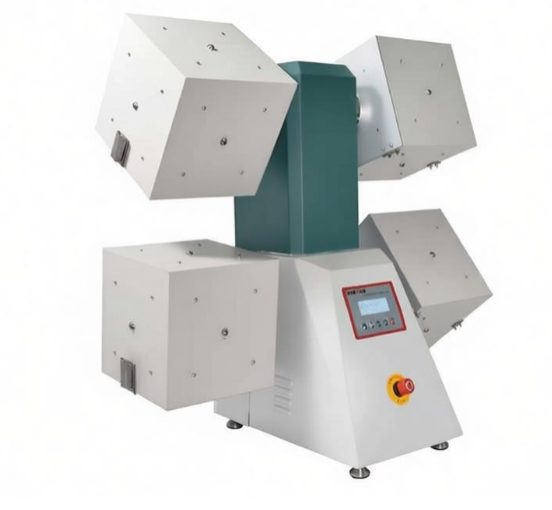
The Fabric Pilling and Snagging Tester is used for rolling friction pilling tests on loosely woven fabrics, knitted fabrics, and other fabrics prone to pilling, to evaluate their pilling and snagging resistance under non-pressure conditions.
Applications
A universal pilling and snagging tester drives system to rapidly repeat pilling or snagging on fabrics to generate normal wear on samples in a fraction of the time.
Provided with unique controller allowing selection between standard and several optional speed settings.
Programmable reversing function at 30 rpm and test cycle definition facilities.
Standards
ISO 12945-1:2021 Textiles — Determination of pilling and fuzzing (ICI box method)
BS 5811:1979+A1:1991 British Standard for Pilling of Textiles
GB/T 4802.3-2008: Chinese National Standard for Pilling Test of Textile Fabrics
JIS L1076:2019: Japanese Standard for Pilling of Textiles
Features
Multi-station configuration: Equipped with 4 pilling boxes, allowing simultaneous testing of multiple samples to improve efficiency;
Flexible operation: Supports forward and reverse rotation, better simulating actual fabric friction scenarios;
Adjustable parameters: Rotational speed covers multiple gears from 20 to 70 rpm, adapting to different testing standards;
Intelligent display and alerts: LCD screen displays parameters in real time, and an alarm sounds automatically upon test completion;
Reliable design: The pilling boxes are well-sealed (ensuring testing stability), and the motor has an automatic pause protection function;
Multi-standard compatibility: Compatible with mainstream pilling test standards such as ISO/BS/GB/JIS, suitable for testing various textiles.
Technical Parameters
| Box Number | 2. 4. 6 | ||
| Control Method | Touch Screen Control | ||
| Speed | 60±2r/min(30~70 can be set) | ||
| Box Inside Dimension | (235×235×235)mm | ||
| polyurethane sample tube | Length 140mm,Outer diameter (31.5±1)mm,thickness(3.2±0.5)mm, mass (52.25±1)g,4pcs for a box | ||
| Counter | 1~99999 cycles | ||
| ICI pilling test method | GB/T 4802.3. ISO 12945.1. BS 5811. JIS L1076 | ||
| Power | AC 220V 50Hz 120W | ||
| Dimension/Weight(cm/kg) | 82*42*55/40 | 82*42*85/60 | 98*51*120/142 |
Test Procedures
First, prepare the accessories and test samples;
Secure the test sample in the PU sample holder;
Place the sample holder containing the test sample into the test chamber;
Turn on the instrument's power switch and access the operating interface;
Set parameters such as rotation speed and number of cycles;
Press the "Start" button, and the test chamber will rotate at a certain speed;
The test will automatically stop when the set number of cycles is reached;
Open the test chamber lid and remove the sample;
After the test is complete, turn off the instrument;
After the experiment, remove the sample for analysis and comparison to evaluate the material's resistance to pilling, snagging, and abrasion.
FAQ
1.What is a fabric pilling and snagging tester?
A fabric pilling and snagging tester is a device used to evaluate the resistance of textiles to pilling and snagging. Pilling occurs when fibers become loose and form small balls on the fabric surface, while snagging refers to the pulling of loops in fabric. This tester helps manufacturers and quality control teams identify how well a fabric can withstand wear and tear, ensuring that products meet durability standards.
2.How does a fabric pilling and snagging tester work?
The fabric pilling and snagging tester typically involves abrasion and resistance testing, where samples of the fabric are subjected to friction or mechanical stresses in a controlled environment. The tester will simulate conditions that fabrics may face during normal use, allowing for an accurate assessment of their performance. Results are measured quantitatively, determining the number of pills or snags after testing.
3.Why is it important to test for pilling and snagging?
Testing for pilling and snagging is crucial for maintaining fabric quality and consumer satisfaction. Fabrics that pill or snag easily can lose their aesthetic appeal and durability, leading to dissatisfaction among customers. By performing these tests, manufacturers can improve fabric designs and blends, ultimately leading to higher-quality products and better brand reputation.
4.What fabrics should be tested for pilling and snagging?
Typically, all types of fabrics, including natural fibers (like cotton and wool) and synthetic materials (like polyester and nylon), should be tested for pilling and snagging. Fabrics that are often subjected to friction or stress, such as those used in clothing, upholstery, and linens, should especially be assessed to ensure they meet required standards for durability and appearance in actual use.
5.Can fabric treatments affect pilling and snagging performance?
Yes, fabric treatments can significantly impact pilling and snagging performance. Treatments such as finishes, coatings, or blends with other fibers can enhance the durability of fabrics. Some treatments are specifically designed to minimize fuzz formation or improve fabric strength, thus leading to reduced pilling and snagging. Testing is essential to determine the effectiveness of these treatments in real-world applications.
6.How can manufacturers improve fabric resistance to pilling and snagging?
Manufacturers can improve fabric resistance to pilling and snagging through various methods, including selecting high-quality fibers, optimizing the weaving or knitting process, and applying finishing treatments that enhance durability. Additionally, educating consumers about proper care—such as machine washing with a gentle cycle or avoiding friction with other items—can help sustain the fabric's appearance and quality over time.