
Tel:+86-21-6780 0179
Fax:+44(0) 207 398 0999
Email:market@qinsun-lab.com

Hydrostatic Pressure Tester
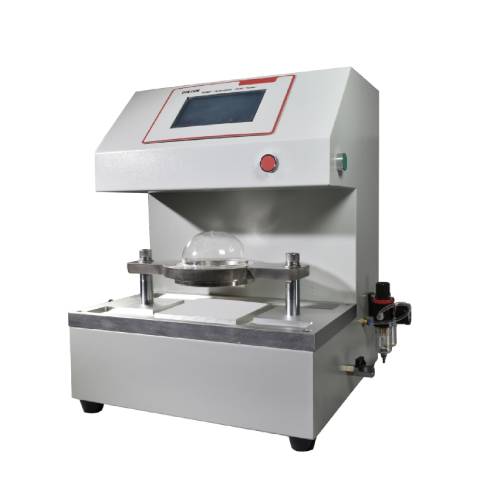
The G018P Hydrostatic Pressure Tester is an upgraded version of the G018. designed to measure the hydrostatic resistance of materials. In a standard atmospheric environment, the instrument determines the pressure at which water first appears on the non-contact side of the sample under continuously increasing water pressure. This provides a precise assessment of the material’s waterproof and water vapor resistance properties.
Application
Testing woven, laminated, and coated fabrics for water resistance and breathability.
Evaluating high-density fabrics, canvas, felt, oilcloth, tent materials, and impermeable fabrics.
Quality assessment for outdoor apparel, umbrellas, rain gear, and protective clothing.
Medical and chemical protective garments testing for body fluid and chemical liquid penetration resistance.
Nonwoven/filtered fabrics, breathable waterproof fabrics, and paper/board water permeability tests.
Standards
GB/T 4744-2013 (Textiles – Determination and evaluation of water resistance – Hydrostatic pressure method)
AATCC 127 (Water resistance: Hydrostatic pressure test)
BS EN 20811 (Textiles – Determination of water resistance – Hydrostatic pressure method)
ISO 811 (Textiles – Determination of resistance to water penetration – Hydrostatic pressure test)
ISO 1420:2016 (Rubber or plastic coated fabrics – Resistance to water penetration)
JIS L1092 (Textiles – Water resistance – Method A low pressure / Method B high pressure)
ASTM F903 (Standard test method for resistance of protective clothing materials to liquid penetration)
FZ/T 01004 (Coated fabrics – Hydrostatic pressure test)
EDANA 120.2-02 (Nonwoven fabrics – Hydrostatic pressure test)
BS 3424-26 (Coated fabrics – Methods 29A–29D – Water penetration and surface wetting)
Parameters
| Parameter | Specification |
|---|---|
| Operation Mode | Fully automatic |
| Test Units | mbar / kPa / Pa / cm w.c / mm w.c |
| Interface Language | Chinese / English |
| Test Modes | Dynamic, Static, Custom |
| Control Panel | Full-color touchscreen |
| Pressure Rate | 1–100 kPa/min; standard speeds: 1.0±0.05 kPa/min, 6.0±0.3 kPa/min |
| Pressure Range | 0–5 mH₂O (0–500 kPa) |
| Test Area | 100 cm² ±1%, optional 26 cm², 19.63 cm², 28 cm² |
| Safety Stop | Automatic on sample rupture; records data |
| Weight | 45 kg |
| Power Supply | 220V, 50Hz |
| Dimensions | 650 × 460 × 650 mm (L × W × H) |
Features
Capable of testing high-density, laminated, coated, and nonwoven fabrics for waterproof and breathable performance.
Applicable for outdoor fabrics, medical protective clothing, chemical protective garments, and filtration materials.
Supports dynamic and static hydrostatic testing with precise pressure control.
Built-in water reservoir ensures continuous supply to the test head, automatically regulating pressure from 0–5 bar.
Automatic safety shutdown upon sample rupture, ensuring reliable and safe operation.
Accessories
(1) Built-in water reservoir with test head
(2) Sample clamps for various sizes
(3) Touchscreen control panel
(4) Pressure sensor and safety valves
(5) Optional adapters for smaller test areas
Maintenance Information
Regularly clean the water reservoir and test head to prevent residue buildup.
Inspect clamps and sensors for wear or damage.
Check and calibrate pressure sensors periodically.
Ensure the touchscreen panel and control system are free from moisture and dust.
Conclusion
The G018P Hydrostatic Pressure Tester provides fast, precise, and reliable measurements of material hydrostatic resistance, supporting comprehensive testing for textiles, nonwovens, protective garments, and industrial coatings.
FAQ
(1) What is this product?
It is a hydrostatic pressure tester that measures the resistance of materials to water penetration.
(2) What is this product used for?
It evaluates waterproof, breathable, and fluid penetration resistance for fabrics, nonwovens, protective clothing, and paper materials.
(3) What is the working principle of this product?
The device gradually applies water pressure to a sample; the pressure at which water first appears on the non-contact side is recorded as the hydrostatic pressure.
(4) Why is this product important?
It ensures fabrics and protective materials meet waterproof and fluid resistance standards for outdoor, medical, and industrial applications.
(5) What industries is this product suitable for?
Textiles, outdoor equipment, medical and chemical protective clothing, filtration materials, paper and packaging, and industrial coatings.