

How the Bending Tester STD-FB2-A Operates?
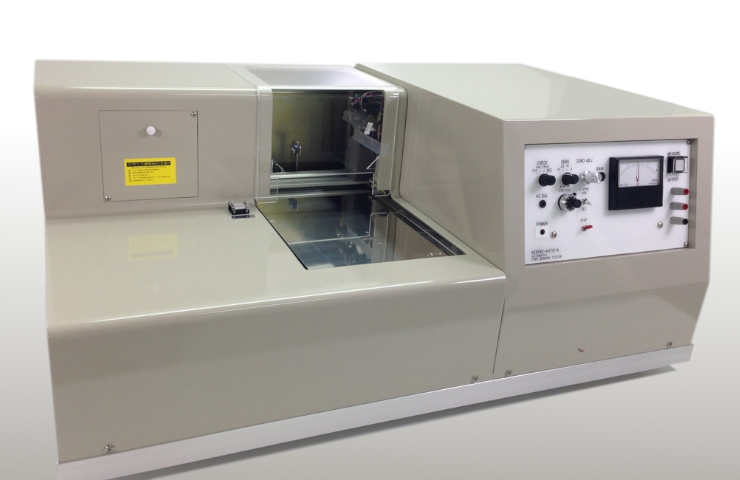
The Bending Tester STD-FB2-A is primarily used to evaluate the bending rigidity, stiffness, and softness of textiles and other flexible materials. By measuring data related to the bending of a material under its own weight, the instrument assesses its resistance to bending and its overall flexibility. It is widely utilized in textile production, quality control, and laboratory-based material performance testing.
Operational Procedure
First, the fabric or flexible material to be tested is cut into specimens of specified dimensions and shapes, ensuring the surfaces are flat and free from noticeable creases or damage. The instrument is then powered on, and the necessary test parameters are configured; the testing platform and the propulsion mechanism are checked to ensure they are functioning correctly. The specimen is placed flat on the instrument’s horizontal testing platform, with one end supported and the other extending freely. Upon activation, a mechanical propulsion mechanism gradually advances the specimen horizontally, causing an increasing length of the material to extend beyond the edge of the platform. As it extends, the free end of the specimen bends downward under the influence of its own gravity. Once the specimen reaches a predetermined bending angle or test position, the device is stopped, and the length of the extended portion is recorded. This process is repeated—potentially in different directions or multiple times—to collect a comprehensive set of data. Based on relevant testing standards and mathematical formulas, parameters such as bending length and bending rigidity are calculated. Finally, the results are analyzed to determine whether the material’s softness, stiffness, and bending characteristics meet the required quality standards. Upon completion, the specimen is removed, the instrument is powered down, and the testing platform is cleaned.
Working Principle
During testing, the fabric or flexible material is cut into strips of specified dimensions and placed on the instrument’s horizontal testing platform. One end of the specimen is secured or supported by the platform, while the other end remains free. The instrument is then activated, and a mechanical propulsion mechanism slowly advances the specimen horizontally until the portion extending beyond the platform begins to bend downward under the force of its own gravity. When the free end of a specimen reaches a specified tilt angle or bending position, the advancement is stopped, and the extended length of the specimen is recorded. Based on this bending length, the specimen's dimensions, and relevant calculation formulas, performance parameters—such as bending length and bending stiffness—are derived. During testing, a softer material—which has a lower resistance to bending deformation—bends more easily under its own weight, typically resulting in a shorter measured bending length. Conversely, a stiffer material—which possesses greater resistance to bending deformation—requires a longer extension to reach the specified bending angle, typically resulting in a longer measured bending length. By conducting repeated tests on specimens in various orientations and comparing the results, one can analyze differences in a material's bending performance across the warp, weft, or other directions. The equipment performs tests through mechanical transmission, specimen displacement, and the measurement of the bending state. Crucially, the process requires no external tensile or compressive loads; instead, the material undergoes bending deformation solely under its own weight, thereby minimizing the influence of external forces on the test results. The data obtained are used to evaluate the softness, stiffness, and bending characteristics of fabrics and other flexible materials, providing a reference for quality inspection, production process control, and performance research.
Fields of Application
In the textile industry, this equipment is primarily used to assess the bending properties of fabrics made from cotton, linen, wool, silk, polyester, nylon, and other chemical fibers. By measuring how a fabric bends under its own weight, it is possible to evaluate the impact of various factors—such as raw fiber materials, yarn structures, fabric weaves, and finishing processes—on the material's softness and stiffness. This assists manufacturers in selecting appropriate raw materials and processing techniques, ultimately enhancing the quality and performance consistency of textile products. In the garment manufacturing sector, the equipment can be utilized for performance testing and the selection of apparel fabrics. Different apparel products have varying requirements regarding the softness, crispness (stiffness), and bending characteristics of their fabrics. For instance, items like shirts and skirts typically require fabrics with good softness and drape, whereas suits, uniforms, and certain functional garments demand a degree of crispness and structural integrity. Testing the bending properties of fabrics provides essential guidance for material selection, product design, and quality control during production. In the nonwoven fabric sector, this equipment can be used to evaluate nonwovens—such as those made from polypropylene or polyester fibers—assessing their bending behavior under various manufacturing processes and fiber structural configurations. The test results help analyze how factors like fiber orientation, material thickness, thermal bonding processes, and finishing treatments influence the softness and stiffness of nonwovens, enabling manufacturers to optimize product structure and production techniques to enhance performance. In the field of textile research and development, the equipment facilitates the study of novel fiber materials, composite fabrics, functional textiles, and specialty products. By testing specimens with diverse materials, structures, and processing conditions, researchers can compare bending characteristics and examine the relationship between material structure and mechanical properties, providing empirical data to support the development of new materials, the optimization of product formulations, and the refinement of manufacturing processes.In the realms of product quality control and third-party inspection, this equipment is utilized for the incoming inspection of raw materials, quality monitoring throughout the production process, and the final testing of finished goods. Standardized testing across different production batches allows for the assessment of whether a material’s bending properties meet technical specifications. It also enables the identification of quality variations between batches, helping to promptly detect performance anomalies—whether caused by changes in raw materials, fluctuations in production processes, or improper finishing—thereby ensuring greater consistency and stability in product quality.
Significance
By measuring the bending deformation of a material under its own weight, one can determine its resistance to bending and analyze how different materials or manufacturing processes affect the softness and stiffness of a fabric.