

What are the features of the Ross Flex Tester?
The Ross Flex Tester is a laboratory testing instrument designed to evaluate the resistance of flexible materials—such as rubber, PU, PVC, and TPR—to repeated flexing. It is widely used in industries involving footwear sole materials, rubber products, and other shoe components. By subjecting a specimen to a specified number of flex cycles, the instrument allows for the observation of surface cracks and the measurement of any extension in pre-existing cuts, thereby assessing the material's flex-fatigue resistance and crack-growth resistance.
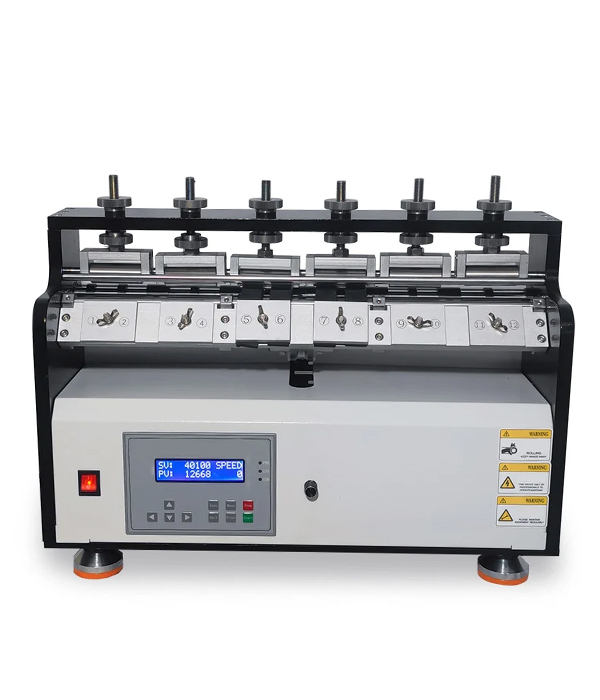
Structural Components
The Ross Flex Tester primarily consists of a frame, a drive system, a transmission mechanism, specimen-clamping fixtures, a flexing mechanism, a counter, and a control system. Frame: Serves as the main structural support, housing various functional components and ensuring stability during operation. Drive System: Comprises a motor that provides power to drive the specimen through continuous, stable, reciprocating flex cycles. Transmission Mechanism: Utilizes components such as gears, connecting rods, or eccentric wheels to convert the rotational motion of the motor into the reciprocating motion required by the flexing mechanism. Specimen-Clamping Fixtures: Consist of fixed and movable clamps that secure the test specimen, preventing it from slipping or coming loose during testing. Flexing Mechanism: The core functional component; it uses mechanical motion to repeatedly bend the specimen at a specified angle, subjecting the material to periodic flexural deformation. Counter: Records the number of flex cycles; the equipment can be set to stop automatically upon reaching a predetermined count, or the test can be halted manually by the operator. Control System: Manages the start, stop, operating speed, and test duration; many units feature a digital display panel and an automatic shut-off function. Safety Guards: Protect operators from contact with moving parts, reducing the risk of mechanical injury during operation.
Key Features
High Testing Precision: Capable of performing repetitive tests at precise, pre-set flex angles and frequencies, ensuring consistent test conditions and reproducible results. High Level of Automation: Employs a motor-driven system to facilitate continuous, reciprocating flexing of specimens, which minimizes manual intervention and enhances testing efficiency. Multi-specimen testing: Some units are equipped with multiple specimen clamps, allowing for the simultaneous testing of several specimens to enhance testing efficiency. Counting function: An integrated automatic counter records the number of flex cycles in real time, facilitating control over the testing process. Targeted testing: By observing the initiation and propagation of cracks in specimens subjected to repeated flexing, the material's resistance to flex fatigue can be evaluated. Broad applicability: Suitable for assessing the flex resistance of various materials, including rubber, PU, PVC, TPR (used in shoe soles), and other flexible materials. Ease of operation: The equipment features a relatively simple design, making specimen installation, testing, and routine maintenance straightforward. Supports quality control: Useful for raw material inspection, product R&D, and production quality control, providing a reference for material selection and product performance evaluation.
Operating Procedure
Equipment inspection: Before testing, verify that the power supply, drive system, transmission mechanism, and specimen clamps are functioning correctly. Ensure the equipment operates stably and that no components are loose or damaged. Specimen preparation: Cut specimens to the specified dimensions and quantity in accordance with the relevant testing standards. Create an initial cut (notch) of the required length and depth at the designated location on each specimen to ensure compliance with testing requirements. Specimen installation: Secure the prepared specimens into the equipment clamps. Adjust their position and clamping status to ensure they are held firmly, preventing any slippage or loosening during the test. Parameter setup: Configure the equipment—including flex frequency, total number of cycles, and other relevant test conditions—based on the applicable standards and material specifications. Initiate testing: Power on the equipment and start the operation; the motor will drive the transmission mechanism, causing the clamps to subject the specimens to continuous, reciprocating flexing. Monitor the equipment during operation to ensure the specimens are flexing as intended. Throughout the test, verify that the specimens remain securely clamped and that all parameters adhere to the relevant standards; do not adjust the clamps or touch moving parts while the equipment is in operation. Test completion: Once the pre-set number of cycles or the specified test duration has been reached, stop the equipment. Wait until all moving parts have come to a complete standstill before removing the specimens. Observation of Results: Examine the surface of the specimen for cracks, fissures, or damage; measure the extension length of the initial cut; and record any observed changes in appearance along with relevant data. Analysis of Results: Evaluate the extent of crack propagation and damage resulting from bending in accordance with testing standards to determine the material’s resistance to flex fatigue and crack growth. Equipment Cleaning and Maintenance: After testing, remove any debris from the fixtures and equipment surfaces, verify that all moving parts are functioning correctly, power down the unit, and ensure the equipment is left clean.
Summary
The primary test metrics for this equipment include crack propagation length, the occurrence of cracking, and the degree of damage sustained by the material following repeated bending. The test results can be used to assess the susceptibility of footwear sole materials to cracking during prolonged walking and repetitive flexing, providing a basis for material selection, product quality control, and research and development.