

Why use a luggage lifting and unloading testing machine?
The Luggage Lifting and Unloading Testing Machine is a specialized piece of testing equipment designed to evaluate the durability of a suitcase’s handles, retractable handles, and overall structural integrity when subjected to repeated lifting, carrying, and lowering. By simulating the real-world scenarios—such as the repeated lifting, moving, and setting down of luggage during daily use or transit—the machine applies specified loads and cyclic motions to the suitcase. This allows for the assessment of the strength, durability, and reliability of its handles, connecting components, and structural framework.
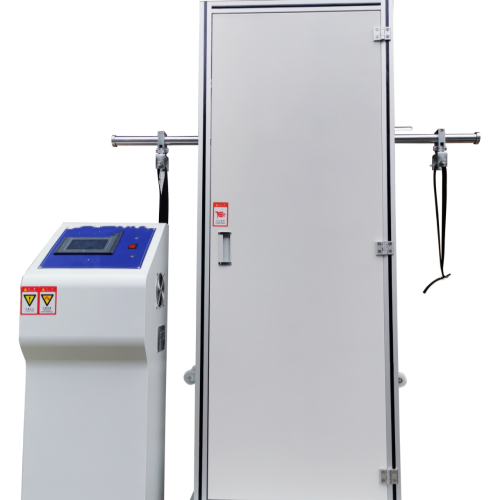
Structural Components
Frame and Support System: Comprising a metal framework, base, and support structures, this system houses and secures the various functional components of the machine. It provides a stable mechanical foundation, ensuring the equipment maintains high rigidity and stability during continuous operation. Drive System: Consisting of a drive motor and associated control components, this system serves as the power source for the machine. The motor provides the necessary energy to drive the lifting mechanism at set speeds and frequencies, enabling the automated lifting and lowering of the luggage. Mechanical Transmission Mechanism: Typically composed of drive shafts, connecting rods, gears, lead screws, or other transmission elements, this mechanism transfers power from the motor and converts it into the specific motion required for the lifting mechanism, ensuring that the test sequences are executed consistently and reliably. Specimen Clamping and Fixture System: Designed to secure the suitcase or its handles, this system utilizes specific clamps and fixtures tailored to different testing methods. It ensures the specimen remains stable throughout the test, preventing unwanted slippage or displacement. Lifting Mechanism: The core component responsible for the lifting and lowering tests, this mechanism drives the suitcase in a reciprocating vertical motion. By configuring the lifting height and travel distance, it accurately simulates the actions of a user lifting a suitcase, holding it suspended, and placing it back on the ground. Load Adjustment Device: This component applies a specified load to the suitcase to simulate its weight when packed with items. It subjects the handles and their connection points to repetitive forces under a defined load, allowing for the evaluation of their load-bearing capacity and durability. Control and Operating System: Typically consisting of a control panel, touchscreen, controller, and electrical control components, this system is used to set and adjust test parameters—such as lifting/lowering height, operating speed, number of test cycles, and operating modes—while also managing the startup, shutdown, and automatic cyclic operation of the equipment. Counting and Display System: This system records the number of completed lifting/lowering cycles in real time and displays relevant test parameters. Once the preset number of cycles is reached, the control program automatically stops the equipment, allowing operators to conveniently record and analyze test results. Safety Protection Devices: These include emergency stop buttons, limit switches, overload protection, and various protective structures. They are designed to prevent the lifting mechanism from exceeding its intended range of motion, guard against abnormal operation, and avoid mechanical collisions, thereby ensuring the safety of both the equipment and the operators during testing.
Scope of Application
Luggage and Suitcase Industry: Used to test the durability of handles and their attachment points on various types of luggage and suitcases during repeated lifting and lowering, evaluating whether the handles are prone to breaking, loosening, or detaching. Carry-on and Hand-luggage Industry: Used to test the structural integrity of small suitcases and hand-luggage during repeated lifting and lowering, assessing their reliability under typical handling conditions. Luggage Manufacturing Industry: Employed for quality control during production; by testing the durability of different materials, handle structures, and attachment methods, it helps manufacturers optimize product design and production processes to enhance overall quality. Quality Testing Organizations: Used to conduct performance testing and quality evaluations on various types of luggage, checking for issues such as handle breakage, loose connections, or deformation of the luggage body under specified load conditions and cycle counts. Scientific Research and Product Development: Used to study how different materials, handle structures, connection methods, and load capacities affect product durability, providing experimental data for the design, development, and performance improvement of new luggage products. Import and Export Inspection: Used for quality sampling and performance assessment of luggage, helping manufacturers and testing agencies determine whether products meet procurement requirements, technical specifications, and applicable testing standards.
Purpose
Designed to test the durability of luggage handles during repeated lifting and lowering cycles. This equipment is used to evaluate the robustness of the connection between the handle and the luggage body, checking for any signs of loosening, detachment, or breakage. It assesses the structural strength and load-bearing capacity of luggage under specified loads. By simulating the long-term handling and usage of luggage, it evaluates the product's operational reliability. It helps identify issues such as deformation, cracking, or damage that may arise in the luggage body, handle, or related connection structures after repeated stress. Furthermore, it allows for the comparison of how different materials, structural designs, and manufacturing processes affect the durability of luggage. It is utilized by luggage manufacturers for product R&D, quality control, and pre-shipment inspection, as well as by third-party testing organizations for performance evaluation.
Summary
The Luggage Lifting and Unloading Testing Machine is primarily designed to test the durability of handles and related structures on various types of luggage, including travel suitcases, wheeled suitcases, carry-on bags, and handheld bags. By simulating the repeated lifting and lowering actions encountered during actual use, it evaluates the load-bearing capacity, durability, and connection reliability of the handle and its associated components, providing a scientific basis for quality control, product R&D, and pre-shipment inspection in the luggage industry.