

What is a Flexometer / Bally-type flexometer?
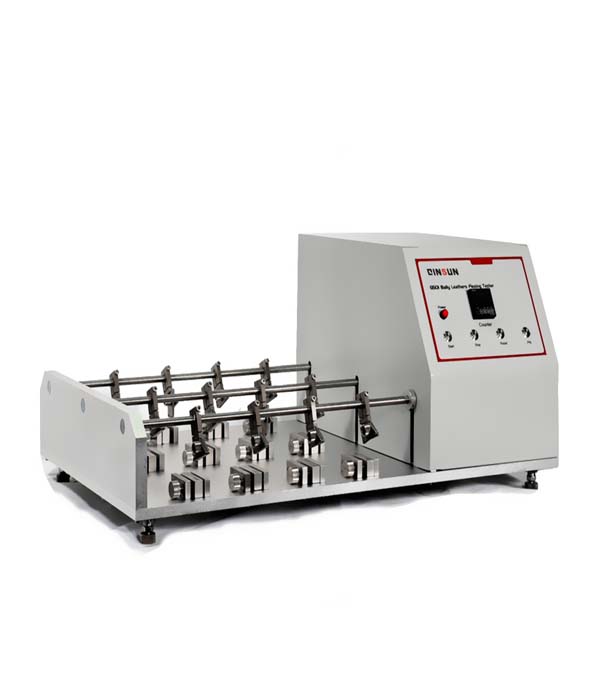
The Bally-type flexometer is a piece of testing equipment used to evaluate the physical properties and durability of materials subjected to repeated bending, folding, and stretching. It is primarily employed for quality testing in sectors such as leather, artificial leather, synthetic leather, rubber, coated textiles, and footwear materials. Within the leather and footwear industries, the Bally-type flexometer serves as a critical instrument for assessing flex resistance—specifically, whether a material develops cracks, coating delamination, surface damage, discoloration, or other forms of degradation after prolonged, repetitive flexing.
Testing Objectives
Flex resistance is the primary test parameter. By repeatedly bending the material, the equipment determines its ability to withstand continuous mechanical deformation. Surface crack resistance is evaluated by observing whether cracks appear on the material's surface during repeated flexing. This is particularly relevant for finished leather, artificial leather, and synthetic leather, which often feature a protective film or coating; if this coating lacks sufficient flexibility, it may develop micro-cracks that gradually expand. Coating adhesion and integrity are assessed by checking for issues such as coating detachment, peeling, cracking, surface flaking, or separation of the coating from the substrate—a critical performance metric for PU synthetic leather, PVC artificial leather, and finished leather. The Bally flexometer typically supports testing under two conditions: dry or standard conditioned states (to evaluate flex resistance under normal usage environments) and wet or water-soaked states (to assess the impact of moisture on flex resistance). Wet-state testing helps determine whether a material is more prone to cracking, coating loss, or structural failure when exposed to humid or damp environments.
Equipment Structure
The frame serves as the main structural component, supporting the entire testing system. It is generally constructed from metal to ensure sufficient stability during long-term operation. The upper clamp is used to secure one end of the test specimen. It is connected to a mechanical transmission system and, driven by a motor, undergoes reciprocating oscillation at a set angle. This is the key component that generates the repeated bending action. The lower clamp is used to secure the other end of the specimen; it typically remains stationary, maintaining a specific clamping angle relative to the upper clamp. Together, the upper and lower clamps cause the specimen to undergo repeated folding and bending as the upper clamp oscillates. The drive motor provides the mechanical power required for the clamps to perform reciprocating motion at a specified speed. Through the transmission mechanism, the rotational motion of the motor is converted into the reciprocating oscillatory motion of the clamps. The transmission mechanism serves to control and transmit mechanical motion, determining the movement trajectory of the clamps, the bending angle, and the stability of the motion. A counter is used to record the number of bending cycles the specimen has undergone, while a control panel allows for the configuration of test parameters. The multi-station design enables operators to test different materials simultaneously—or multiple specimens of the same material—thereby enhancing laboratory testing efficiency.
Operating Principle
The test specimen is secured at both ends, with one of the clamps oscillating back and forth at a specified angle and speed. This subjects the material to continuous, repetitive bending deformation. The testing process is as follows: the material is cut into a specimen of the required dimensions and folded along a specified direction. One end of the specimen is secured in the upper clamp; the specimen is then folded according to the test method, and the other end is secured in the lower clamp. The position of the specimen is adjusted to ensure proper clamping, avoiding any unintended tension that would deviate from the standard. After setting the number of bending cycles and other test parameters, the equipment is started. The upper clamp begins a continuous, reciprocating oscillation, causing the specimen to undergo repeated bending. Once the specified number of cycles is reached, the equipment stops. The specimen is then removed and inspected for any damage to its surface or internal structure.
Applications
In the leather industry, it is used to test whether natural leather develops cracks, surface damage, or coating delamination after repeated bending. In footwear manufacturing, it evaluates the flex resistance of upper materials—such as leather, synthetic leather, and textiles—to determine if they can withstand the demands of long-term wear. In the synthetic leather industry, it assesses the integrity of surface coatings on materials like PU and PVC after repeated flexing. In the automotive interior sector, it is used to evaluate how leather and coated materials perform when subjected to continuous bending. It is also used to test the flex resistance of materials used for luggage, bags, handles, and other flexible components.
Summary
The Flexometeris a piece of equipment designed to test material durability. Rather than simply measuring the angle to which a material can be bent, it assesses whether the material sustains damage through continuous, repetitive mechanical flexing. It primarily evaluates a material's resistance to flex-induced failure, specifically monitoring for the development of cracks, coating delamination , surface damage, or other forms of material failure. It effectively simulates the repetitive bending that materials may experience during actual use.