

How to use a bag-lifting fatigue testing machine?
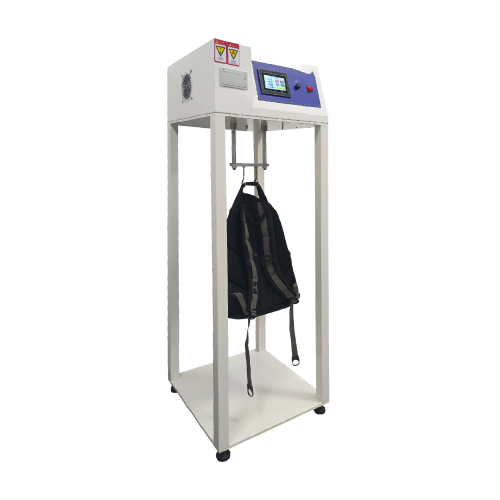
A Bag lifting fatigue testing machine is an instrument designed to perform vertical vibration fatigue tests on plastic carry bags. It serves as a specialized testing device that simulates the fatigue damage—caused by repeated lifting and load-bearing—that a bag might experience during actual use, thereby allowing for the assessment of its durability.The core operating principle involves using a mechanical system to replicate the human action of carrying a bag, subjecting the sample to periodic, repetitive loading. This accelerates the fatigue process, enabling the evaluation of the bag's fatigue life and durability by observing whether any failure occurs, such as material damage, handle breakage, or the splitting of seams. Some advanced models are equipped with features that can automatically detect sample failure, halt the test, and record the results.
Scope of Application
This equipment is widely used in the manufacturing of packaging materials, product quality inspection, third-party testing laboratories, and scientific research institutions, providing a basis for testing to support the design optimization and quality control of packaging bags.
It is designed to test the fatigue resistance of handles on various types of shopping bags, including those made of plastic, non-woven fabric, paper, or reusable materials. Through repeated lifting tests, the equipment evaluates whether handles are prone to breakage, detachment, or tearing at the connection points. It is suitable for kraft paper bags, paper carrier bags, gift bags, and other paper-based packaging. By simulating actual usage, it tests the durability of the connection between the handle and the bag body, helping manufacturers optimize handle structures and bonding processes. For PE, PP, and other plastic bags, the equipment assesses handle performance under repeated loading—checking for deformation, tearing, or breakage—to enhance the reliability of these products. It is also applicable to non-woven shopping bags, eco-friendly bags, and promotional carrier bags; repeated lifting tests evaluate the fatigue resistance of stitched seams, heat-sealed joints, and the handle material itself, offering insights for structural improvement. Third-party testing organizations and professional laboratories can utilize this equipment to conduct standardized fatigue testing on various packaging bags, comparing the durability of different materials, handle designs, and production processes to provide objective data for quality assessment. Manufacturers can employ this equipment during product R&D and production to compare different handle designs, material thicknesses, attachment methods, and load-bearing capacities, enabling the early detection of potential quality issues and ensuring greater product consistency.
Components
A handle fatigue tester for bags typically consists of a frame system, drive system, clamping system, load system, motion control system, and safety protection system. These components work in coordination to perform repetitive fatigue testing on the handles of packaging bags.
The frame serves as the foundational support structure for the equipment. Usually constructed from metal, it offers high rigidity and stability. Its primary functions include supporting the various functional components, maintaining overall stability during testing, minimizing vibrations during operation, and providing a mounting base for the fixtures and drive mechanisms. The drive system is the core component of the tester; it generally comprises a motor, transmission mechanisms, and related mechanical parts. It provides the power required for testing, drives the testing mechanism in a reciprocating (up-and-down) motion, regulates the speed and frequency of this motion, and simulates the repetitive stress experienced by a bag handle during actual use.
The clamping system is designed to secure the packaging bag and its handle, ensuring the specimen remains correctly positioned throughout the test. Handle fixtures hold the bag handle in place, simulating real-world lifting conditions. Bag-body securing devices hold the main body of the bag or work in conjunction with the load system to facilitate testing. Auxiliary positioning mechanisms ensure the specimen is installed accurately, thereby reducing testing deviations. The load system applies a specified test load to the bag, simulating the tension exerted on the handle by the contents during actual use. It provides a controlled test load, replicates the effects of items of varying weights on the handle, evaluates the fatigue resistance of the handle connection points, and detects issues such as handle breakage, detachment, or tearing of the bag material.
The motion control system, typically composed of a controller, electrical components, and an operator interface, is used to manage the test parameters. It allows for setting the number of test cycles, adjusting the speed of the reciprocating motion, controlling the range of motion, starting, pausing, or stopping the test, and recording the operational status. A counting system automatically tracks the number of reciprocating test cycles completed. The safety protection system is designed to ensure the safety of both the equipment and the operators.
Summary
This equipment is extensively used for quality inspection and R&D testing of shopping bags, paper bags, plastic bags, non-woven bags, and other handled packaging products. Through scientific and repeatable fatigue testing, companies can optimize handle designs, refine production processes, improve product quality, and reduce the risk of damage during actual use.