

How Can You Ensure Global Buyers Trust the pH Value of Your Fabrics?
From yarn to finished garments, a piece of fabric undergoes a long series of wet-processing procedures, including scouring, bleaching, dyeing, and finishing. Acids and alkalis take turns playing their roles throughout these processes. Once processing is complete, residual acidic or alkaline chemicals may remain trapped between the fibers.Healthy human skin is protected by a slightly acidic surface barrier. If a fabric intended for direct skin contact is excessively acidic or alkaline, it may compromise this protective barrier, potentially causing itching, irritation, and allergic reactions. For this reason, textile safety regulations and technical requirements worldwide have consistently identified pH value as a key compliance parameter. Whether it involves eco-textile certification, cross-border e-commerce inspections, or brand audits, a pH test report is almost always one of the first requirements that must be met.As a result, every textile and leather laboratory faces the same critical question: Can your pH testing keep pace with your orders?
Manual pH Testing: The Time Cost Goes Far Beyond the Test Itself
Under traditional methods, testing the pH value of a fabric sample involves cutting the specimen into small pieces, adding a measured quantity of water, performing temperature-controlled extraction through oscillation, calibrating the electrode, allowing the reading to stabilize, conducting parallel tests, eliminating outliers, and calculating the average. Throughout this entire process, laboratory technicians are constantly occupied with repetitive manual tasks.
During peak order seasons, samples queue up waiting for extraction, while reports are delayed seemingly indefinitely. As testing personnel change, differences in operating techniques can cause parallel test results to vary considerably. An electrode that has not been calibrated in time, an extraction solution assigned to the wrong sample, or a transcription error when recording results—any one of these seemingly minor oversights can lead to a batch of compliant fabric being incorrectly rejected or a batch of non-compliant fabric reaching the market.
Even more challenging for laboratory managers is the fact that the quality of manual testing depends heavily on the condition and performance of the people conducting it. Difficulty recruiting experienced technicians and retaining skilled laboratory personnel is a common problem for many laboratories.
As customer delivery schedules become increasingly demanding and factory audit requirements become more stringent, how much longer can a testing model built primarily on manual labor remain sustainable?
Let a Robot Take Charge of Your Laboratory
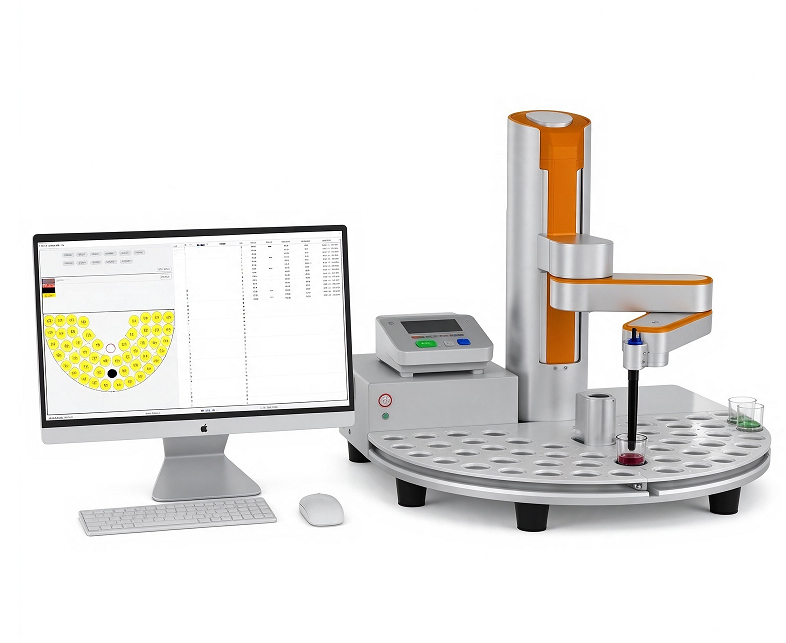
The Automatic pH Tester offers a straightforward solution: leave the entire testing workflow to a machine.
Built around an industrial-grade robotic arm, the system integrates a fully automated workflow covering sampling, extraction, liquid transfer, measurement, and data processing.
Operators simply place the prepared samples on the sample turntable. The machine handles the remaining procedures automatically, including sample cutting and quantitative liquid addition, temperature-controlled oscillation extraction, transfer of the extract to the measurement cell, automatic reading, outlier identification, and calculation of the mean of parallel test results.
Operators do not need to remain beside the instrument throughout the testing process. Voice prompts provide reminders at key stages, allowing even inexperienced users to become familiar with the operation within a single day.
At the heart of the measurement system are a high-precision pH meter and a temperature-sensing electrode from internationally recognized brands. Temperature is recorded automatically during measurement, helping minimize reading deviations caused by temperature fluctuations.
Multiple testing modes can be selected to suit different requirements, including rapid single-sample testing, parallel verification of multiple samples, and continuous batch processing. Its daily processing capacity is designed to meet the demands of large-scale quality control operations.
Test data is stored automatically and can be exported to spreadsheets with a single click. The system can also integrate seamlessly with a Laboratory Information Management System (LIMS). Reports no longer need to be handwritten, traceability no longer depends on searching through paper records, and retrieving test records during customer audits becomes a simple, straightforward task.
With a footprint comparable to half a standard office desk, this automated laboratory solution can be conveniently installed in quality inspection rooms, R&D laboratories, and even production-floor testing areas.
The robotic arm and other automation modules are engineered to industrial-grade standards, supporting stable and reliable long-term operation. It is a one-time investment designed to deliver lasting returns.
One Instrument, Three Major Benefits
1. For Trading Companies: A Gateway to Winning Orders
Rapidly generate reliable test data aligned with applicable international and national standards, giving your company greater confidence during customer inspections and when providing export test reports. Even when delivery schedules are tight, automated testing helps reduce delays caused by sample backlogs.
2. For Manufacturers: A Guardian of Profitability
Screen incoming raw materials and retest finished products before shipment. By identifying excessive or non-compliant pH values before goods leave the factory, manufacturers can avoid costly batch returns, rework, and even contractual compensation.
Automation also significantly reduces dependence on highly experienced testing personnel. Reducing the need for an additional full-time technician can translate into substantial annual labor cost savings. Unlike human operators, the machine does not tire, take leave, or experience fatigue.
3. For Third-Party Testing Laboratories: A Multiplier for Testing Capacity
High-throughput batch processing significantly increases laboratory testing capacity while improving the consistency of results. As the need for repeat testing and the likelihood of disputes decrease, laboratories can strengthen their reputation, improve operational efficiency, and attract more orders.
Confidence That Goes Beyond Performance
The instrument incorporates a range of maintenance-friendly features to simplify routine operation. These include reminders for periodic electrode calibration, easy-to-clean measurement cells and sample trays, and automatic backup of operating data, helping make daily maintenance more convenient and efficient.
We also provide comprehensive support for electrode selection, including glass electrodes and combination electrodes, along with standard calibration solutions, maintenance kits, and other essential consumables.
In addition, we offer worldwide shipping and responsive technical support. From installation and operator training to software upgrades, our commitment extends well beyond the initial purchase.
Conclusion
Fabric safety depends on an invisible balance between acidity and alkalinity, while the success of an order often depends on the timely delivery of every test report.While other laboratories may still rely on large teams of technicians working late into the night to meet reporting deadlines, your laboratory can already have a robotic arm operating quietly through the night. By the following morning, all test data can be neatly organized in the system, ready for review.Testing efficiency determines how confidently a company can quote and commit to delivery schedules. Reliable data determines how much customers trust the business.The Automatic pH Tester brings both advantages together in a compact instrument that occupies no more than half the space of a standard office desk.Why shouldn't your company be the next one that earns buyers' confidence and wins their orders?