

How Does Mask Breathing Resistance Affect Wearing Comfort and Safety?
In the evaluation of mask wearing comfort and protective performance, breathing resistance is one of the key indicators. Excessively high breathing resistance may cause discomfort such as chest tightness and difficulty breathing for the wearer, and prolonged use may even affect respiratory function. In contrast, an appropriate level of breathing resistance can significantly improve wearing comfort while maintaining the required protective performance.As a professional testing instrument, the Mask Breathing Resistance Tester can accurately measure the inhalation resistance and exhalation resistance of masks under standardized testing conditions. It provides reliable and authoritative data support for quality control by mask manufacturers and compliance testing conducted by national inspection and testing institutions for labor protective equipment.
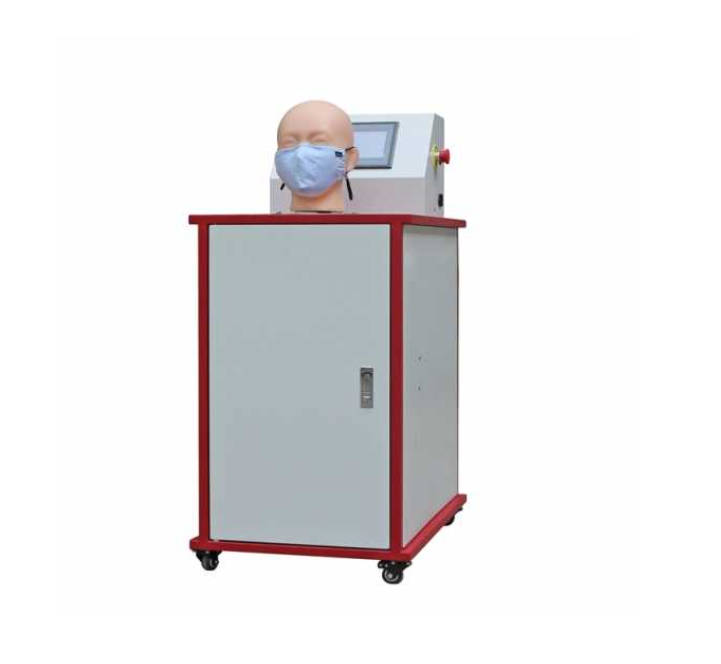
Core Principle: Resistance Testing by Simulating Realistic Breathing Conditions
The working principle of the Mask Breathing Resistance Tester is to simulate the airflow conditions of human breathing and accurately measure the inhalation and exhalation resistance of a mask.
Airflow Simulation and Control:
The instrument uses a precision flow-control system to simulate a constant airflow during human inhalation and exhalation. A typical test flow rate is 85 L/min, although some standards require different flow rates depending on the specific testing conditions. The airflow passes through the mask specimen mounted on a dedicated test fixture.
Real-Time Differential Pressure Measurement:
High-precision pressure sensors are installed upstream (airflow inlet) and downstream (airflow outlet) of the mask specimen to continuously monitor the pressure difference before and after the airflow passes through the mask. This pressure difference represents the breathing resistance of the mask.
Separate Measurement of Inhalation and Exhalation Resistance:
Inhalation resistance and exhalation resistance are tested separately. A directional valve is used to switch the airflow direction, allowing the instrument to collect pressure data under both operating conditions and comprehensively evaluate the mask's bidirectional air permeability performance.
Data Calculation and Evaluation:
The instrument automatically records the peak and average differential pressure values during the test. For example, surgical masks require an inhalation resistance of ≤49 Pa and an exhalation resistance of ≤29.4 Pa under the applicable testing requirements. For protective masks such as KN95. the resistance limits must comply with the corresponding applicable standards. This helps prevent excessive breathing resistance from causing breathing difficulties, insufficient oxygen intake, or other discomfort for the wearer.
Outstanding Product Features of the Mask Breathing Resistance Tester
The tester is equipped with a high-resolution touchscreen and supports a bilingual Chinese-English interface. Its intuitive operating logic allows users with different operating habits to quickly become familiar with the instrument. A high-precision electronic flow meter is used to provide excellent flow-control accuracy, enabling precise adjustment of the airflow rate required for testing and establishing a reliable foundation for accurate test results.
The core component, a high-precision differential pressure sensor, can reliably detect minute changes in differential pressure, ensuring the accuracy, reliability, and repeatability of breathing resistance measurements. The dedicated test head form supports multi-directional adjustment and fully meets the stringent requirements of EN standards regarding test angles, allowing the instrument to simulate breathing resistance under different wearing orientations.
The instrument supports independent switching between inhalation and exhalation modes and allows precise adjustment of different test flow rates to accommodate the testing requirements of various mask products. In addition, the inhalation and exhalation test circuits are completely independent. This hardware design minimizes airflow interference and further improves the accuracy and reliability of test results.
Furthermore, the instrument provides large-capacity storage for up to 500 sets of test data, enabling real-time recording of test processes and results for convenient data traceability and trend analysis. The built-in thermal printer can quickly print test reports, meeting the documentation and record-retention requirements of quality inspection procedures.
Technical Advantages: Precision, Intelligence, and Efficiency
Modern Mask Breathing Resistance Testers incorporate multiple technological advancements to ensure the accuracy, reliability, and credibility of test data.
First, high-precision sensing technology serves as the core of the instrument. A thermal mass flow meter chip is used to achieve high-precision flow measurement without the need for complex temperature and pressure compensation. Its flow range typically covers 0–200 L/min, with an accuracy better than ±2%, enabling the instrument to accurately detect even minute changes in airflow. Meanwhile, the two-wire micro-pressure gauge sensor offers excellent stability and sensitivity, effectively minimizing signal drift and ensuring consistent test results over long-term operation.
Second, intelligent operation significantly improves testing efficiency. The instrument is generally equipped with a color touchscreen or embedded industrial computer, supporting Chinese-English interface switching, one-touch test initiation, automatic switching between inhalation and exhalation procedures, and automatic data storage. Some high-end models also provide large-capacity data storage, allowing hundreds of sets of test data to be saved for subsequent traceability and analysis. They may also support direct output of test reports through a thermal printer, meeting the dual requirements of high-volume quality inspection in manufacturing facilities and scientific research in laboratories.
In addition, user-oriented structural design enhances the versatility and practicality of the equipment. A quick-change standard head-form design allows the tester to accommodate mask specimens of different sizes and types. Corrosion-resistant airflow circuits and explosion-proof design further enhance operational safety and long-term durability, enabling the equipment to operate reliably even under demanding environmental conditions.
Industry Value: Building a Dual Safeguard for Mask Safety and Wearing Comfort
The breathing resistance of a mask affects not only wearing comfort but also the health and safety of people who wear masks for extended periods. Excessive breathing resistance may make breathing more difficult and can contribute to carbon dioxide retention, potentially causing discomfort such as dizziness and chest tightness. By providing scientific and precise testing methods, the Mask Breathing Resistance Tester offers critical support for mask quality control. It helps manufacturers optimize product performance and achieve a balance between filtration efficiency and wearing comfort. It also provides reliable technical support for the implementation of industry standards, contributing to the development of the mask industry toward greater safety and comfort.
Conclusion
The Mask Breathing Resistance Tester is more than just an industrial testing instrument; it serves as a bridge between protective performance and wearing comfort. Through rigorous and scientific measurement, it quantifies the ease of breathing through a mask and provides solid technical support for mask quality and safety. With the continuing development of intelligent, multifunctional, and portable testing technologies, future breathing resistance testers are expected to become more efficient and convenient, continuing to play an important role in supporting respiratory health and improving the safety and comfort of mask products.