

Why Should Footwear Manufacturers Use a Bennewart Flex Tester?
Can a pair of safety shoes last for six months? Whether the steel in the upper is hard enough is merely the surface-level concern. The real key to determining whether the sole will eventually crack or break off lies in whether the outsole can withstand tens of thousands of walking and bending cycles without tearing from a cut. In footwear testing laboratories, the EN Sole Flexing Tester is specifically designed to put the outsole through a rigorous test of its resistance to crack growth. Developed in accordance with European standards, it is a critical testing requirement that occupational safety shoes and protective footwear must meet when exported to the European Union.
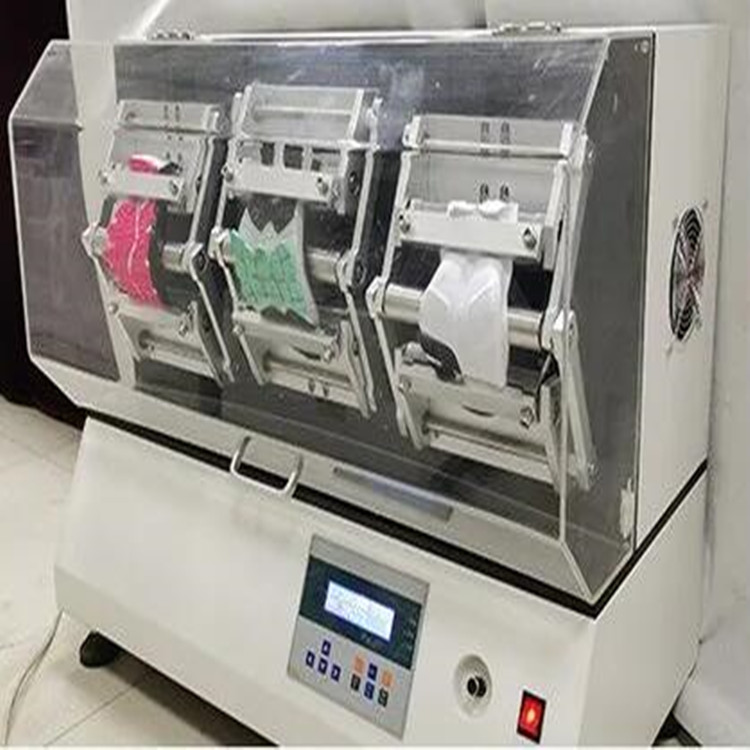
Technological Evolution: From Mechanical Counting to Intelligent Control
With the development of industrial automation, modern EN Sole Flexing Testers have overcome the limitations of traditional purely mechanical timing systems and are increasingly moving toward greater intelligence and precision:
Precision Drive: Brushless motors combined with variable-frequency speed control technology ensure that the flexing frequency remains stable during long-term operation, while angular deviations are controlled within a very small range, ensuring the repeatability of test results.
Intelligent Interaction: Equipped with a PLC control system and touchscreen interface, the tester allows users to preset parameters such as the number of test cycles and operating speed, as well as store multiple sets of test recipes. The equipment features an automatic shutdown function, stopping automatically and saving data once the preset number of cycles has been reached.
Safety Protection: Integrated transparent acrylic protective covers and door-opening stop interlock devices help prevent sole fragments from flying out during high-speed flexing and reduce the risk of accidental contact by operators, meeting modern laboratory safety requirements.
Efficient Parallel Testing: Mainstream equipment is commonly designed with three or six testing stations, allowing multiple specimens to be tested simultaneously. This significantly improves testing efficiency and meets the needs of factory quality sampling inspections and high-volume testing conducted by third-party testing laboratories.
Why Pre-Cut the Shoe Sole
During everyday walking, the forefoot area of the sole undergoes the most intense bending. Even if the surface of the sole appears intact, microscopic air bubbles, impurities, or hidden weak points along the mold parting line can cause cracks to initiate and propagate rapidly under repeated flexing.
The testing principle of the EN Sole Flexing Tester is particularly rigorous:
Introducing a Predefined Defect
At the line of maximum bending stress in the forefoot area of the sole, a standard cutting knife is used to create a standardized 2 mm-long cut in advance (or a small hole is drilled as specified). This is not intended to destroy the specimen but to simulate a small defect that may already exist inside the material.
Amplifying Weak Points
Through continuous flexing around an axis, stress is concentrated at the cut. If the material lacks sufficient toughness or the formulation is inadequate, the cut will grow at a visibly measurable rate, accompanied by surface cracking and potentially complete fracture. If the material has good flexing resistance, the increase in cut length will be minimal.
The final evaluation criterion is not simply whether the sole has broken, but rather the extent of cut growth and the degree of surface cracking. This provides a more reliable indication of actual service life than simply flexing the sole until it breaks.
How Does It "Twist" the Shoe Sole
The machine's structure is designed around stringent ISO standard requirements. Its core operation involves flexing the sole back and forth through 90° around a cylindrical axis.
1. Key Parameters (Standard-Specified)
Flexing Cylinder Diameter: (30 ± 0.1) mm. The cut in the sole must be precisely aligned with the centerline of the cylindrical axis.
Flexing Angle: (90 ± 2)°. This simulates the extreme forefoot bending that occurs during the push-off phase of walking.
Flexing Frequency: 125–150 cycles per minute (cpm). A constant rate helps avoid stress deviations caused by speed fluctuations.
Specimen Clamping: The two ends are secured in fixed and movable clamps, respectively. The clamp width is approximately 144 mm, ensuring that the sole does not slip, deform, or shift during flexing.
2. Testing Procedure
Specimen Preparation: Cut out the forefoot section of the shoe sole, including the insole (typically a 2 mm cellulose board), or use the complete outsole. Create a 2 mm cut at the point of maximum flexing using a standard cutting tool.
Clamping: Secure both ends of the sole in the clamps, positioning the cut centrally on the top of the Φ30 mm cylindrical axis.
Operation: Set the number of cycles (commonly 30.000 cycles; safety footwear testing is often conducted in accordance with EN ISO 20344 requirements), then start the motor to drive the movable clamp in a reciprocating motion.
Evaluation: After the test stops, use a graduated magnifying glass to measure the final cut length, calculate the amount of growth, and inspect the specimen for cracks and material detachment.
Mainstream equipment is commonly designed with three or six testing stations for simultaneous testing, allowing 3–6 specimens to be tested in a single run. It also typically features automatic shutdown when the preset number of cycles is reached, door-opening safety protection, and other safety functions.
Application Value: A Dual Benchmark for R&D and Quality Control
The EN Sole Flexing Tester plays a dual role in the footwear industry. It serves both as an exploratory tool for validating material potential during research and development and as a critical checkpoint for ensuring the reliability of finished products during production.
During the R&D stage, it acts as a screening tool for new material formulations. It helps engineers compare the effects of different vulcanization levels and filler ratios on the flexing resistance of shoe soles. Before a specimen is introduced into mass production, the tester can clearly identify which formulation is less prone to cracking or aging under repeated flexing. This enables product design optimization and shortens the validation cycle from the laboratory to the production floor.
During the production stage, it serves as a safeguard for consistent quality. Through regular sampling inspections, it helps identify potential quality issues caused by uneven mixing or process fluctuations. This ensures that each batch of shoe soles undergoes standardized flexing resistance testing before entering the market, helping prevent widespread customer complaints caused by sole breakage and reducing the impact of after-sales recalls on brand reputation.
In conclusion, the EN Sole Flexing Tester is not merely a standard piece of equipment in footwear testing laboratories; it is also an important bridge connecting materials science with the end-user experience. Through rigorous standards and scientific testing methods, it quantifies the service life of shoe soles and provides solid technical support for the development of more durable and safer footwear products.