

AKRON Abrasion Testing Machine: Principle, Applications and Key Advantages
In the rubber industry, tire manufacturing, and footwear material development, the abrasion resistance of materials directly determines the service life and safety of products. As a standard testing instrument for determining the abrasion resistance of vulcanized rubber, the Akron Abrasion Tester has become a key tool for evaluating the wear resistance of materials, thanks to its scientific testing principle and highly standardized operating procedure.
Basic Principle of the Akron Abrasion Test
The Akron abrasion test is a testing method used to determine the abrasion resistance of materials under specified conditions through sliding friction between an abrasive wheel and a test specimen. Its basic principle can be summarized as follows: a specimen of a specified shape and size is pressed against a rotating abrasive wheel at a predetermined angle and under a specified load. After undergoing the prescribed abrasion distance, the amount of material loss is determined by measuring the volume loss of the specimen. The abrasion loss is generally expressed as the volume loss per unit abrasion distance. A lower value indicates better abrasion resistance of the material.
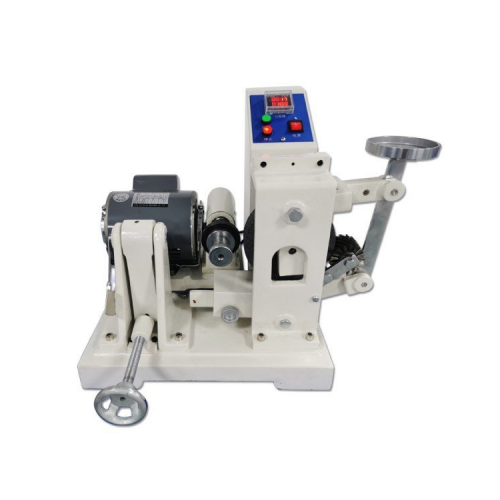
The Akron Abrasion Tester manufactured in Fuzhou strictly follows this classic testing principle. The equipment typically consists of a main frame, drive system, loading system, abrasive wheel, specimen holding device, and the necessary counting and control units. During the test, the specimen is brought into contact with the rotating abrasive wheel at a specified inclination angle and under a predetermined load, thereby simulating the frictional wear that materials experience during actual use.
In-Depth Exploration of the Application Fields of the Akron Abrasion Tester
Based on its testing principle and performance characteristics, the Akron Abrasion Tester manufactured in Fuzhou plays an important role in various industrial sectors and research and development processes.
1. Rubber Industry — The Core Application Field
Tire Manufacturing:
This is the most traditional and important application of the Akron Abrasion Tester. It is used to evaluate the abrasion resistance of tire tread compounds, which is one of the key indicators for assessing tire service life and performance. By testing the Akron abrasion values of compounds with different formulations, such as changes in the type and amount of carbon black, oils, and vulcanization systems, researchers can optimize formulations and achieve a balance among abrasion resistance, wet grip, rolling resistance, and other performance characteristics.
Footwear Industry:
The abrasion resistance of shoe soles, particularly rubber soles, is a major concern for consumers. Akron abrasion testing is widely used to evaluate the wear resistance of various sole materials, including natural rubber, synthetic rubber, and thermoplastic elastomers. The test results provide a basis for footwear material selection and quality control.
Rubber Products:
Rubber products that require a certain level of abrasion resistance, such as conveyor belt covers, seals, shock-absorbing pads, and other rubber components, can also be evaluated using this testing method.
2. Polymer Materials and Plastics Industry
For materials such as polyurethane (PU), thermoplastic polyurethane (TPU), plasticized polyvinyl chloride (PVC), engineering plastics, and their composites, abrasion resistance is also an important mechanical property. The Akron Abrasion Tester can be used to compare the effects of different resins, fillers, reinforcing fibers, and additives on material abrasion resistance, thereby providing guidance for the development of modified plastics and high-performance polymer materials.
3. Coatings and Textile Fields
Certain thick functional coatings or coated fabrics, such as tarpaulin fabrics and conveyor belt coatings, may require evaluation of their surface abrasion resistance. Although the Akron abrasion test is not the most widely used method for these materials, it can be applied in certain specific standards or internal quality-control procedures to compare the abrasion resistance of different materials.
For some heavy-weight textiles or textiles treated with special resin finishes, this method may also be referenced to evaluate their resistance to friction and wear under specific testing requirements.
4. Quality Control and Standardized Testing
During incoming inspection of raw materials, production process monitoring, and finished-product inspection, Akron abrasion testing is used by many manufacturers as a relatively rapid and convenient comparative testing method. It helps manufacturers monitor material performance and ensure consistency and stability between different production batches.
5. Scientific Research and Education
In university laboratories specializing in materials science and engineering, rubber engineering, and related disciplines, the Akron Abrasion Tester is a common teaching and experimental instrument. It helps students gain a more intuitive understanding of material wear mechanisms and abrasion-resistance testing methods. Research institutions developing new wear-resistant materials can also use the tester as a basic tool for evaluating and comparing material performance.
Core Advantages of the Akron Abrasion Tester
The core advantage of the Akron Abrasion Tester is that it is specifically designed for the rolling friction conditions of vulcanized rubber, making its test results highly representative of the actual wear mechanisms experienced by products such as tires. In addition, its automated operation and strong data comparability make it a reliable solution for evaluating abrasion resistance.
Core Advantages
Close Simulation of Actual Service Conditions:
The tester uses rolling friction between the specimen wheel and the abrasive wheel at a 15° inclination angle and a 26.7 N load, simulating the wear conditions experienced by products such as tires and shoe soles during actual use. Compared with simple sliding-friction tests, this method provides a closer representation of real-world wear conditions.
High Degree of Standardization:
The tester can comply with multiple international and national standards, allowing test results obtained from different laboratories and different instruments to be compared more effectively.
Automated Operation:
Equipped with an electronic counter, the tester allows the required number of abrasion revolutions to be preset and can automatically stop when the test is completed. The integrated mechanical and electrical control system reduces errors caused by manual intervention.
Quantitative and Reliable Results:
Abrasion resistance is quantitatively characterized based on the volume loss caused by abrasion. The resulting data are objective, reliable, and highly repeatable.
Clearly Defined Applications:
The Akron Abrasion Tester is a well-established solution in the industry for evaluating the abrasion resistance of rubber products, including tires, footwear materials, conveyor belts, seals, and rubber-covered rollers.
Technological Development and Future Trends
With the continued development of materials science, traditional Akron Abrasion Testers are evolving toward intelligent operation and environmental simulation. Modern equipment can integrate features such as digital displays, automatic shutdown, and data transmission. Some advanced models may also incorporate heating systems to simulate high-temperature wear conditions around engines or under extreme climatic environments.
Furthermore, with the integration of big-data analysis, abrasion testing equipment is gradually becoming an intelligent link between material formulations and performance prediction. This development can provide deeper technical support for the high-quality development of the rubber industry.
Conclusion
In summary, the Akron Abrasion Tester is not merely a physical testing instrument but also an essential reference tool in the performance evaluation of rubber materials. Through standardized operation and proper maintenance, it can provide manufacturers with accurate and reliable abrasion-resistance data, helping them continuously improve product quality and optimize material formulations.