

How Does a Dynamic Foam Fatigue Tester Work?
In industries such as furniture, automotive, and medical care, foam (sponge) is a key material widely used in sofa cushions, mattress cores, automotive seats, and cushioning packaging. Its service life and comfort directly affect the quality and user experience of the final product.However, foam materials are prone to permanent deformation, hardening, and reduced resilience after prolonged and repeated compression. These changes can significantly affect the durability, comfort, and functional performance of the finished product.The Foam Repeated Compression Testing Machine is designed specifically to address this challenge. By simulating the cyclic loading conditions encountered during actual use, the machine repeatedly compresses the foam specimen under controlled conditions to accurately evaluate its fatigue resistance and compression durability.As a result, the Foam Repeated Compression Testing Machine has become an important testing solution for assessing the long-term durability, resilience, and fatigue performance of foam materials, helping manufacturers improve material selection, product design, and quality control.
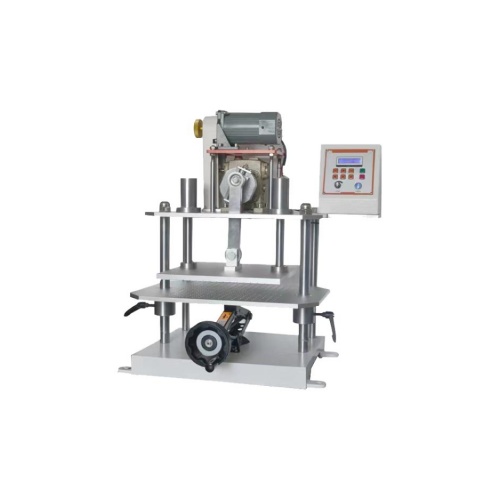
Technical Highlights of the Foam Repeated Compression Testing Machine
Precision Mechanical Structure
The machine features a rigid dual-column frame design combined with low-friction linear guides to ensure stable force transmission during compression and minimize the influence of mechanical vibration on test results.
The compression platform is equipped with a high-flatness fixture, which can accommodate foam specimens of different sizes and shapes.
Intelligent Control System
The machine is equipped with an industrial-grade PLC and touchscreen human-machine interface (HMI) and supports multi-stage program programming.
Users can freely set testing parameters such as compression speed (0.1–500 mm/min), number of cycles (1–999.999 cycles), and holding time according to different testing requirements.
The system also features automatic cycle counting, power-off memory, and fault alarms, significantly improving testing efficiency and operational safety.
High-Precision Sensors
The machine uses imported force sensors and displacement encoders. The force measurement accuracy can reach ±0.5% F.S., while the displacement resolution is 0.01 mm.
The system can collect compression force–deformation curves in real time. The data analysis software can then generate test reports, providing a clear visualization of changes and performance trends in the tested material.
Modular Design
The machine supports an optional temperature-controlled environmental chamber, allowing material performance tests to be conducted under extreme temperature conditions ranging from −70°C to +200°C.
This configuration can meet the testing requirements of specialized fields such as aerospace and polar equipment, where materials may be exposed to demanding environmental conditions.
Core Principle: Simulating Real-World “Repeated Stress”
The working principle of the Foam Repeated Compression Testing Machine is relatively straightforward. Its core concept can be summarized as “reproduce” and “quantify.”
The machine reproduces the repeated compression conditions that foam materials may experience during actual use and quantifies the resulting changes in their mechanical properties through controlled testing and data analysis.
By applying repeated compression cycles under specified conditions and monitoring parameters such as compression force, deformation, and recovery performance, the machine can help evaluate the material’s resistance to repeated loading and long-term fatigue.
Testing Procedure: Four Steps from Preparation to Data Analysis
Although specific details may vary slightly between different models of testing machines, the standard testing procedure generally consists of the following four key stages:
1. Specimen Preparation and Installation
First, the technician cuts the foam specimen to the specified dimensions, such as 50 mm × 50 mm or larger, and ensures that the specimen surface is flat and free from visible defects.
The specimen is then placed at the center of the lower platform of the testing machine and secured using a dedicated fixture to prevent movement or displacement during testing.
2. Parameter Setting: Defining the “Test Intensity”
This is a critical stage of the testing process. The operator sets the required testing parameters through the control panel, mainly including:
Compression Ratio:
The foam is typically compressed to 50% of its original thickness, or to another specified compression ratio such as 25% or 40%, depending on the testing requirements.
Compression Frequency:
This defines the rate at which the foam is repeatedly compressed. A commonly used testing condition is approximately 60 cycles per minute.
Total Number of Cycles:
According to the applicable testing standard, the number of compression cycles may be set to 80.000 cycles or even higher to simulate the effects of years of repeated use.
3. Automatic Operation: Tireless Repeated Cycling
After the test is started, the servo motor drives the upper compression plate to move vertically back and forth according to the preset frequency and stroke, repeatedly compressing the foam specimen.
During this process, the internal sensors continuously monitor changes in compression force and displacement in real time.
Whether operating during the day or overnight, the testing machine can maintain a stable and consistent loading condition throughout the entire test. This is a major advantage over manual testing, where variations in operator performance can affect testing consistency.
4. Result Evaluation: Assessing the Recovery Performance
Once the preset number of compression cycles has been completed, the machine automatically stops.
The technician removes the specimen and allows it to rest for a specified period, such as 30 minutes, so that the foam can naturally recover.
The final thickness is then measured and compared with the original thickness before testing. Based on the difference between the initial and final thicknesses, the compression set can be calculated.
A higher compression set indicates greater permanent deformation. If the deformation is excessive, it suggests that the foam has relatively poor fatigue resistance and is more likely to experience sagging, loss of support, or reduced resilience during actual use.
Industry Applications and Value
The Foam Repeated Compression Testing Machine has a wide range of applications and serves as an essential quality control tool for both upstream and downstream manufacturers across the foam material industry.
Furniture Manufacturing
The machine is used to evaluate the long-term durability of foam materials used in sofa cushions and mattresses. Through repeated compression testing, manufacturers can identify high-quality raw materials with strong resistance to permanent deformation and sagging.
This helps prevent problems such as noticeable indentation or “body impressions” shortly after a product is sold, while improving product durability, customer satisfaction, and brand reputation.
Automotive Industry
Automotive seat cushions and foam padding are exposed to frequent loading when passengers get in and out of vehicles, as well as continuous loads during long-distance driving.
The Foam Repeated Compression Testing Machine helps automotive manufacturers evaluate the fatigue resistance and durability of seat foam, ensuring that its performance, comfort, and supporting properties can meet relevant domestic and international requirements.
New Material Research and Development
For foam formulation and process engineers, the quantitative data generated by the testing machine provides an important basis for optimizing material formulations and improving foaming processes.
By comparing the permanent deformation or compression set of samples produced with different formulations, R&D engineers can quickly identify and develop high-performance foam materials with improved durability and fatigue resistance.
Overall, the Foam Repeated Compression Testing Machine is more than just a testing instrument. It serves as a bridge connecting materials science with real-world user experience.By converting the relatively subjective concept of “durability” into measurable data such as thickness loss, permanent deformation, and changes in hardness, the machine provides an objective, scientific, and traceable basis for product quality evaluation.As consumers continue to place greater emphasis on comfort, durability, and overall product quality, rigorous durability evaluation using professional testing equipment has become an increasingly important approach for manufacturers seeking to enhance product competitiveness and achieve high-quality development.