

What is Fabric Liquid Penetration Time Tester?
In the textile and hygiene product industries, the liquid penetration performance of materials is directly related to product comfort, safety, and functionality. The Fabric Liquid Penetration Time Tester, as a professional testing instrument, is mainly used to evaluate the liquid penetration performance of nonwoven fabrics and lightweight fabrics. It is a key quality control instrument for personal hygiene products such as sanitary napkins and diapers.
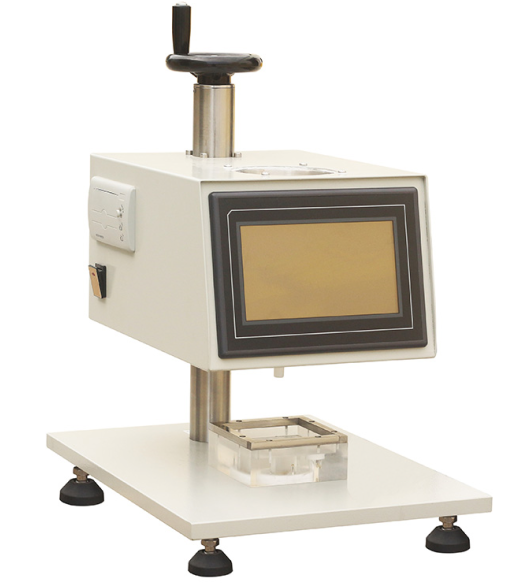
Working Method of the Fabric Liquid Penetration Time Tester
Sample Preparation:
Place the nonwoven fabric or textile specimen to be tested flat on a standard absorbent pad, ensuring that the specimen is free from wrinkles and does not curl or lift.
Liquid Supply:
A specified formulation of synthetic urine is used as the test medium. The instrument delivers the liquid onto the surface of the specimen at a specified flow rate and volume through a burette or funnel device.
Electrical Timing:
The instrument uses an electrical measurement method for precise timing. Timing starts automatically when the liquid first contacts the surface of the specimen. When the liquid has completely penetrated the specimen and has been fully absorbed by the standard absorbent pad underneath, the electrical circuit state changes and the instrument automatically stops timing.
Data Recording:
The total time required for the liquid to penetrate the specimen is displayed directly on the screen, typically in seconds. A shorter penetration time indicates better liquid penetration performance and faster liquid transfer.
Applications of the Fabric Liquid Penetration Time Tester
The Fabric Liquid Penetration Time Tester is a key instrument in the field of textile testing, primarily used to evaluate the liquid penetration performance of thin nonwoven materials for hygiene applications. By simulating actual usage conditions, the instrument accurately measures the time required for liquid to travel from the surface of the material through to the underlying layer, providing a scientific basis for quality control, product development, and compliance testing of personal care products.
In the personal care industry, the instrument is mainly used to test the cover materials of feminine sanitary napkins, baby diapers, and adult incontinence products. Penetration time is an important indicator for evaluating liquid leakage protection. A shorter penetration time indicates that the liquid can pass through the material more quickly, while a longer penetration time indicates slower liquid penetration. By measuring this parameter, manufacturers can effectively evaluate product performance and help ensure user comfort and dryness during use.
In the manufacturing process, the instrument can be used throughout the entire quality-control workflow, including incoming inspection of raw materials, in-process monitoring of semi-finished products, and final inspection of finished products. Particularly on large-scale automated production lines, regular sampling inspections can help identify potential quality issues caused by material variations or process fluctuations, thereby reducing the risk of customer complaints and ensuring consistent product quality between batches.
In addition, during the development of new materials, researchers can use the instrument to compare the effects of different fiber compositions, surface treatment processes (such as hydrophilic or hydrophobic coatings), and three-dimensional structural designs on liquid penetration behavior, thereby selecting the optimal technical solution. For example, by controlling the porosity of polymer-modified polypropylene fibers, the liquid penetration time can be optimized, helping to improve the performance and market competitiveness of the final product.
Core Value of the Fabric Liquid Penetration Time Tester
The Fabric Liquid Penetration Time Tester plays an indispensable role in the textile and hygiene products industries. Its core value is mainly reflected in four aspects: ensuring product safety, improving user comfort, optimizing manufacturing processes, and ensuring compliance with industry standards.
1. Ensuring Leakage Protection Performance and Product Safety
The instrument is a key tool for evaluating the liquid penetration resistance of thin nonwoven materials used in hygiene products, such as the top-sheet materials of feminine sanitary napkins, baby diapers, and adult incontinence products. By simulating actual usage conditions, it accurately measures the time required for liquid to travel from the surface of the material through to the underlying layer, directly reflecting the material's liquid barrier performance. A longer penetration time indicates that the material can retain liquid for a longer period, helping to reduce the risk of side leakage and back leakage and contributing to personal hygiene and safety during use.
2. Improving User Comfort and Overall Experience
Liquid penetration time is closely related to the perceived dryness of a product. If the penetration time is too short, liquid may pass rapidly through the top sheet and potentially increase moisture or wet-back at the surface, affecting skin comfort. By using this instrument, researchers can identify material combinations that provide efficient liquid transfer while maintaining appropriate liquid barrier characteristics, helping to keep the product surface relatively dry during use and significantly improving user comfort and satisfaction.
3. Supporting New Material Development and Process Optimization
During new product development, the instrument provides researchers with an objective method for evaluating material performance. By comparing the effects of different fiber compositions, surface treatment processes—such as hydrophilic or hydrophobic coatings—and three-dimensional structural designs, such as embossed structures and liquid guide channels, on liquid penetration behavior, manufacturers can quickly identify optimal material formulations and process solutions. This can shorten development cycles, reduce trial-and-error costs, and contribute to the development of more competitive and innovative products.
4. Strengthening Quality Control and Ensuring Compliance with Industry Standards
During production, the instrument can be used for incoming inspection of raw materials, in-process monitoring of semi-finished products, and final inspection of finished products, helping to ensure stable and consistent performance between production batches. Particularly on large-scale automated production lines, regular sampling inspections can effectively identify quality issues caused by material variations or process fluctuations, reducing the risk of customer complaints. In addition, various industry standards require liquid penetration time testing for certain nonwoven hygiene materials. Using this instrument helps manufacturers meet applicable regulatory and testing requirements, supporting market access and protecting brand reputation.
In summary, the Fabric Liquid Penetration Time Tester, with its high level of automation, convenient operation, and accurate measurement capabilities, has become an important quality-control instrument in the hygiene and textile industries. It not only helps manufacturers optimize production processes and improve product competitiveness but also contributes to providing consumers with more comfortable and safer personal care products. With continued advances in material science, these testing instruments are also evolving toward greater multifunctionality and intelligence to meet increasingly complex research and development testing requirements.For more detailed product information, specifications, or technical support, please feel free to leave us a message or contact us directly.