

What is a Sole Sand Bath Heat Insulation Tester?
In high-temperature working environments, foot protection is a critical part of ensuring the safety of workers. The Sole Sand Bath Thermal Insulation Tester is a key testing instrument for evaluating the high-temperature insulation performance of occupational safety footwear. By simulating high-temperature ground conditions, it can accurately assess the ability of finished footwear to prevent heat transfer through the sole. It is currently widely used for quality control in footwear manufacturing, new material research and development, and testing by third-party authoritative laboratories.
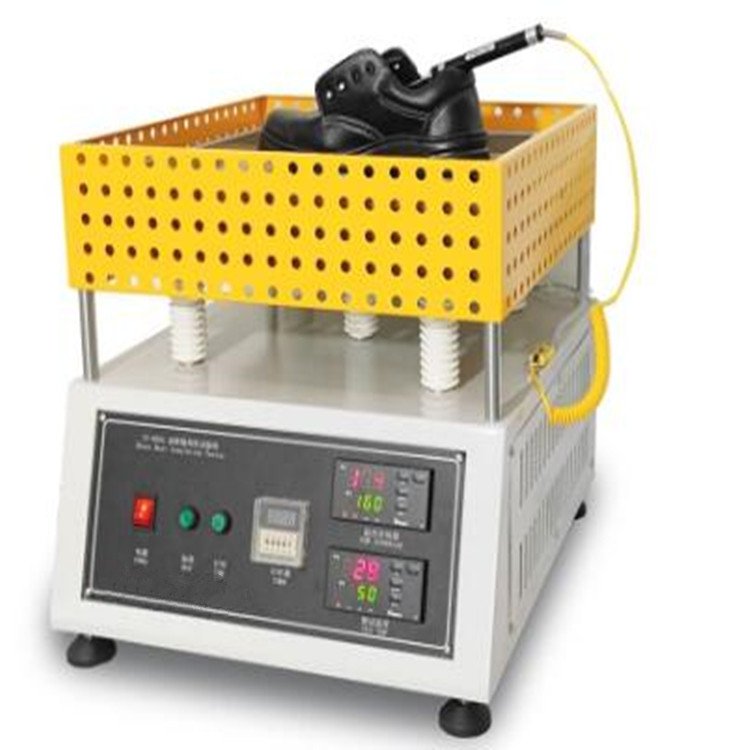
Test Principle of the Sole Sand Bath Thermal Insulation Tester
The instrument uses a constant-temperature sand bath to simulate heat transfer from a high-temperature ground surface and follows the standardized test procedure specified by the relevant national standard. By reproducing heat transfer from the ground under actual high-temperature working conditions, the tester systematically evaluates the thermal insulation performance of the footwear sole. The test focuses on simulating conductive heat transfer between the sole and a high-temperature surface and accurately measuring the amount of heat transferred into the footwear, thereby obtaining scientific and repeatable test data.
Step 1: Position the temperature sensor
A temperature sensor equipped with a copper disc shall be securely fixed at the center of the forefoot area of the insole of the finished footwear. This position corresponds closely to the primary load-bearing and heat-exposure area of the human foot. During installation, the sensor must be in full and close contact with the insole, without any gaps or suspension, to ensure accurate and representative temperature measurements.
Step 2: Add the simulated load
A total mass of 4 kg of stainless-steel balls shall be placed inside the footwear. The steel balls should be distributed evenly throughout the entire shoe cavity to simulate the weight distribution and pressure exerted by a human foot. This ensures that the load is applied uniformly and stably to the sole, reproducing the stress conditions of the footwear during actual use and preventing measurement deviations caused by uneven pressure distribution.
Step 3: Start the sand bath and place the specimen
Start the sand bath and wait until the temperature of the sand inside the chamber stabilizes at the specified high temperature of 150 ± 5°C. Then, place the safety footwear specimen steadily on the surface of the sand bath, ensuring that the hot sand makes sufficient contact with and covers the entire test area of the outsole. The sand layer should be evenly distributed over the sole contact surface to ensure uniform heating of the entire sole and simulate the condition of footwear in stationary contact with a high-temperature ground surface.
Step 4: Start the data recording system
Start the timing and temperature recording system and continuously record the real-time temperature changes measured by the temperature sensor on the insole throughout the 30-minute test period. During the test, the specimen must not be moved or touched, and the test process must not be interrupted. This ensures consistent test conditions and continuous data collection, ultimately providing a complete temperature-rise curve that reflects the thermal insulation performance of the sole.
Important Considerations During Testing
The sand bath thermal insulation test is a comprehensive test designed to evaluate the overall thermal insulation performance of finished footwear, whereas the HRO heat resistance to hot contact test focuses primarily on the heat resistance of the outsole material itself. The two tests have different objectives, test methods, and evaluation criteria. They are therefore independent testing procedures and must not be substituted for or confused with each other.Before and after each test, the operator should carefully inspect the condition of the sand in the sand bath. If the sand is found to have become compacted, heavily sintered, contaminated, or otherwise deteriorated, it should be replaced promptly with fresh sand. This helps prevent abnormal thermal conductivity of the sand layer from affecting the accuracy and consistency of the test results.
In addition, key measuring instruments, such as the temperature sensor, should be calibrated regularly to ensure that their temperature measurement accuracy meets the applicable requirements. Proper calibration can effectively reduce systematic errors and ensure the reliability, accuracy, and traceability of the test data.
Main Applications of the Sole Sand Bath Thermal Insulation Tester
1. Evaluation of Footwear Thermal Insulation Performance
The sand bath can simulate extreme high-temperature conditions. By placing the footwear specimen in the sand bath for a specified period and measuring the temperature rise on the surface of the insole, the thermal insulation performance of the sole can be evaluated. This is essential for ensuring the comfort and safety of footwear used in high-temperature environments.
2. Quality Control
The sand bath module can be used to evaluate the manufacturing quality of footwear products and ensure compliance with design specifications and applicable quality standards. By comparing the thermal insulation performance of products from different production batches or manufacturers, potential quality issues can also be identified in a timely manner.
3. Product Research and Development
During the development of footwear products, the tester can be used to evaluate the effects of different materials, structures, and designs on thermal insulation performance. The test results can help designers optimize product designs and improve the thermal insulation performance of finished footwear.
Core Importance of the Sole Sand Bath Thermal Insulation Tester
The core importance of the Sole Sand Bath Thermal Insulation Tester lies in its ability to simulate high-temperature ground conditions and quantitatively evaluate the effectiveness of the overall thermal insulation barrier of finished footwear. It helps directly reduce the risk of foot burns and serves as an important basis for evaluating the compliance of high-temperature protective footwear with applicable safety requirements.
1. Prevention of Irreversible Thermal Injury
In high-temperature working environments such as metallurgy, welding, and other industrial applications, the tester helps evaluate whether footwear can effectively prevent heat from rapidly transferring through the sole and causing deep thermal injuries to the feet. This provides an important physical safeguard for the safety of workers exposed to high-temperature surfaces.
2. Verification of Overall Footwear Structure Performance
Unlike tests performed on individual materials, this tester evaluates the finished footwear as an integrated structure. It verifies the overall thermal barrier performance of the outsole, midsole, insole, and composite layers under sustained heating, helping determine whether these components maintain their protective performance without failure, melting, or perforation.
3. Simulation of Realistic and Complex Working Conditions
The tester uses a constant-temperature sand bath medium to provide uniform heat transfer through surface contact, accurately reproducing the mechanical loading and heat-transfer conditions encountered when footwear is exposed to hot sand, gravel, or heated ground surfaces. This helps minimize evaluation deviations that may occur with localized point-heat-source testing.
Suitable Factory Customer Groups
1. Finished Protective Footwear Manufacturers
Manufacturers of welding safety shoes, high-temperature safety footwear for metallurgical applications, construction safety shoes, mining protective boots, and fire-resistant heat-insulating boots represent the core user group for this equipment.
2. Footwear Manufacturers Serving Both Domestic and International Markets
Footwear manufacturers that handle domestic occupational safety footwear orders as well as export orders for protective footwear to the EU, Middle East, and Southeast Asia need to meet both applicable Chinese national standards and international ISO testing requirements. The tester can support their quality control and compliance testing needs.
3. Sole and Footwear Material Manufacturers
Manufacturers and R&D companies producing rubber, PU, TPU, EVA, composite thermal insulation layers, heat-resistant insoles, and other footwear materials can use the tester to compare the thermal insulation performance of different materials and evaluate new material formulations.
4. Footwear Material R&D Laboratories and Brand Quality Control Departments
Internal quality control laboratories of occupational safety footwear brands and high-temperature protective footwear brands, as well as professional footwear material R&D institutions, can use the equipment for formulation development, material comparison, product optimization, and performance verification.
5. Third-Party Testing, Inspection, and Calibration Institutions
Professional footwear material testing laboratories, occupational safety testing and certification organizations, and quality inspection institutions can use the equipment to conduct thermal insulation performance testing and issue professional test reports. It can also support relevant CNAS accreditation and laboratory assessment requirements, where applicable.
Overall, the Sole Sand Bath Thermal Insulation Tester uses a standardized sand bath to simulate high-temperature working conditions and supports multiple applications, including finished footwear quality control, material R&D, product performance verification, and export-related compliance testing. It is therefore suitable for a wide range of enterprises across the footwear industry's upstream and downstream supply chain.When selecting the equipment, manufacturers can choose the appropriate configuration based on their business type, testing frequency, and domestic or export order requirements. The selected equipment should be configured according to the applicable national and international testing standards to support customer factory inspections, third-party calibration or verification, and relevant export compliance requirements.