

What is a flexometer?
In the modern textile industry, coated fabrics are widely used due to their excellent properties, including water resistance, stain resistance, and weather durability. However, unlike traditional textiles, the performance of coated fabrics is more susceptible to flexing damage during actual use. Therefore, the Coated Fabric Flex Resistance Tester has been developed as an essential instrument for evaluating the quality and performance of coated fabrics.
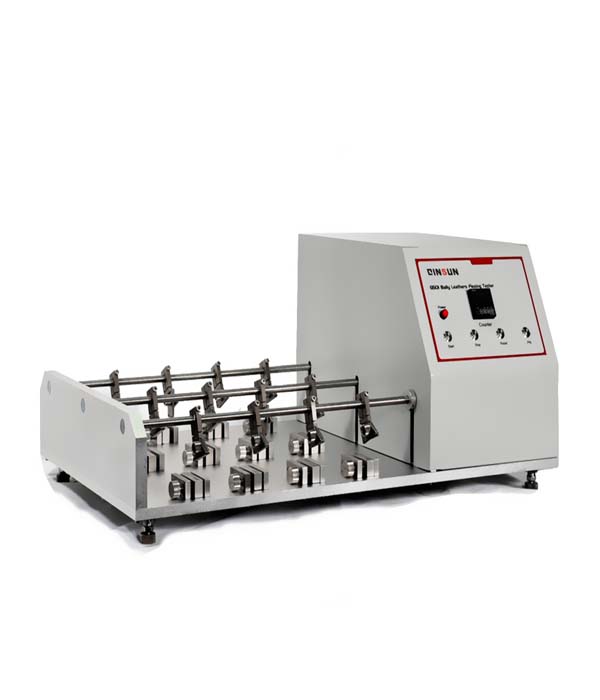
Core Technologies of Coated Fabric Flex Resistance Tester
The technical design of the Coated Fabric Flex Resistance Tester fully complies with relevant standard requirements and focuses on overcoming three major challenges in flex resistance testing:
1. Dynamic Flexing Simulation Technology
The tester adopts a crank connecting rod transmission mechanism, enabling specimens to undergo reciprocating flexing at a preset frequency. Unlike static flexing tests, Method C requires the simulation of dynamic bending conditions encountered during actual material use, such as fabric folding and roll material curling. Driven by a high-precision servo motor, the instrument ensures smooth and stable flexing operation without jamming. This effectively prevents specimen displacement caused by mechanical vibration, thereby avoiding interference with test results.
2. Coating Damage Observation Technology
Equipped with a 20-megapixel high-definition industrial camera and an adjustable light source, the tester can capture real-time changes in the coating during the specimen flexing process and supports 10× magnified observation. Traditional equipment relies on manual visual inspection, while this instrument uses image recognition technology to automatically capture the moment when damage occurs and simultaneously record the number of flexing cycles, significantly reducing human error.
3. Multi-Specimen Synchronous Testing Technology
The tester features a dual-station design, allowing two specimens to be tested simultaneously. Each station is independently controlled and can meet different testing requirements for flexing frequency and angle. For enterprises requiring batch testing, compared with single-station equipment, the testing efficiency is increased by 50%, greatly reducing the overall testing cycle.
Key Parameter Interpretation of Coated Fabric Flex Resistance Tester
The core parameters of the Coated Fabric Flex Resistance Tester strictly comply with the requirements of relevant GB/T standards, and each parameter is designed to ensure testing accuracy and reliability.
1. Flexing Performance Parameters
Flexing Frequency:
Adjustable from 0–60 cycles/min (the standard recommended frequency is 30 cycles/min, with an accuracy of ±1 cycle/min), meeting the dynamic flexing requirements of different materials.
Flexing Angle:
Adjustable from 0–180°. The angle variation is precisely controlled by a servo motor to ensure consistent flexing amplitude during each cycle.
Specimen Clamping Force:
Adjustable from 0–50 N (default clamping force: 10 N, accuracy ±0.5 N). This prevents specimen slipping caused by insufficient clamping force while avoiding coating damage caused by excessive clamping force.
2. Observation and Recording Parameters
Camera Frame Rate:
30 frames/s, enabling clear capture of minor coating cracks during the flexing process, with a minimum detectable crack size of 0.1 mm.
Counting Range:
0–99.999 cycles. The tester supports an “automatic damage stop” function. When the camera detects coating cracking or peeling, the equipment automatically stops the flexing test and records the number of cycles, meeting the standard requirement of “recording the number of flexing cycles at the first occurrence of damage.”
Data Storage:
Supports storage of up to 1.000 sets of test data and export of Excel-format reports, including specimen information, flexing parameters, damage cycles, damage images, and other details for convenient traceability.
3. Basic Equipment Parameters
Power Supply:
220V/50Hz, power consumption ≤ 500 W, requiring no high-voltage power supply.
Working Environment:
Temperature: 15–35°C; Humidity: 45%–75% RH (non-condensing), suitable for most laboratory environments.
Overall Dimensions:
800 mm × 600 mm × 1200 mm (L × W × H). The compact design saves laboratory space and facilitates flexible installation and layout.
Working Principle of Coated Fabric Flex Resistance Tester
The working principle of the Coated Fabric Flex Resistance Tester consists of three key steps to achieve accurate and reliable testing:
1. Specimen Preparation and Fixing
According to the standard requirements, a 100 mm × 200 mm coated fabric specimen is prepared with the coating side facing outward. Both ends of the specimen are fixed onto the upper and lower clamps of the tester. The clamps adopt a special rubber anti-slip clamping structure, which prevents damage to the specimen edges. Meanwhile, a pressure sensor continuously monitors the clamping force in real time to ensure that it reaches the preset value. The default clamping force is 10 N.
2. Dynamic Flexing and Damage Monitoring
After the tester is started, the servo motor drives the crank connecting rod mechanism, causing the clamps to perform a 180° reciprocating flexing motion at a frequency of 30 cycles/min, simulating the bending conditions experienced by coated fabrics during actual use.
At the same time, a high-definition industrial camera is positioned toward the central flexing area of the specimen and works together with a ring light source to capture the coating condition in real time. The image data is synchronously transmitted to the dedicated software.
Through image comparison algorithms, the software compares real-time images with the initial image to determine whether coating defects such as cracking or peeling have occurred.
3. Data Recording and Report Generation
When the software detects the first occurrence of coating damage, such as a crack length ≥1 mm or a peeling area ≥1 mm², the tester automatically stops the flexing operation and records the current number of flexing cycles.
After the test is completed, the software automatically generates a test report containing flexing frequency, flexing angle, clamping force, damage cycle count, and images of damaged areas. The report can be directly printed or exported for data storage and traceability.
Importance of Coated Fabric Flex Resistance Tester
The Coated Fabric Flex Resistance Tester plays an irreplaceable role in quality control, product development, and safety evaluation.
1. Simulating Real Working Conditions and Accurately Predicting Service Life
In practical applications, coated fabrics are often exposed to dynamic stress environments. For example, automotive seat fabrics must withstand repeated compression and friction caused by passengers sitting down and standing up; outdoor tent fabrics need to resist continuous shaking caused by wind and rain; and joint areas of protective clothing must accommodate large-scale body movements. All of these scenarios involve repeated flexing deformation of materials.
The Flex Resistance Tester simulates these real-life operating conditions through a mechanical system, applying controlled flexing frequency, angle, and load to specimens. This enables accurate evaluation of material durability and helps predict the service life of coated fabrics under actual usage conditions.
2. Strengthening Quality Control and Reducing Market Risks
For manufacturers, the Flex Resistance Tester serves as a critical quality control tool. It enables enterprises to identify defective products before shipment, including materials with insufficient coating adhesion, inadequate substrate strength, or manufacturing process defects, preventing unqualified products from entering the market.
This not only helps reduce return rates and compensation risks caused by product quality issues but also protects brand reputation. In supply chain management, standardized testing methods provide objective quality acceptance criteria for both upstream and downstream enterprises, eliminating trade disputes caused by subjective judgment differences and ensuring consistency between product batches.
3. Driving R&D Innovation and Optimizing Material Processes
During the development of new materials and the improvement of manufacturing processes, the Flex Resistance Tester provides an important feedback mechanism. Researchers can compare test data from different coating formulations, substrate fabric densities, and composite processes to gain deeper insights into internal stress distribution and failure mechanisms of materials.
The test results help optimize material structures, improve coating technologies, and develop coated fabrics with better durability and flex resistance.
4. Ensuring Safety and Supporting Compliance Certification
In the field of Personal Protective Equipment (PPE), the integrity of coated fabrics is directly related to user safety. If firefighting suits, chemical protective clothing, or medical isolation gowns become damaged due to flexing fatigue, harmful substances may penetrate the protective barrier or microorganisms may enter, causing serious risks.
Through strict standardized testing, the Flex Resistance Tester ensures that these critical protective materials can maintain their barrier performance even under intensive movement conditions.
Furthermore, as global product quality requirements continue to become more stringent, flex resistance test reports complying with international standards such as GB, ISO, and ASTM have become essential requirements for products entering high-end markets and obtaining industry certifications. The reliable data provided by this equipment offers strong technical support for product compliance.
Conclusion
In summary, the Coated Fabric Flex Resistance Tester is not merely an instrument for evaluating the physical properties of materials; it also serves as a bridge connecting manufacturing processes with real-world applications. Through scientific simulation, quantitative evaluation, and in-depth analysis, it comprehensively ensures the quality reliability, technological advancement, and safety performance of coated fabrics.The tester plays a significant role in promoting sustainable development across the textile and related industries. Contact us directly for more information about the product and technical solutions.