

What is a button impact testing machine?
The button impact force testing instrument is a critical component in ensuring the quality and usage safety of related products. Currently, this testing work is facing multiple industry challenges, including inconsistent testing standards, insufficient availability of dedicated testing equipment, limitations in testing methods, and significant interference from environmental factors. By establishing a scientific and standardized testing standard system, introducing advanced professional testing technologies, and optimizing sample selection methods and performance evaluation systems, the accuracy and scientific reliability of button impact force testing can be effectively improved.
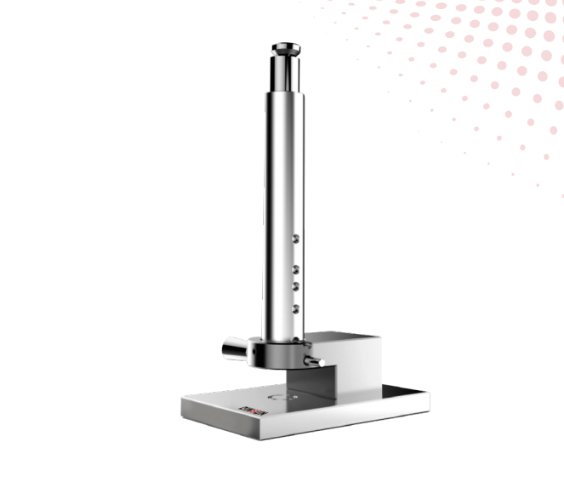
Working Principle of Button Impact Tester
The core principle of this testing method is to accurately simulate various impact conditions that buttons may encounter during actual wearing situations by applying a specific impact force to the button. During the testing process, a weight with an accurately specified mass of 0.84 kg (29.5 ounces) is allowed to undergo free-fall movement from a preset height and then forcefully impacts the button fixed on the testing machine. By carefully observing and accurately recording the degree of button breakage, the impact resistance performance of the button can be scientifically and objectively evaluated, providing a reliable basis for button quality control and performance improvement.
During actual operation, the button impact strength test must strictly follow a series of rigorous and standardized procedures. The first and most important step is to carefully prepare test samples that meet the required standards. The type, size, and material of the buttons must be strictly selected and confirmed to ensure that every parameter precisely complies with the testing requirements, thereby guaranteeing the accuracy and reliability of the test results from the source.
Afterward, the prepared buttons are securely fixed onto the clamps of the testing machine. The position and angle of the buttons are carefully adjusted to achieve the optimal testing condition, preventing improper fixation from affecting the test results. Subsequently, according to the specific testing requirements, the falling height of the weight is precisely adjusted, and the most appropriate impact height is selected to meet the requirements of different testing scenarios.
Finally, the testing machine is started, allowing the weight to fall freely under the force of gravity and accurately impact the button. At the same time, professional personnel closely observe and record the breakage condition of the button in detail, providing comprehensive and reliable data for subsequent analysis and performance evaluation.
Operating Method of Button Impact Tester
Use a micrometer to accurately measure the Ligne size of the button (it should be noted that 1 Ligne is equivalent to 0.635 mm), ensuring the accuracy and reliability of the measurement data and providing precise basic parameters for subsequent testing.
According to the test requirements, adjust the impact head to an appropriate height. At this stage, the holes on the bearing sleeve can be used to accurately mark different height positions, ensuring that the impact head is positioned at the specified test height.
Carefully place the test specimen in the center position of the double annular groove with the front side facing upward. Ensure that the specimen is positioned stably and centrally to prevent improper placement from affecting the test results.
After confirming that the test specimen is correctly positioned, smoothly release the impact head so that it impacts the specimen according to the predetermined procedure, simulating the impact force that may occur during actual use.
After the impact is completed, slowly lift the impact head and carefully remove the impacted button specimen, taking care to avoid causing secondary damage to the specimen.
Use the visual evaluation device to carefully assess the damage condition of the removed specimen, determine whether it has experienced different levels of damage such as cracking, fragmentation, or breakage, and make detailed records accordingly.
The Importance of Button Impact Tester in Garment Safety
In the manufacturing industries of clothing, luggage, and toys, buttons may be small accessories, but they are directly related to the durability of finished products and the safety of users. As a core testing device for evaluating the impact resistance performance of buttons, the importance of the button impact tester is not only reflected in the quality control process but also runs throughout the entire process of product development, standard compliance, and brand reputation maintenance.
1. Simulating Real-Life Conditions and Accurately Evaluating Durability
During daily wearing, washing, and transportation, buttons are often exposed to risks such as accidental pulling, compression, or impact from hard objects. The button impact tester scientifically simulates these extreme conditions and provides quantitative data for product reliability evaluation.
This equipment usually applies the principle of converting gravitational potential energy into kinetic energy. A specified mass impact head (such as 0.84 kg) is released freely from a specific height (such as 32 mm to 200 mm) and vertically impacts the button specimen fixed on the test platform. By observing the breakage, deformation, crack propagation, or fragment detachment of the button after impact, testing personnel can directly evaluate its structural strength.
This testing method effectively overcomes the limitations of traditional manual tensile testing and can more accurately reflect the maximum resistance of buttons under sudden external forces, ensuring that finished products are less likely to loosen, detach, or break during long-term use.
2. Ensuring User Safety and Preventing Potential Risks
Button safety is a key focus of industry supervision, especially in the fields of children's clothing and toys. If buttons have insufficient impact resistance, they may produce sharp fragments or completely detach after impact, potentially causing safety accidents such as accidental swallowing and choking hazards for children or injuries caused by sharp fragments.
The application of the button impact tester enables manufacturers to identify and eliminate batches with potential safety hazards before products leave the factory. For buttons made of brittle materials such as plastics and resins, the instrument can also perform low-temperature preconditioning tests to evaluate the brittle behavior of materials under cold environments, further expanding the scope of safety protection.
Through strict impact resistance testing, enterprises can reduce product recall risks from the source and effectively fulfill their responsibility for protecting consumer life and health.
3. Optimizing Research and Development Design and Improving Data Support
During the product development stage, the button impact tester is not only a quality inspection tool but also a verification platform for material science and structural design. By measuring the fracture energy threshold and analyzing the damage patterns of buttons with different formulations, thicknesses, and structures, research and development personnel can obtain objective and repeatable experimental data.
For example, by analyzing different failure modes such as "fragmentation fracture" and "localized chipping", engineers can optimize mold design or adjust raw material formulations, thereby improving product performance while maintaining controllable production costs.
In addition, this equipment supports batch consistency comparison testing, helping manufacturers monitor production stability and ensure uniform product quality during large-scale production.
4. Meeting International Standards and Enhancing Market Competitiveness
With increasing global trade requirements for product quality, various international and national standards (such as GB, ISO, and ASTM) have established clear requirements for the physical performance of garment accessories. The standardized test reports provided by button impact testers are an essential qualification for enterprises seeking third-party testing certification and entering high-end supply chain systems.
Enterprises equipped with accurate testing capabilities can demonstrate their professionalism and strict quality control management to customers, thereby building brand trust and gaining advantages in highly competitive markets.
In the future, with the integration of automated testing and intelligent data analysis technologies, button impact testing will become more efficient and scientific, providing a strong technical foundation for the high-quality development of the garment and related industries.
Conclusion
In summary, the button impact tester is not merely a physical testing tool, but a key connection between product design, safety assurance, and market access. Its widespread application not only improves the overall technical level of the accessory industry but also provides end consumers with safer and more durable product experiences.For more information about the equipment, please feel free to contact us directly.