

What is a non-contact color measurement?
Color measurement is a critical part of quality control in industrial production, especially in industries such as textiles, printing, and coatings, where color differences directly affect product qualification rates. Traditional contact color measuring instruments require direct contact with the sample surface, and the measurement results can easily be affected by factors such as contact pressure, temperature, or surface texture of the sample.The Non-contact Color Measuring Instrument utilizes optical imaging technology to obtain color data without touching the sample, providing a more efficient and accurate color measurement solution for modern industrial applications. This article will introduce this equipment from the following aspects, aiming to provide useful references for users.
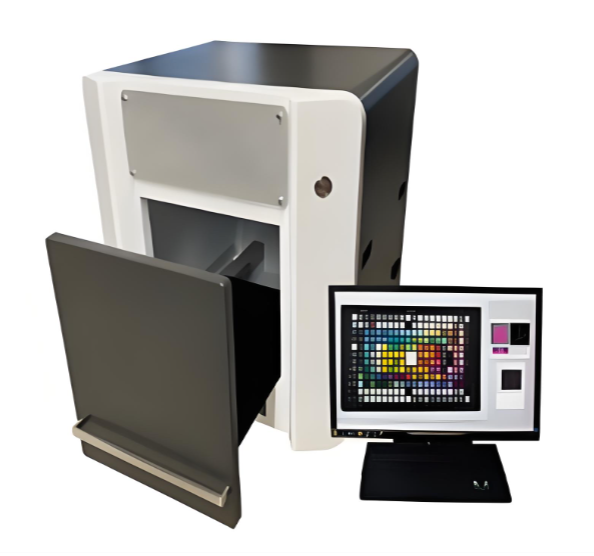
Working Principle of Non-contact Color Measuring Instrument for Textiles
1. Spectral Color Acquisition Principle
The instrument uses a high-energy xenon lamp to simulate a standard daylight source. When the light beam illuminates the surface of a suspended textile sample, part of the light is absorbed by the dyes in the fabric, while the remaining reflected light enters the receiving optical path through diffuse reflection.
The reflected light passes through the slit and is projected onto a diffraction grating, where it is separated according to wavelength to form a continuous visible light spectrum. The CCD photoelectric sensor collects the reflectance signal at each wavelength and converts it into digital spectral data.
Based on the CIE international colorimetric standard and corresponding algorithms, the system converts the spectral reflectance data into three-dimensional color coordinates in a uniform color space: L* (lightness), a* (red-green axis), and b* (yellow-blue axis). The system then compares the coordinate differences with the standard sample and automatically calculates the total color difference ΔE. A smaller ΔE value indicates a higher color matching degree between the two fabrics.
The complete spectral data can also be used to analyze dye absorption characteristics, providing support for fine adjustment of dye formulations.
2. Non-contact Suspended Measurement Principle Without Compression
The equipment adopts a vertical adjustable support structure, with the optical measuring head fixed above the sample and the optical path directed vertically downward. The textile sample is placed flat on the platform without being subjected to any external pressure.
For traditional contact-type instruments, the pressure from the probe can flatten the fibers of velvet and coral fleece, compress the pores of knitted fabrics, and change the microscopic reflection characteristics of the textile surface. As a result, the measured color may appear darker or differ from the actual visual perception.
The non-contact design completely preserves the original fluffy structure and surface texture of the fabric, making the measurement results highly consistent with the visual appearance of garments in their natural hanging or wearing conditions.
The distance between the measuring head and the sample can be adjusted according to the thickness of the textile. For thick blankets, the distance can be increased, while for ultra-thin chiffon fabrics, the distance can be reduced to ensure stable optical transmission and minimize interference from stray light.
3. d/8 Ring Optical Path and Gloss Compensation Principle
Most advanced models adopt a diffuse illumination d/8° geometry optical system, combined with a ring-shaped light source to provide 360° uniform illumination. A gloss trap structure is also integrated to eliminate strong specular reflection from the fabric surface.
Smooth silk, satin, and metallic yarn fabrics usually have strong reflective properties, which may cause unstable measurement readings. The ring-shaped diffuse lighting system effectively reduces directional gloss effects and captures the true color characteristics of the dye rather than surface reflections.
This significantly improves the measurement repeatability of glossy fabrics and provides a unified comparison standard for both matte and glossy textiles.
4. Standard Calibration and Environmental Compensation Principle
Before each measurement after startup, the instrument performs baseline calibration using the supplied standard white ceramic tile and black calibration cylinder to eliminate systematic errors caused by light source aging and optical path deviation.
The instrument is equipped with an environmental light shielding cover. During testing, the shielding structure can block interference from workshop lighting, windows, and other external light sources.
The software includes temperature compensation algorithms to correct and compare color differences caused by temperature variations, such as the color change of dyed fabrics before and after cooling.
The system also supports multi-illuminant measurement and allows one-click switching between different light sources, including D65 daylight, A warm incandescent light, and CWF commercial fluorescent light. This helps predict metamerism problems under different viewing conditions, preventing customer complaints caused by inconsistent color appearance between indoor and outdoor environments.
5. Intelligent Color Data Evaluation and Traceability Principle
The accompanying color management software can store customer-approved standard color samples in advance. After testing bulk production fabrics, the system automatically compares the measured results with the standard color and classifies the color difference levels.
Typical evaluation criteria include:
ΔE ≤ 1: Excellent color consistency
1 < ΔE ≤ 2: Qualified range
ΔE > 2: Unqualified result
The system automatically records key information for each tested sample, including fabric lot number, batch information, color difference value, and testing time, and generates complete quality inspection reports.
The test data can be directly exported and integrated with ERP systems, textile dyeing and color matching systems, and factory management platforms. Unqualified results can trigger real-time alerts, enabling full-process digital color traceability and replacing traditional subjective manual color evaluation methods.
Application Industries of Non-contact Color Measuring Instrument for Textiles
1. Color Measurement and Quality Control
The instrument can accurately measure textile color parameters, including hue, lightness, saturation, and CIELAB color space coordinates, ensuring that product colors meet established standards and customer requirements.
During the production process, it can quickly detect color differences in fabrics, yarns, and other textile materials, helping manufacturers identify and adjust problems in dyeing processes in a timely manner. This ensures color consistency between different production batches and reduces the defect rate.
2. Raw Material Inspection
The instrument can be used for color inspection of textile raw materials, such as fibers, dyes, and other materials, ensuring stable color quality and preventing final product color deviations caused by inconsistent raw material colors.
It helps enterprises select qualified raw materials with consistent color performance, ensuring stable product quality while improving production efficiency.
3. Product Design and Research & Development
The instrument provides designers with accurate color data, helping them select suitable color combinations, better achieve design concepts, and meet market demands for personalized and fashionable textile products.
During the development of new products, color measurements of samples produced with different formulations and processes can be performed to optimize color performance, shorten the development cycle, and reduce R&D costs.
4. Production Process Monitoring
The instrument can be integrated into textile production lines to achieve real-time online monitoring of fabric colors. It provides timely color feedback, allowing operators to quickly adjust production parameters and maintain color stability throughout the manufacturing process.
When combined with automated production equipment, it enables fully automated, intelligent, and efficient color difference inspection, improving production efficiency and reducing labor costs. It is especially suitable for large-scale textile manufacturing enterprises.
5. Quality Traceability and Management
The measurement data can be stored and traced, allowing enterprises to track and manage textile color quality throughout the entire production process. When quality issues occur, the causes can be quickly identified and corresponding corrective actions can be taken.
The system provides reliable data support for establishing a comprehensive quality control system, helping enterprises improve overall quality management capabilities.

Importance of Non-contact Color Measuring Instrument for Textiles
The core importance of the Non-contact Color Measuring Instrument for Textiles lies in its ability to preserve the original structure of fabrics without physical contact while obtaining accurate color data. At the same time, it enables high-speed online quality control and precise prediction of metamerism, making it a key solution for addressing color measurement distortion in fluffy and glossy fabrics, reducing rework losses, and meeting standardized color evaluation requirements in international trade.
1. Core Problems Solved and Key Advantages
Avoiding Color Measurement Errors Caused by Physical Deformation
Traditional contact-type probes may flatten the fibers of fluffy textiles such as velvet and coral fleece or compress the pores of knitted fabrics, changing the light reflection path and causing measured colors to appear darker than the actual color.
The non-contact measurement mode (with a suspended distance of 2–10 mm) maintains the natural fluffiness and surface texture of textiles, ensuring that measurement data closely matches the visual appearance of finished garments under natural wearing conditions.
Eliminating Gloss and Texture Interference
By adopting d/8 geometry optical design combined with gloss trap technology, the instrument effectively filters strong specular reflections from fabrics such as silk and metallic yarn textiles. It captures the true color characteristics of the dyes rather than surface reflections, significantly improving the repeatability and accuracy of color measurement for highly glossy or complex textured fabrics.
Supporting Measurement of Various Sample Forms
Without requiring sample flattening or compression, the instrument can measure a wide range of textile products, including lightweight chiffon, thick blankets, jacquard fabrics, and irregular finished products such as underwear and lace.
This overcomes the limitations of traditional color measurement instruments regarding sample flatness, thickness, and surface structure.
2. Key Roles in Production and Trade
Online Real-time Quality Control and Cost Reduction
The instrument supports continuous and rapid sampling inspection near production lines, providing real-time warnings for batch variation and color deviation. Manufacturers can correct production parameters without stopping the production line, significantly reducing dye waste, rework costs, and material losses.
Replacing Subjective Visual Evaluation with Quantitative Standards
Based on CIE international color standards, the instrument provides objective L*a*b* values and ΔE color difference data, eliminating differences caused by individual visual judgment and environmental lighting conditions.
It provides reliable and traceable measurement data for trade arbitration, brand inspection, and customer acceptance.
Advance Management of Metamerism Risks
With built-in multi-illuminant simulation, the instrument can identify potential color changes of fabrics under different lighting conditions in advance. This helps prevent customer complaints and returns caused by inconsistent color appearance between indoor and outdoor environments.
Digital Traceability and Intelligent Color Matching
The complete spectral data can be used to analyze dye absorption characteristics and assist in fine-tuning dye formulations. The measurement data can also be connected with ERP systems and color matching platforms, enabling full-process digital color management from raw materials to finished products.
Conclusion
With the current textile industry trend toward small-batch production, rapid color variation, and increasingly strict requirements for color consistency and metamerism control from brands, non-contact color measurement technology has become an essential quality inspection method for high-end dyeing and finishing companies and international apparel manufacturers.In the future, textile color measuring instruments will continue to develop toward greater intelligence, including wireless portable designs, continuous online scanning measurement on production lines, AI-based automatic pattern recognition and color zone measurement, and cloud-based standard color database synchronization. These advancements will further improve testing efficiency, automation levels, and digital quality management capabilities.For more information, please feel free to contact us. We are committed to providing detailed product information and professional technical support.