

What are the methods of wrinkle resistance test?
In today’s fashion and textile industries, the quality and performance of fabrics directly influence the market competitiveness of products. Especially in garment design, fabric appearance, hand feel, and durability are often important factors considered by customers when making purchasing decisions. Among the many factors affecting fabric performance, the wrinkle recovery property of textiles is undoubtedly one of the most critical aspects.Wrinkle recovery performance not only affects wearing comfort but also plays an important role in maintaining the overall appearance and aesthetic quality of garments. To accurately evaluate the wrinkle recovery ability of fabrics, the Fabric Wrinkle Bending Tester was developed and has become an essential advanced testing instrument in the textile industry.
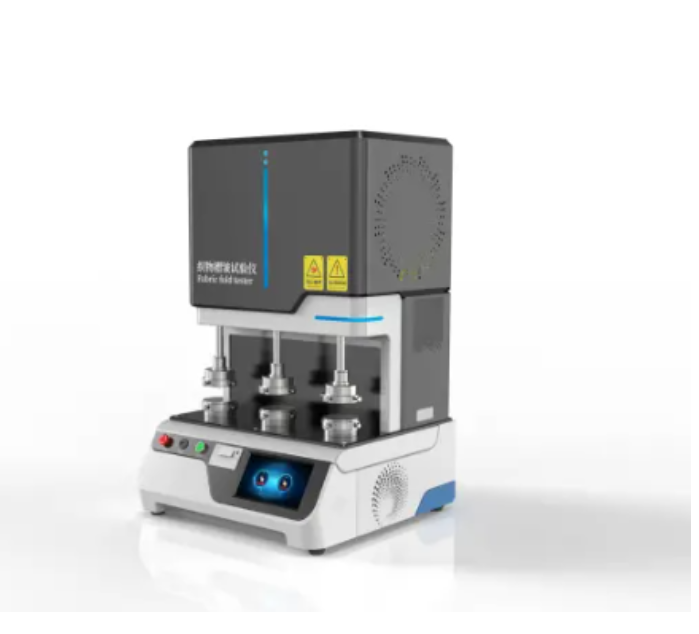
Working Principle of Fabric Wrinkle Recovery Tester
I. Fabric Wrinkle Recovery Testing Principle
1. Fabric wrinkle recovery testing is the core testing function of this instrument. The test is mainly performed using the vertical folding, compression, and rebound recovery method. First, fabric specimens with standard dimensions, smooth surfaces, and no defects are cut according to the requirements of relevant standards. The specimen is then folded according to a unified procedure and placed steadily on the dedicated compression testing position of the instrument.
2. The equipment drives the compression rod downward at a uniform speed through a precision transmission mechanism, applying a standard constant pressure to the folded fabric specimen. The specified loading time is strictly maintained to allow the internal fiber structure of the fabric to form a stable wrinkle deformation under compression. After the pressure holding period is completed, the compression device automatically rises quickly to completely release the external force. The wrinkled fabric specimen then begins to recover naturally through the elastic recovery force of its own fibers.
3. The instrument is equipped with a high-precision photoelectric angle sensing system, which can accurately capture the real-time changes in the opening angle on both sides of the wrinkled specimen. It records the instant elastic recovery angle immediately after pressure release and the delayed elastic recovery angle after standing for a specified period of time. Based on the collected angle values, the system automatically calculates the fabric wrinkle recovery rate.
The larger the recovery angle and the higher the recovery rate, the stronger the wrinkle recovery ability and wrinkle resistance of the fabric. Conversely, fabrics with smaller recovery angles are more likely to wrinkle and have poorer ability to return to a smooth condition.
II. Fabric Bending Performance Testing Principle
1. In bending test mode, the instrument performs testing based on the principle of cantilever natural bending deformation. One end of the strip-shaped fabric specimen is firmly clamped and fixed, while the other end remains freely suspended. Under the influence of its own gravity, the specimen naturally bends and hangs downward.
2. Using a high-precision angle measurement component, the instrument accurately measures the bending angle formed by the free end of the specimen. Combined with basic parameters such as fabric weight per unit area, thickness, and specimen dimensions, the built-in standard calculation formula automatically converts the results into fabric bending stiffness, bending flexibility, and other performance indicators.
These results are used to evaluate the overall softness, stiffness, and drape performance of fabrics, clearly distinguishing the performance differences between soft skin-friendly fabrics and stiff structured fabrics. The test data provides reliable support for garment design and fabric selection.
III. Automatic Driving and Precise Positioning Principle
1. The instrument uses a stepper motor as the main power source and is equipped with a precision gear transmission structure. It ensures that both the downward compression speed and upward pressure release speed remain uniform and stable, avoiding impact forces that may damage the original fiber structure of the fabric.
The compression stroke, applied load, and pressure holding time can all be freely set and adjusted through the operation panel, allowing the instrument to flexibly meet the testing requirements of fabrics with different materials and different weights per unit area.
2. The angle measurement process eliminates the traditional manual angle measurement method and adopts non-contact photoelectric sensing detection technology. It is not affected by specimen color, texture, thickness, or other surface characteristics, providing high measurement accuracy and effectively reducing errors caused by manual reading.
The entire testing process, including specimen placement, automatic compression, timed pressure holding, automatic pressure release, angle acquisition, and data calculation, is completed automatically. This greatly reduces operational difficulty while improving testing efficiency and data accuracy.
IV. Data Calculation and Result Evaluation Principle
1. The equipment is equipped with an intelligent microcomputer control system with built-in calculation programs based on national and international standards. After testing, the system can instantly process and calculate the data, directly displaying multiple test results on the screen, including:
Instant elastic recovery angle
Delayed elastic recovery angle
Fabric wrinkle recovery rate
Bending angle
Bending stiffness
Other related test parameters
2. Operators can directly compare the test results with industry qualification standards and enterprise internal quality control requirements to quickly determine whether the wrinkle resistance, bending flexibility, and softness performance of the fabric batch meet the required specifications.
The equipment also provides functions such as data storage, result retrieval, batch statistical analysis, and printing output. These functions help testing personnel prepare test reports efficiently and provide clear and effective data support for process improvement and raw material selection.
The Fabric Wrinkle Bending Tester adopts a mature and stable working principle combining compression-induced wrinkle formation, elastic natural recovery, photoelectric angle acquisition, and intelligent data calculation. It can accurately and efficiently complete the dual evaluation of fabric wrinkle recovery performance and bending softness performance.The instrument completely replaces the traditional subjective manual evaluation method and realizes the digitalization, standardization, and systematic evaluation of textile fabric appearance and wear performance testing.With a reasonable structural design, simple operation, and accurate and stable testing performance, this instrument plays an essential role in various fields, including garment textiles, home furnishing fabrics, dyeing and finishing processing, raw material quality inspection, scientific research, and educational training.It can not only quickly determine the wrinkle resistance grade and softness grade of fabrics but also effectively guide manufacturers in optimizing weaving processes and finishing technologies, continuously improving fabric wearing performance and product quality.
Testing Methods and Application Fields of Fabric Wrinkle Recovery Tester
I. Testing Methods
The instrument provides two testing methods to meet the testing requirements of different types of fabrics:
1. Vertical Method
The fabric specimen is folded in half and vertically suspended. After removing the applied pressure and allowing the specimen to rest for a specified period of time, the recovery angle at the crease position is measured.
This method uses the natural effect of gravity to more realistically simulate the wrinkle resistance performance of heavy fabrics during actual use. It is suitable for evaluating the wrinkle recovery properties of thick and heavy fabrics.
2. Horizontal Method
The fabric specimen is placed horizontally. After completing the folding and compression process, the pressure is released, and the recovery angle of the crease is measured.
This method can minimize the influence of gravity on the test results and is more suitable for wrinkle recovery evaluation of lightweight and thin fabrics.
II. Application Fields
1. Textile Manufacturing Industry
Throughout the entire textile production process, the fabric wrinkle tester helps enterprises accurately identify potential wrinkle-related issues caused by seam processing, cutting processes, sewing operations, and other production procedures.
By combining test data with production analysis, manufacturers can optimize processing techniques, reduce quality complaints caused by wrinkle problems during later stages, and ensure consistent product quality before shipment.
2. Garment Design Industry
During new product development and garment design, designers can use the fabric wrinkle tester to conduct multiple simulation tests and clearly understand the wrinkle formation and recovery performance of fabrics under different wearing conditions and environmental situations.
This enables designers to develop clothing products that better meet consumer wearing requirements and provide improved wrinkle resistance.
3. Professional Testing and Certification Institutions
Third-party testing organizations can utilize the fabric wrinkle tester to provide professional wrinkle performance evaluation services for textile enterprises.
The test results help companies successfully obtain relevant quality certifications, improve product market recognition, and enhance their core competitiveness.
4. Scientific Research and Material Development
In textile material research, the fabric wrinkle tester can be used to investigate the formation mechanisms and elastic recovery characteristics of wrinkles in new textile materials.
It provides important experimental data accumulation and offers reliable technical support for future innovation, material development, and performance improvement of advanced textile products.
Importance of Fabric Wrinkle Recovery Tester
The Fabric Wrinkle Recovery Tester is a core testing instrument used for the quantitative evaluation of fabric wrinkle resistance performance, ensuring product appearance quality and wearing performance. It directly influences textile product classification, process optimization, and brand reputation.
1. Foundation of Quality Control
The instrument provides objective test data to replace subjective visual evaluation, accurately identifying fabrics with poor wrinkle resistance. It ensures the smooth appearance and dimensional stability of finished fabrics, reduces the defect rate of garments, and improves overall product quality control.
2. Basis for Process Research and Development
By analyzing the instant elastic recovery angle and delayed elastic recovery angle, the instrument provides reliable data support for optimizing key production parameters such as durable press finishing agent formulations, heat-setting temperatures, and finishing processes. It helps promote the development of functional fabrics with excellent wrinkle recovery performance.
3. Market Access and Product Classification Standard
As an important tool for verifying compliance with international testing standards, the Fabric Wrinkle Recovery Tester supports textile product grading and classification, such as distinguishing between ordinary fabrics and wrinkle-resistant or easy-care fabrics.
The test results serve as important evidence for trade contract fulfillment, quality certification, and premium pricing strategies for high-end textile brands.
4. Guarantee of Consumer Wearing Experience
Fabric wrinkle recovery performance is directly related to the appearance retention ability of garments after wearing. It plays an important role in maintaining the neat appearance and professional image of clothing products such as suits, uniforms, and business wear, thereby improving consumer satisfaction.
With continuous technological advancement, future Fabric Wrinkle Recovery Evaluation Testers will become increasingly intelligent, with broader application fields and more advanced testing capabilities.As an essential testing solution in the fashion and textile industries, this instrument will continue to play an increasingly important role in improving textile quality and providing consumers with better product experiences.We sincerely welcome your inquiries or direct contact with us. We will be pleased to provide more detailed product information and technical support.