

How to pull test snap button?
The Button Strength Tester is mainly suitable for testing the attachment firmness and fixing strength of buttons, snaps, and various garment accessory components. This equipment is particularly applied in the design, research and development, production, and quality inspection processes of infant and children's clothing.If buttons on infant and children's garments become detached, they can easily be accidentally swallowed or ingested by children, causing serious safety hazards such as choking.Conducting button strength testing can effectively standardize the quality control responsibilities of garment manufacturers, ensuring that buttons, snaps, and various clothing accessories are securely fixed to the garment surface. It helps eliminate potential safety risks from the production source and ensures the wearing safety of children.
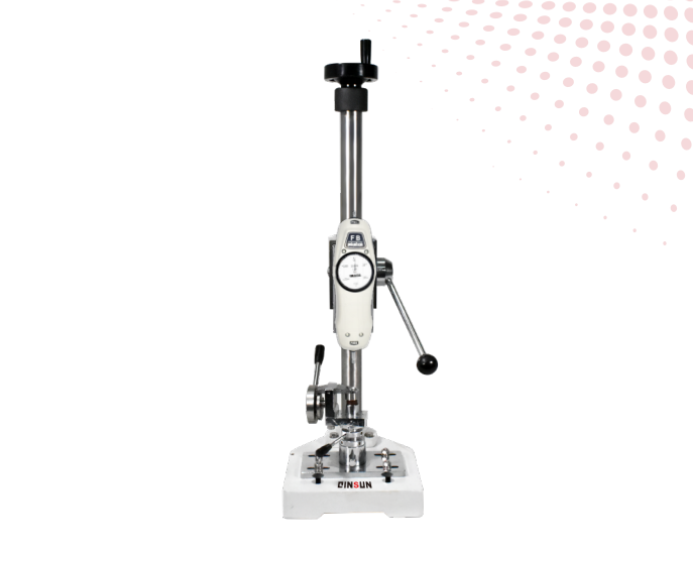
Understanding the Button Strength Tester
Appearance and Structure
The appearance of the Button Strength Tester is usually simple and compact. Its common dimensions are approximately 260 mm in length, 360 mm in width, and 700 mm in height. The overall structure is rectangular, which makes it convenient to place on a workbench while occupying minimal space. Although its appearance looks ordinary, the internal structure incorporates highly precise engineering design. The tester mainly consists of a power system, transmission mechanism, sensor, and control system.
The power system acts as the “heart” of the tester, providing stable driving force throughout the testing process, just like the engine of a vehicle that supplies power for operation. The transmission mechanism functions like a vehicle’s drive shaft, accurately transferring the power generated by the power system to the testing components. It ensures smooth and precise force application, allowing the button to be subjected to uniform force during the test.
The sensor can be regarded as the “sensory nerve” of the tester. It is capable of accurately detecting various data changes during the button’s loading process, such as the applied tensile force and deformation degree of the button. These measured values are converted into electrical signals and transmitted to the control system, similar to how human nerves transmit external stimuli to the brain.
The control system serves as the “brain” of the tester. Operators can precisely set test parameters through this system, such as the tensile loading speed and maximum test force. It can also display and record test data in real time, making it convenient for operators to analyze and evaluate test results, just as the human brain controls body movements and processes various types of information.
Operation and Maintenance Guidelines for the Button Strength Tester
1. Correct Operating Procedures
Mastering the correct operating procedures is essential to ensuring the Button Strength Tester delivers accurate performance. Every step is critical, just like a precise surgical procedure where each operation directly affects the final result. The detailed operation process is described below.
When installing the fixtures, select the appropriate fixture according to the shape and size of the button, just like choosing suitable shoes for people with different foot sizes. Then, carefully install the fixture onto the tester and use the provided tools, such as an Allen wrench, to firmly secure the fixture. Ensure that there is no loosening during the test process. This step is the foundation of accurate testing, and a stable foundation is essential for reliable results.
Fixing the button sample also requires careful operation. Place the garment with the button flatly on the base fixture and ensure that the button is positioned at the center of the fixture, just like aiming at the center of a target when shooting an arrow. Then, gently push the push rod handle to slowly clamp the garment and button. Avoid clamping too loosely, as the button may detach during testing and affect the test results. At the same time, avoid excessive clamping force, which may damage the button or the garment.
The next step is parameter setting. According to the relevant standards and testing requirements, the operator needs to accurately input parameters such as tensile loading speed and maximum test force into the control system. These parameters are like the rules of a competition, determining the testing method and intensity. Different types of buttons may require different parameter settings, so careful adjustment is necessary.
Once all preparations are complete, the test can be started. Press the start button, and the power system begins operation. The transmission mechanism drives the fixture to gradually apply tensile force to the button. During the testing process, the operator should closely monitor the test condition and observe any changes to the button, such as deformation, loosening, or other abnormalities.
When the button becomes detached, damaged, or reaches the preset maximum tensile force, the tester will automatically stop operation. At this point, the test data should be recorded promptly. These results are an important basis for evaluating button quality. During data recording, ensure that all information is accurate and complete, without missing any key details.
2. Precautions
During the entire operation process, the following precautions should be kept in mind:
Before testing, check whether the equipment is operating normally and whether all components are securely connected.
During testing, do not touch moving parts of the equipment to avoid potential safety risks.
After testing, turn off the power supply promptly and clean the testing area.
The Importance of the Button Strength Tester
1. Providing Quality Control Methods for Manufacturers
In industrial production, buttons are small components, but their quality directly affects the final quality of finished products. Through the Button Strength Tester, manufacturers can conduct necessary quality monitoring on various types of buttons during production, ensuring that products meet quality standards and protecting consumer rights and interests.
2. Providing Consumer Rights Protection
Product quality is one of the most important concerns for consumers when purchasing products. If garments experience problems such as loose stitching or button detachment due to poor button quality, it will negatively affect the overall product quality and may even impact the consumer’s wearing experience.
By using the Button Strength Tester to evaluate the tensile strength of buttons, manufacturers can verify product reliability through whether performance indicators meet the required standards, thereby providing consumers with quality assurance and protecting their rights.
3. Providing Experimental Data for Research
The material, shape, structure, and other factors of buttons can all affect their strength and durability. For researchers studying button performance, the test data obtained from the Button Strength Tester can provide important experimental references for analyzing button properties, performance variations, and structural improvements.
How to Choose a Suitable Button Strength Tester
1. Define Your Requirements
When selecting a Button Strength Tester, the first step is to clearly define your actual requirements. Different garment production scales, testing frequencies, and button types have different requirements for the tester’s functions and accuracy.
For large-scale garment manufacturers that need to test a large number of buttons every day, it is necessary to choose a tester with high testing efficiency and a high level of automation. Such equipment can complete testing tasks quickly and accurately, meeting the requirements of mass production.
For small garment workshops or users who only perform button testing occasionally, a basic model with simple operation and an affordable price may be sufficient. There is no need to pursue advanced functions excessively. This type of tester can meet basic testing requirements while reducing costs.
At the same time, the types of buttons being tested should also be considered. Buttons made of different materials and with different shapes vary in testing difficulty and requirements. For example, metal buttons are usually stronger than plastic buttons and require greater tensile force to accurately evaluate their actual performance. Special-shaped buttons may require customized fixtures during fixation and testing. Therefore, when selecting a tester, it is important to ensure that it can accommodate different types of buttons.
2. Focus on Key Parameters
After defining the requirements, attention should be paid to the key parameters of the Button Strength Tester.
The first important parameter is the maximum load, which determines the maximum tensile force range that the tester can apply during testing. Generally, for testing ordinary garment buttons, a tester with a maximum load of around 300N–500N can meet most requirements. However, if testing special high-strength buttons, such as reinforced buttons used in outdoor clothing, a tester with a higher maximum load capacity should be selected.
The effective travel distance is another important parameter. It refers to the maximum movement distance of the tester during the testing process. A larger effective travel distance can accommodate garments of different thicknesses and buttons of different sizes, providing more flexible testing conditions.
Accuracy directly affects the reliability of test results. For button tensile strength testing, the accuracy generally needs to reach within ±0.5%, ensuring reliable test data and providing an accurate basis for quality evaluation.
In addition to the above parameters, operational convenience and durability should not be overlooked. A tester with simple and intuitive operation can reduce operator training costs and improve work efficiency. A durable tester can maintain stable performance during long-term use, reduce the frequency of maintenance and equipment replacement, and lower overall operating costs.
Conclusion
In summary, as a commonly used testing instrument, the Button Strength Tester plays an important role in production quality control, consumer protection, and scientific research. With its flexibility, ease of operation, and accurate measurement performance, this equipment provides manufacturers and consumers with a reliable platform for ensuring product quality.We sincerely welcome your inquiries or direct contact with us so that we can provide more detailed product information and professional solutions.