

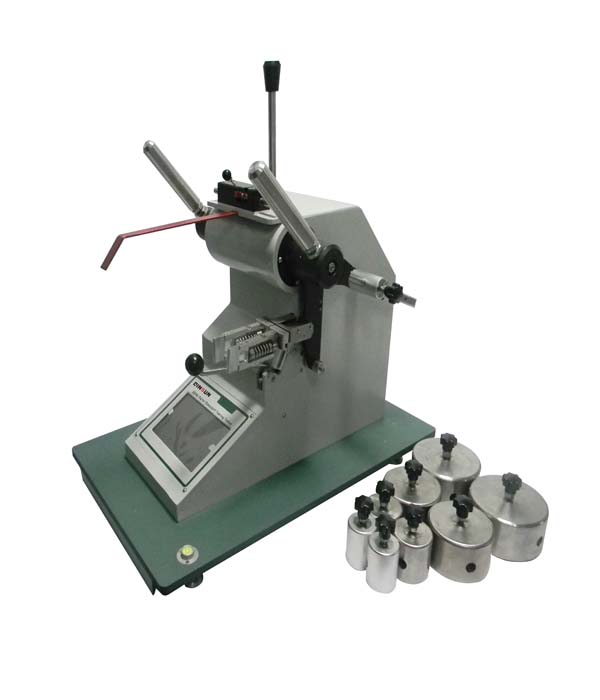
What exactly is the Digital Elmendorf Tearing Tester?
The Digital Elmendorf Tearing Tester is a precision mechanical testing instrument specially designed to determine the resistance of fabrics and thin materials against tear propagation. Its core principle is based on the impact pendulum method (Elmendorf method), which converts the energy required to extend a pre-cut notch into a tearing force value.It is a professional testing device specifically used for evaluating the tear resistance performance of fabrics. Its main function is to simulate tearing conditions that may occur during actual use and perform quantitative analysis and evaluation of textile materials. The instrument can accurately measure the ability of fabrics to resist tearing when subjected to external forces, providing scientific data support for product quality control, research and development improvement, and the establishment of testing standards.In the textile industry, the Fabric Tearing Strength Tester is widely used throughout the entire process, from raw material inspection to finished product testing, ensuring that products meet relevant technical requirements and market demands.This article will introduce this equipment from the following aspects and aims to provide useful information for readers.
What is Tear Strength
Fabric tear strength refers to the phenomenon in which local yarns in a fabric are subjected to a concentrated load, causing the fabric to tear apart. This commonly occurs during actual use when clothing is caught by sharp objects or hooked by external objects. Local yarns are subjected to concentrated stress and break, causing the fabric to form strip-shaped or triangular tears.
Significance of Studying Tear Strength
After clothing has been worn for a certain period of time, friction gradually reduces the thickness of yarns. When local yarns inside the fabric are subjected to external forces, they may break and form cracks.
Fabrics used for military uniforms, sails, parachutes, hammocks, and other high-strength applications are more likely to experience concentrated loads during service. Such concentrated stress may cause local damage and tearing of the products. When a fabric is caught by an object or partially held under external force, it may eventually split into two parts.
This phenomenon, where fabric is torn under concentrated loading, is generally called tearing or tear failure. Tearing can be described as the sequential breaking of one or several yarns along a crack line. It is one of the most common failure modes leading to fabric damage or the end of product service life.
Fabric tearing is a common and easily occurring form of material failure. Due to the special stress concentration characteristics at the tear edge, the tear strength of fabrics is generally much lower than their tensile breaking strength.
At the same time, tear strength is an important quality indicator for evaluating the ability of fabrics to resist damage under localized stress during use. Other mechanical failure modes of fabrics, such as bursting and abrasion, often eventually develop into tearing failure. Therefore, studying fabric tear resistance is essential for improving product durability and service life.
Applicable Industries of Fabric Tearing Strength Tester
The Fabric Tearing Strength Tester is mainly applied in industries including textiles, packaging, medical protection, geotechnical engineering materials, automotive transportation, scientific research, and quality inspection. It is used to evaluate the tear resistance of fabrics, films, nonwoven materials, and other thin materials.
Main Application Industries
1. Textile and Apparel Industry
Used for tear strength testing and process optimization of woven fabrics, knitted fabrics, coated fabrics, home textiles, and industrial textiles.
2. Packaging and Film Industry
Used for evaluating the tear resistance and durability of plastic films, composite packaging materials, paper bags, and similar products.
3. Medical and Healthcare Industry
Used for durability and compliance testing of medical protective clothing, surgical gowns, mask materials, and disposable hygiene products.
4. Geotextile and Construction Material Industry
Used for mechanical performance verification of engineering materials such as geotextiles, waterproof membranes, industrial filter fabrics, tents, and tarpaulins.
5. Automotive and Transportation Industry
Used for tear safety testing of automotive interior fabrics, safety belts, webbing materials, seat fabrics, and aircraft seat materials.
6. Scientific Research and Third-Party Quality Inspection
Used by universities, research institutions, and testing laboratories for material research and certification report preparation.
Types and Characteristics of Fabric Tear Strength Testing
According to testing principles, fabric tearing strength testers are mainly divided into two categories:
Impact Pendulum Type (Elmendorf Method)
Constant Rate of Extension Type (Constant Rate of Extension, including tongue tear, trapezoidal tear, and wing tear methods)
The former measures dynamic tearing energy, while the latter measures static tear propagation force.
1. Comparison of Main Types and Characteristics
Impact Pendulum Type (Elmendorf Method)
Principle:
The pendulum uses falling kinetic energy to tear a specimen with a pre-cut notch. The energy loss during tearing is converted into tearing strength.
Characteristics:
Fast testing speed and simple operation.
Mainly reflects the maximum force value during the initial tearing moment.
Not suitable for elastic fabrics, knitted fabrics, or loose fabrics with significant differences between warp and weft directions.
Applications:
Suitable for rapid quality inspection of conventional woven fabrics, nonwoven fabrics, coated fabrics, films, and paper materials.
Constant Rate of Extension Type (Constant Rate of Extension Universal Testing Machine Compatible)
Principle:
The fixture stretches the pre-notched specimen at a constant speed and records the force-displacement curve. A special fixture is required.
Main Testing Methods:
Tongue Tear Method / Single Tongue Method
A single slit extends during testing, simulating single-point tearing. It is suitable for general woven fabrics.
Double Tongue Method
Two slits extend simultaneously, causing multiple yarns to bear stress at the same time. The measured values are usually higher than those obtained from the single tongue method.
Trapezoidal Tear Method
The specimen is clamped in a trapezoidal shape. The tearing process involves significant yarn stretching and is more suitable for heavy fabrics or materials that are difficult to tear transversely. The measured values are usually the highest.
Characteristics:
Provides complete tearing process curves, including peak force, average force, and tearing energy.
Provides more comprehensive testing information.
Requires a high-precision tensile testing machine.
Testing speed is slower, but the mechanism is closer to actual progressive tearing behavior.
2. Key Selection Recommendations
Consider Testing Standards:
If testing according to GB/T 3917.1 or ASTM D1424. an impact pendulum type tester must be used.
If testing according to GB/T 3917.2/3/4 or ISO 13937 series, a constant rate of extension tester with corresponding fixtures is required.
Consider Material Type:
Lightweight conventional fabrics: choose impact pendulum type.
Heavy fabrics, highly elastic materials, or applications requiring tearing mechanism analysis: choose constant rate of extension type.
Consider Data Requirements:
For simple pass/fail evaluation: choose impact pendulum type.
For studying tearing mechanisms, material anisotropy, or complete tearing curves: choose constant rate of extension type.
Importance of Fabric Tearing Strength Tester
As a key instrument for evaluating physical properties of materials, the Fabric Tearing Strength Tester plays an important role in supporting product quality, safety, and market competitiveness.
By simulating damage conditions caused by hooking, scratching, or localized stress concentration during actual use, the instrument accurately measures the ability of materials to resist tear propagation. It is an essential method for evaluating the durability of textiles, paper materials, films, and other thin materials.
1. Essential Role in Quality Control and Compliance Verification
Compared with tensile strength, tear strength more realistically reflects the damage resistance of fabrics during daily wear and industrial applications.
Manufacturers use this instrument for internal quality inspection to ensure that products comply with national and international mandatory safety standards, meet customer contract requirements, and provide reliable testing data for third-party inspection organizations.
This not only helps prevent quality disputes caused by premature material failure but also provides an important foundation for products entering domestic and international markets.
2. Guidance for Product Development and Process Optimization
The instrument provides important support for new product development and manufacturing improvement.
Through various testing methods such as tongue tear, trapezoidal tear, and wing tear methods, engineers can analyze tearing behavior and energy absorption characteristics of materials with different structures and orientations.
These detailed test results help manufacturers optimize fabric formulations, adjust production processes, improve toughness and uniformity, and achieve performance improvements from acceptable quality to premium quality.
3. Wide Application Range and Technical Support
The Fabric Tearing Strength Tester is widely used in textile and apparel, household products, industrial textiles, military materials, and other fields.
Whether for ensuring the service life of daily clothing, verifying the durability of outdoor sportswear, workwear, tents, and other high-strength products, or evaluating the performance of medical protective clothing, automotive interior materials, and geotextiles, the instrument provides objective and scientific technical support.
It effectively reduces resource waste caused by material defects, protects consumer rights, and provides a solid foundation for improving the overall technical level and market competitiveness of the industry.
Conclusion
In summary, the primary function of the Fabric Tearing Strength Tester is to accurately measure the tear resistance of fabrics and provide critical data support for product quality control and research and development.
Its extensive applications not only improve the technical level of the textile industry but also provide consumers with safer and more reliable textile products.
In the future, with continuous technological development and increasing market demands, the Fabric Tearing Strength Tester will continue to play an important role in promoting the textile industry toward higher standards and improved performance.
We sincerely welcome your inquiries and comments. Please feel free to contact us directly so that we can provide more detailed product information and professional technical support.