

What is Impact Abrasion Resistance Tester?
The Impact Abrasion Resistance Tester is a specialized laboratory instrument designed to evaluate how materials and surface coatings withstand the combined effects of impact force and abrasive wear. In real-world environments, many materials are not only subjected to continuous rubbing or erosion but also sudden mechanical impacts caused by particles, tools, or external forces. This dual-action damage is common in industries such as automotive manufacturing, protective coatings, construction materials, flooring systems, and electronic device housings. The tester simulates these conditions in a controlled and repeatable environment by applying both mechanical impact and abrasive movement to a specimen surface. This allows engineers to evaluate how quickly a material deteriorates, how coating layers respond to repeated stress, and whether the substrate maintains its structural integrity. Unlike single-function abrasion testers or impact testers, this equipment combines both mechanisms, making it especially valuable for realistic performance evaluation. It is widely used in research and development, quality control, and product certification processes where surface durability is a critical performance factor.
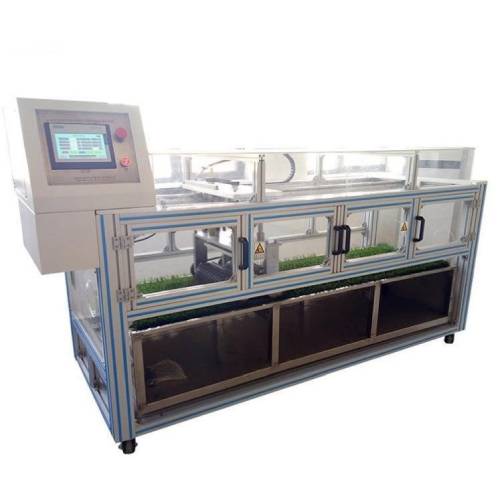
Working Principle Based on Combined Impact Energy and Controlled Abrasive Motion Simulation Mechanisms
The working principle of an Impact Abrasion Resistance Tester is based on the simultaneous or sequential application of impact force and abrasive friction to a test specimen. The system typically uses a mechanical arm, pendulum, or pneumatic mechanism to deliver controlled impact energy to the surface, while an abrasive medium such as sand, grit, steel particles, or standardized abrasive wheels moves across the same area. The specimen is firmly fixed on a test platform, and parameters such as impact force, impact angle, cycle frequency, abrasion speed, and load pressure can be precisely adjusted. During testing, the material experiences repeated stress cycles where impact creates micro-cracks or surface deformation, and abrasion gradually removes material from weakened areas. This interaction accelerates the failure process, allowing researchers to observe how materials behave under complex real-world conditions. Sensors and control systems record key variables such as force distribution, wear depth, and cycle count until failure. After testing, the sample is analyzed visually or with measurement instruments to determine wear volume, coating loss, and surface roughness changes. This integrated approach provides a more complete understanding of material durability compared to traditional single-mode testing systems.
Structural Design and Core Components Ensuring Precision, Stability, and Repeatable Testing Conditions
The Impact Abrasion Resistance Tester is constructed with a robust mechanical structure designed to withstand repeated high-force operations without deformation. The main frame is typically made from reinforced steel or high-strength alloy materials to ensure stability during impact events. The impact generation system is one of the most critical components and may use a pendulum hammer, pneumatic piston, or servo-controlled actuator to deliver consistent energy levels. The abrasion system is equally important and often includes rotating abrasive wheels, linear sliding tables, or controlled particle delivery systems depending on the testing standard. A specimen holding platform is designed to securely fix materials at precise angles while resisting vibration and displacement during testing. Load cells and force sensors are integrated into the system to measure real-time impact force and abrasion resistance. Modern versions include digital control interfaces that allow operators to set test parameters, monitor performance, and store data automatically. Safety enclosures are installed to prevent debris scattering during high-energy impact events, ensuring operator protection. The integration of mechanical precision and digital control ensures that every test is repeatable, accurate, and suitable for comparative material analysis.
Applications Across Automotive Coatings, Industrial Materials, Flooring Systems, and Protective Surface Engineering
The Impact Abrasion Resistance Tester is widely used across industries where materials are exposed to both mechanical impact and continuous wear. In the automotive sector, it is used to test exterior coatings, bumpers, interior panels, and protective films to ensure they can withstand gravel impacts, sand erosion, and repeated mechanical contact. In the construction industry, flooring materials, wall coatings, and protective surface layers are evaluated for resistance to foot traffic, dropped objects, and abrasive cleaning processes. The electronics industry uses this tester to assess the durability of device housings, protective coatings, and touch surfaces that may experience frequent handling and accidental impacts. In aerospace applications, surface coatings on aircraft components are tested to ensure resistance to particle erosion combined with mechanical stress during operation. Material manufacturers also rely on this equipment to develop advanced composites, nano-coatings, and reinforced polymers designed for high-performance environments. Even consumer product industries use it to improve the durability of everyday items such as luggage, appliances, and protective gear. By simulating real-world combined stress conditions, the tester helps industries improve product lifespan, reduce failure rates, and enhance customer satisfaction.
Testing Standards, Evaluation Methods, and Interpretation of Wear and Damage Behavior
Testing procedures for the Impact Abrasion Resistance Tester are generally guided by industrial standards that define test conditions, specimen preparation, and evaluation criteria. These standards ensure that results are consistent and comparable across different laboratories and product types. During testing, the specimen is subjected to a defined number of impact and abrasion cycles under controlled environmental conditions. The evaluation process involves both qualitative and quantitative assessments. Qualitative evaluation includes visual inspection of surface damage, such as scratches, dents, coating peeling, or crack formation. Quantitative analysis involves measuring material loss, wear depth, surface roughness changes, and weight reduction before and after testing. Advanced laboratories may use microscopy or 3D surface profiling systems to analyze damage morphology in detail. Force-displacement data collected during testing is also used to understand how materials respond to repeated stress. Engineers often analyze failure patterns to determine whether damage originates from coating weakness, substrate failure, or poor adhesion between layers. This information is essential for improving material design and optimizing production processes. By combining visual inspection with precise measurement data, the tester provides a comprehensive understanding of how materials behave under combined mechanical stress.
Future Development Trends Toward Intelligent Control Systems, Multi-Stress Simulation, and Advanced Material Research Integration
The future development of Impact Abrasion Resistance Testers is closely linked to automation, digitalization, and advanced simulation technologies. Modern systems are increasingly equipped with intelligent control software that allows automated test programming, real-time monitoring, and data analysis. Artificial intelligence and machine learning technologies are being integrated to analyze wear patterns and predict material failure behavior based on accumulated test data. Another major trend is the integration of multi-stress simulation, where impact abrasion testing is combined with environmental factors such as temperature changes, humidity exposure, and UV radiation. This creates a more realistic testing environment that closely replicates actual service conditions. High-speed imaging and laser-based measurement systems are also being introduced to capture real-time surface deformation and wear progression at microscopic levels. Additionally, advancements in material science are driving demand for more precise testing of new-generation coatings, including self-healing materials, ultra-hard ceramics, and flexible composite surfaces. As industries continue to demand higher durability and longer product lifespans, the Impact Abrasion Resistance Tester will evolve into a more intelligent, integrated, and highly precise system, playing a key role in future material innovation and quality assurance processes.