

What is Mask Synthetic Blood Penetration Tester?
The Mask Synthetic Blood Penetration Tester is a professional laboratory instrument used to evaluate the resistance of medical masks and protective face coverings against the penetration of synthetic blood under controlled pressure conditions. It is primarily designed to simulate real-world exposure scenarios in which healthcare workers may come into contact with high-velocity blood splashes or body fluids during surgical operations, emergency treatment, or trauma care. The main purpose of the device is to determine whether a mask can effectively block liquid penetration and maintain a safe barrier between the wearer and potentially infectious fluids. This type of testing plays a critical role in ensuring that medical protective products meet required safety standards before being approved for clinical use.
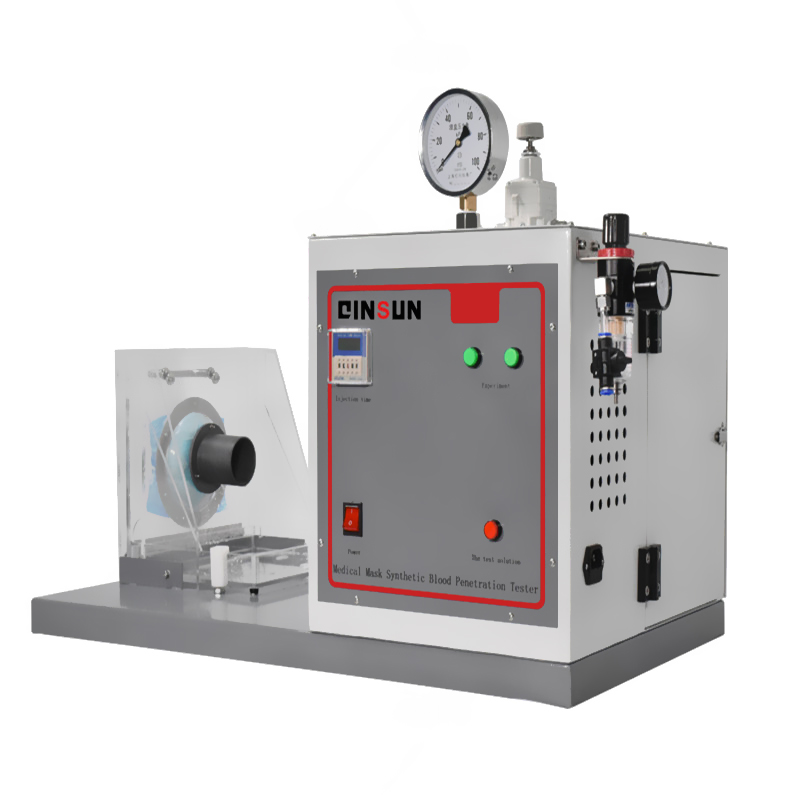
Working Principle Based on Controlled Synthetic Blood Spray and Pressure Simulation Technology
The working principle of the Mask Synthetic Blood Penetration Tester is based on generating a controlled jet of synthetic blood and directing it toward a mask sample under defined pressure and distance conditions. The mask specimen is securely mounted on a fixture that simulates the natural wearing position on the human face. Once the test begins, a pressurization system forces synthetic blood through a precision nozzle, producing a high-speed fluid stream that impacts the mask surface.
The key objective is to observe whether the synthetic blood penetrates through the outer layers of the mask and reaches the inner side. If no penetration occurs, the mask is considered to have passed the test under that specific pressure level. If any liquid appears on the inner surface, it indicates a failure in barrier performance. Different pressure levels are applied to simulate varying degrees of exposure, from minor splashes to high-pressure jets. This controlled simulation ensures consistency, repeatability, and reliable comparison between different mask materials and designs.
International Standards and Regulatory Requirements Guiding Test Accuracy and Product Certification
The Mask Synthetic Blood Penetration Tester operates in accordance with internationally recognized testing standards that define procedures, parameters, and acceptance criteria for medical mask evaluation. Common standards include ASTM F1862. ISO 22609. and EN 14683. which are widely adopted in global medical device regulation systems. These standards specify important testing conditions such as synthetic blood formulation, spray velocity, nozzle distance, exposure angle, and sample positioning.
Each standard also defines performance classification levels that determine whether a mask is suitable for specific medical environments. For example, surgical masks used in high-risk procedures must withstand higher synthetic blood impact velocities compared to standard medical masks. Regulatory authorities in regions such as North America, Europe, and Asia require compliance with these standards as part of product approval processes. As a result, the testing equipment becomes an essential tool for manufacturers seeking certification and international market access.
Structural Composition and Engineering Design of the Testing Equipment System
The structure of the Mask Synthetic Blood Penetration Tester is composed of several key components that work together to ensure accurate and stable testing performance. These include a synthetic blood reservoir, a pressure control system, a nozzle assembly, a sample mounting fixture, and an electronic control interface. Each component is designed with high precision to maintain consistent test conditions.
The pressure control system is responsible for generating stable and adjustable pressure levels, allowing the simulation of different impact intensities. The nozzle assembly ensures that synthetic blood is delivered in a uniform and controlled jet stream with consistent velocity and direction. The sample fixture holds the mask securely in place at a standardized angle to replicate real wearing conditions. Modern systems often integrate digital control panels that allow operators to set parameters such as pressure value, spray duration, and test cycles, improving both efficiency and repeatability while reducing human error in laboratory operations.
Standardized Testing Procedure and Operational Workflow in Laboratory Environments
The testing process of the Mask Synthetic Blood Penetration Tester follows a strict and standardized workflow to ensure accuracy and reproducibility. Before testing begins, synthetic blood is prepared according to specified formulations that match international standards. The solution is then loaded into the system reservoir. The mask sample is carefully mounted on the fixture, ensuring correct alignment and proper sealing around the edges to prevent false results.
Once the system parameters are configured, the pressurization unit is activated, releasing synthetic blood through the nozzle onto the mask surface. After exposure, the inner side of the mask is examined visually or with the help of absorbent indicators to detect any signs of penetration. Multiple tests are usually conducted at different pressure levels to determine the mask’s performance threshold. All results are recorded and analyzed to evaluate whether the product meets the required safety classification. This structured process ensures consistency across different laboratories and production batches.
Industrial Applications in Medical Device Development, Manufacturing, and Quality Assurance
The Mask Synthetic Blood Penetration Tester is widely used across the entire lifecycle of medical mask development and production. In research and development stages, engineers use the equipment to evaluate different materials, including nonwoven fabrics, melt-blown filtration layers, and multilayer composite structures. The goal is to improve fluid resistance while maintaining breathability and comfort.
In manufacturing environments, the tester is used for batch quality control to ensure that production consistency is maintained across all units. Any variation in material quality or production process can be detected through standardized testing. Third-party laboratories and certification agencies also rely on this equipment to verify compliance before issuing approvals for medical products. The importance of this equipment has significantly increased due to global health concerns and the rising demand for reliable protective equipment.
Technological Development Trends and Future Evolution of Penetration Testing Systems
The development of Mask Synthetic Blood Penetration Testers is moving toward greater automation, precision, and intelligent control. Modern systems increasingly feature programmable test sequences, digital monitoring, and automated data recording functions. These improvements enhance efficiency and reduce operator dependency, making testing more reliable and standardized.
Future trends include the integration of artificial intelligence for data analysis and material performance prediction. Such systems may help manufacturers identify optimal material combinations more quickly, reducing development time. In addition, multi-functional testing platforms are being developed to combine synthetic blood penetration testing with other evaluations such as bacterial filtration efficiency and particulate resistance. Environmental sustainability is also becoming a focus, with efforts to reduce synthetic blood consumption and improve energy efficiency in testing systems.
Conclusion Highlighting the Importance of Mask Synthetic Blood Penetration Tester in Global Health Protection
The Mask Synthetic Blood Penetration Tester is a vital instrument in ensuring the safety and effectiveness of medical masks used in healthcare environments. By simulating realistic high-pressure fluid exposure conditions, it provides accurate and standardized evaluation of mask barrier performance. Its compliance with international testing standards, precise engineering design, and wide industrial application make it an essential tool in the medical device industry. As global health and safety requirements continue to evolve, the importance of reliable testing equipment will only increase. The Mask Synthetic Blood Penetration Tester will remain a core technology in verifying protective performance, supporting product innovation, and ensuring the safety of healthcare professionals and patients worldwide.