

What is Mask Visual Field Tester?
A mask visual field tester is a precision optical testing instrument designed to evaluate the field of view (FOV) of protective masks, respirators, helmets, and other face-covering safety equipment. It measures how much of a user’s natural visual range is obstructed or preserved when wearing a mask, ensuring that protective equipment does not significantly impair visibility or situational awareness. This type of testing is especially important in industries such as industrial safety, medical protection, firefighting, military operations, and hazardous environment work, where clear vision is directly linked to operational safety and decision-making speed. The tester simulates human eye positioning and head geometry to accurately assess how mask structures interfere with forward, lateral, and downward vision. By providing quantifiable visual field data, it helps manufacturers optimize product design to achieve a balance between protection performance and visual comfort. Unlike subjective wearer feedback, the mask visual field tester produces standardized and repeatable measurements that can be used for certification, quality control, and product development. As global safety regulations become stricter and user expectations for comfort increase, visual field testing has become a critical step in ensuring that protective masks meet both safety and usability requirements.
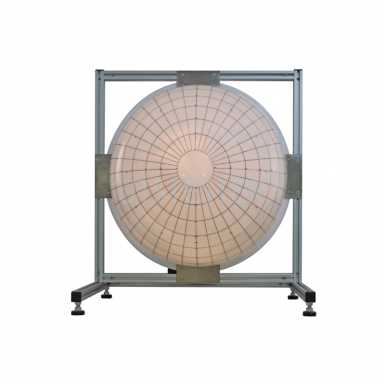
Working Principle and Optical Simulation Technology for Accurate Human Eye Field of View Measurement and Mask Interference Analysis
The working principle of a mask visual field tester is based on optical projection and angular measurement systems that simulate the human visual field under real wearing conditions. The device typically uses a headform model that replicates the anatomical structure of the human head, including eye position, interpupillary distance, and facial contour. Once the mask is mounted on the headform, a light source or projection system is used to generate reference points or patterns within a calibrated optical environment. Sensors or optical detectors then measure how much of the projected field is visible through the mask openings. The system calculates horizontal, vertical, and peripheral visual angles to determine the total field of view available to the wearer. Some advanced models use digital imaging systems and CCD cameras to capture real-time visual obstruction mapping, allowing more precise analysis of blind spots created by mask frames, filters, or structural components. The tester may also include rotational platforms to simulate head movement and dynamic viewing angles. By combining geometric optics with digital measurement technology, the system accurately replicates human visual perception and provides detailed data on how mask design affects visibility under different conditions.
Structural Design, Headform Accuracy and Optical System Integration for High-Precision Visual Field Evaluation
A mask visual field tester is composed of several key structural and optical components that ensure measurement accuracy and repeatability. The central element is the standardized headform, which is designed based on anthropometric data to replicate average human facial dimensions and eye positioning. This headform is typically made from rigid, dimensionally stable materials to prevent deformation during testing. Surrounding the headform is an optical measurement chamber or frame that supports controlled lighting conditions and consistent measurement geometry. The optical system includes calibrated light sources, projection targets, and angular measurement scales that define the reference visual field boundaries. In digital systems, high-resolution cameras or optical sensors are integrated to capture visual obstruction patterns and convert them into measurable data. The mask mounting system ensures that the tested product is securely fitted to the headform without shifting during evaluation, maintaining realistic wearing conditions. The control unit allows operators to set test parameters, including viewing angles, measurement resolution, and data capture modes. Some advanced systems also include software platforms that generate visual field maps and comparative analysis reports. The overall structural design focuses on eliminating external light interference, ensuring stable positioning, and providing accurate simulation of real-world human vision while wearing protective equipment.
Application Scope Across Industrial Safety Masks, Medical Respirators, Firefighting Equipment and Military Protective Gear Design Optimization
Mask visual field testers are widely used across industries where protective face equipment is essential for safety and operational effectiveness. In industrial environments, they are used to evaluate safety helmets, dust masks, and gas respirators worn in construction sites, chemical plants, mining operations, and manufacturing facilities. These environments require both high-level protection and sufficient visibility to prevent accidents caused by limited vision. In the medical field, the tester is used to assess surgical masks, N95 respirators, and isolation equipment to ensure that healthcare workers maintain adequate visibility during procedures while remaining protected from airborne contaminants. In firefighting applications, full-face respirators and breathing apparatus masks are tested to ensure that firefighters retain sufficient field of view in smoke-filled and low-visibility environments, where spatial awareness is critical. Military and law enforcement sectors also rely on visual field testing for tactical masks, ballistic helmets, and protective gear used in combat or emergency operations. In these cases, the balance between protection and situational awareness is essential for mission success. The system is also used in product development and ergonomic design optimization, helping manufacturers refine mask shape, lens size, and structural layout to improve user experience. By supporting multiple industries, the mask visual field tester plays an important role in ensuring that protective equipment does not compromise safety through reduced visibility.
Testing Procedure, Data Interpretation and Product Optimization Value for Safety Certification and Human-Centered Design Improvement
The testing procedure for a mask visual field tester follows a structured process designed to ensure consistent and objective results. First, the mask is fitted onto the standardized headform according to manufacturer instructions, ensuring correct alignment with the eye position. The headform is then placed inside the optical testing system, where controlled lighting or projection patterns are activated. The tester measures the visible range by identifying the angular boundaries where the visual field is blocked or partially obstructed by the mask structure. Horizontal, vertical, and peripheral vision angles are recorded and compiled into a complete field-of-view profile. In digital systems, software automatically generates a visual map showing blocked zones and clear visibility areas, allowing engineers to analyze design limitations in detail. The data is then compared with industry standards or regulatory requirements to determine compliance levels. Beyond certification purposes, the results are highly valuable in product optimization. Designers can adjust mask frame geometry, lens curvature, or structural thickness to improve visibility without compromising protective performance. In iterative development cycles, repeated testing allows continuous refinement of ergonomic and optical design features. This improves user comfort, reduces visual fatigue, and enhances operational safety in real-world applications. Ultimately, the mask visual field tester serves as a critical bridge between protective performance and human visual ergonomics, ensuring that safety equipment meets both functional and usability expectations in demanding environments.