

What is G651 Shoes Bending Tester?
The G651 Shoes Bending Tester is a specialized laboratory testing instrument designed to evaluate the flexing resistance, bending durability, and structural integrity of footwear materials and finished shoes under repeated bending conditions. It is widely used in the footwear manufacturing industry, quality inspection laboratories, and research institutions to simulate the natural bending motion of shoes during walking. By repeatedly flexing the shoe or shoe sole at a controlled angle and frequency, the device helps determine how materials behave under long-term mechanical stress.
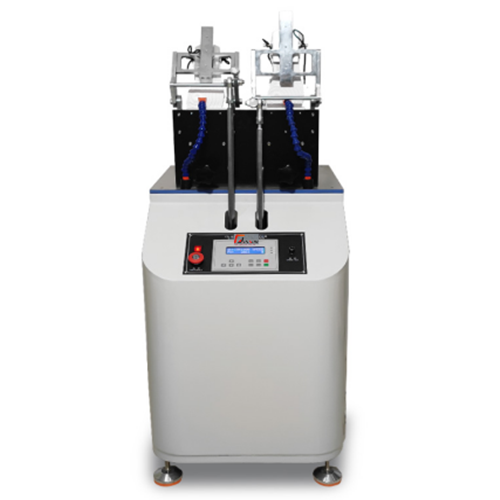
Working Principle Based on Repeated Mechanical Flexing Simulation of Human Walking Motion
The G651 Shoes Bending Tester operates on the principle of mechanical replication of human walking movements by applying repeated bending cycles to footwear samples. The shoe or shoe sole is fixed onto a set of clamping fixtures, typically positioned at the forefoot area, where natural bending occurs. Once secured, the machine drives the sample through a continuous flexing motion at a predefined angle and speed.
The bending mechanism is powered by a motor system that ensures consistent cyclic movement. Each cycle simulates one step of walking, and thousands or even hundreds of thousands of cycles can be performed to represent long-term usage. The bending angle, frequency, and speed can be adjusted depending on test requirements and material specifications.
During testing, the machine continuously monitors the structural response of the shoe, observing whether cracks, delamination, sole separation, or material fatigue occurs. Some advanced models allow real-time inspection or automatic detection of failure points, helping engineers evaluate durability performance more precisely.
The tester can also simulate different environmental conditions, such as temperature variation or humidity exposure, which influence material flexibility and aging behavior. This combination of mechanical stress and environmental simulation provides a realistic prediction of footwear performance in real-world conditions.
Structural Design and Core Mechanical Components Ensuring Accurate and Stable Operation
The structure of the G651 Shoes Bending Tester is designed for durability, stability, and precise motion control. The main frame is typically constructed from high-strength steel to withstand continuous repetitive motion without deformation. The machine includes a motor drive system, clamping fixtures, bending arms, control unit, and safety protection components.
The clamping system is one of the most important parts of the tester. It is designed to securely hold different types of shoes, including sports shoes, leather shoes, safety shoes, and casual footwear. The fixtures ensure that the shoe remains fixed in position while allowing natural bending at the designated flex point.
The bending mechanism is driven by a servo motor or mechanical crank system, which converts rotational motion into repeated linear or angular flexing. This ensures consistent bending cycles with high repeatability. The angle adjustment system allows users to set different bending ranges to simulate various walking intensities.
The control system is equipped with a digital interface that allows operators to set test parameters such as cycle count, bending angle, speed, and test duration. Modern versions often include programmable controllers and touchscreen displays for easier operation and monitoring.
Some advanced configurations include automatic shutdown systems that stop the test when material failure is detected or when the preset cycle count is reached. This improves testing efficiency and ensures safety during long-duration operation.
Application in Footwear Industry Quality Control and Product Development Processes
The G651 Shoes Bending Tester plays a crucial role in footwear manufacturing, where product durability and comfort are key quality indicators. It is widely used in sports shoe production, leather footwear manufacturing, safety shoe development, and outdoor boot testing.
In sports footwear, the tester evaluates how soles and uppers perform under high-frequency bending conditions, such as running, jumping, and training activities. It helps manufacturers improve flexibility, shock absorption, and material resilience.
For leather shoes, the tester is used to assess cracking resistance and surface durability. Leather materials must maintain structural integrity and appearance even after repeated bending cycles, making this test essential for quality assurance.
In safety footwear, durability is critical because shoes are exposed to heavy-duty working environments. The G651 tester ensures that protective boots can withstand continuous movement without structural failure, supporting workplace safety standards.
Manufacturers also use this equipment during product development to optimize material selection, sole design, stitching methods, and adhesive performance. By identifying weaknesses early in the design stage, companies can reduce production risks and improve overall product reliability.
Testing Parameters, Failure Analysis, and Simulation of Real Walking Conditions
The G651 Shoes Bending Tester allows precise adjustment of multiple testing parameters, including bending angle, cycle frequency, load conditions, and test duration. These parameters are designed to simulate different walking speeds, body weights, and usage environments.
Failure analysis is a key part of the testing process. Common failure modes include sole cracking, upper material tearing, adhesive separation, and deformation of structural components. By analyzing these failure points, engineers can identify material weaknesses and improve shoe design.
The system can simulate different user scenarios, such as light walking, heavy usage, or long-distance travel. Some advanced models also include heating or humidity chambers to replicate environmental effects such as hot climates, cold weather, or wet conditions.
Wear progression is observed throughout the test cycle, allowing researchers to study how materials degrade over time. This helps in predicting product lifespan and improving long-term durability.
Importance in Enhancing Footwear Quality, Comfort, and Consumer Satisfaction
The importance of the G651 Shoes Bending Tester lies in its ability to ensure footwear durability and user comfort. Shoes are one of the most frequently used consumer products, and their performance directly affects walking comfort, safety, and customer satisfaction. By simulating long-term bending stress, the tester helps manufacturers identify potential defects before products reach the market. This reduces return rates, improves brand reputation, and ensures compliance with international footwear quality standards.
The test results also help improve material engineering, such as developing more flexible rubber compounds, stronger adhesives, and reinforced stitching techniques. These improvements lead to longer-lasting shoes with better performance under daily use conditions. In addition, the tester contributes to innovation in footwear design by providing data on how different structures respond to mechanical stress. This supports the development of lightweight, flexible, and high-performance shoes for sports and industrial applications.
Future Development Trends Toward Intelligent Testing, Automation, and Advanced Material Simulation Technologies
The future development of the G651 Shoes Bending Tester is moving toward automation, digital intelligence, and more realistic simulation capabilities. Modern systems are increasingly equipped with AI-based data analysis tools that can predict material failure patterns and estimate product lifespan based on early test results. Automation is also improving testing efficiency by enabling continuous multi-sample testing with minimal human intervention. Robotic loading systems and smart control interfaces allow laboratories to increase throughput and reduce operational costs.
Another trend is the integration of multi-environment simulation, combining bending tests with temperature, humidity, and water exposure to create more realistic real-world conditions. This helps manufacturers better understand how shoes perform under complex environments. Digital data management systems are also being introduced, allowing real-time monitoring, cloud storage, and advanced statistical analysis of test results. These technologies enhance accuracy, traceability, and decision-making in product development.
Overall, the G651 Shoes Bending Tester is an essential instrument in the footwear industry, providing reliable evaluation of bending durability and structural performance. Its ability to simulate real walking conditions in a controlled laboratory environment makes it a key tool for ensuring product quality, improving design, and enhancing consumer satisfaction.