

What is Cantilever Fabric Stiffness Tester?
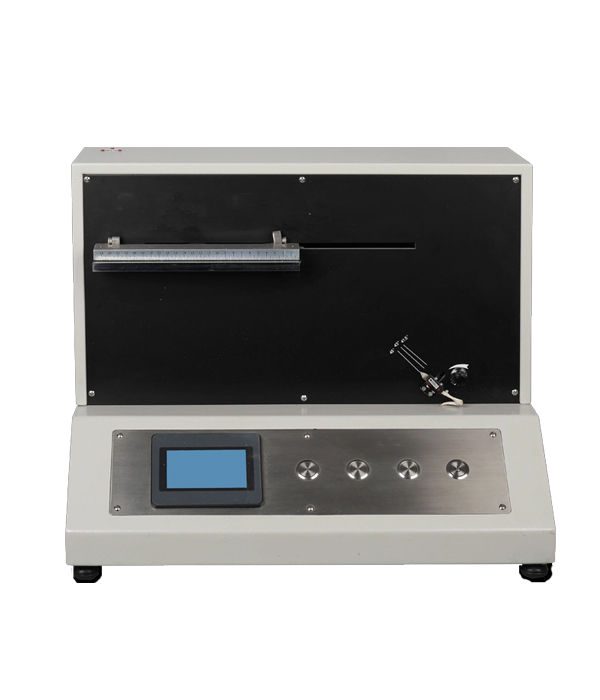
A Cantilever Fabric Stiffness Tester is a laboratory instrument designed to evaluate the bending stiffness and flexibility of textile materials. It measures the resistance of a fabric to bending under its own weight by using the cantilever principle, providing a quantitative indication of fabric handle and rape performance. Fabric stiffness is an important physical property because it directly affects the appearance, comfort, usability, and processing characteristics of textiles used in garments, home furnishings, industrial products, and technical fabrics.
Working Principle Based on the Cantilever Bending Method for Reliable Measurement
The operating principle of a Cantilever Fabric Stiffness Tester is based on the cantilever bending method, where a rectangular fabric specimen is gradually advanced over the edge of a horizontal platform until the free end bends downward under its own weight and reaches a specified angle. At this point, the overhanging length is recorded and used to calculate bending length and flexural rigidity.
During testing, the specimen is placed flat on the test platform and moved forward at a controlled speed. As the unsupported section extends beyond the edge, gravity causes the fabric to bend naturally. Once the leading edge reaches the predetermined bending angle defined by the testing standard, the overhang distance is measured. The longer the overhang required to achieve the specified angle, the stiffer the fabric. The obtained bending length can then be converted into flexural rigidity values to compare materials objectively.
This method is widely accepted because it closely simulates how fabrics behave in practical use conditions and provides repeatable and comparable results.
Main Structural Components and Functional Design of the Testing Equipment
A typical Cantilever Fabric Stiffness Tester consists of several essential components designed to ensure accurate and repeatable measurements. The test platform provides a smooth horizontal surface for specimen placement and controlled movement. A specimen advancing mechanism allows gradual and stable movement of the fabric sample during testing. An angle indicator or optical observation system determines when the specimen reaches the required bending position.
Modern versions may incorporate digital displays, automatic sample feeding systems, electronic sensors, and integrated calculation software to improve operational efficiency and reduce human error. Some advanced models also include touchscreen interfaces, automatic data storage, and export functions for laboratory management systems.
The overall design emphasizes measurement precision, ease of operation, and compliance with international testing standards while maintaining long-term stability under frequent laboratory use.
Key Parameters and Measurement Results Obtained During Fabric Stiffness Evaluation
The Cantilever Fabric Stiffness Tester primarily generates values that describe the mechanical behavior of textile materials during bending. The most common parameter is bending length, which represents the length of fabric extending beyond the platform edge before reaching the required bending angle.
Another important result is flexural rigidity, which combines bending length with fabric mass per unit area to express overall resistance to bending. Higher flexural rigidity values indicate a stiffer fabric structure, while lower values reflect softer and more flexible characteristics.
Some testing procedures also evaluate stiffness in both warp and weft directions because fabric structure and yarn orientation may influence bending performance differently. Comparing directional stiffness provides additional insight into fabric balance and end-use suitability.
These quantitative results help manufacturers optimize fabric design, maintain product specifications, and support technical decision-making during development.
Common Testing Standards and Industry Requirements for Fabric Stiffness Measurement
To ensure consistency and comparability of results across laboratories and manufacturers, Cantilever Fabric Stiffness Testing is commonly performed according to internationally recognized standards. Different standards specify requirements for specimen dimensions, testing conditions, bending angle, calculation methods, and environmental preparation.
Testing conditions such as temperature and humidity are particularly important because textile properties can change depending on environmental exposure. Standardized conditioning procedures are typically applied before testing to minimize variation.
Compliance with recognized testing standards enables manufacturers to provide reliable product data, satisfy customer specifications, and support certification requirements for domestic and international markets.
Wide Range of Applications Across Textile and Material Industries
Cantilever Fabric Stiffness Testers are widely used throughout the textile supply chain and in various material evaluation fields. In apparel manufacturing, the instrument helps determine whether fabrics deliver the desired softness, structure, and draping characteristics for garments such as shirts, jackets, dresses, and uniforms.
In home textile production, stiffness testing supports quality evaluation of curtains, upholstery fabrics, bedding materials, and decorative textiles where appearance and handling properties are essential. Technical textile manufacturers use stiffness data to optimize industrial fabrics, filtration materials, protective clothing, and composite reinforcements.
Research institutions and textile laboratories also rely on stiffness testing to study the effects of fiber type, yarn construction, finishing processes, coatings, and washing treatments on fabric behavior.
Factors That Influence Fabric Stiffness and Testing Accuracy in Practical Use
Fabric stiffness can be affected by many variables, making proper testing procedures essential for obtaining dependable results. Fiber composition plays a major role, as natural fibers and synthetic fibers exhibit different bending characteristics. Yarn count, fabric density, weave structure, and knitting methods also contribute significantly to stiffness performance.
Finishing treatments such as resin finishing, coating, softening, calendaring, and washing processes may increase or reduce fabric rigidity. Environmental factors including humidity and temperature can further alter mechanical properties.
Accurate testing requires consistent specimen preparation, proper conditioning, correct alignment, and regular equipment calibration. Attention to these details helps reduce variability and ensures meaningful comparisons between samples.
Advantages of Using a Cantilever Fabric Stiffness Tester in Quality Control Laboratories
The Cantilever Fabric Stiffness Tester offers several advantages that make it a preferred solution in textile testing environments. The method is straightforward, easy to operate, and capable of delivering repeatable results with relatively simple sample preparation.
Because the instrument evaluates fabric behavior under gravity-induced bending, it provides realistic information about actual fabric performance. The standardized testing approach also allows manufacturers and buyers to communicate quality requirements using objective data rather than subjective hand-feel assessments.
Additionally, modern automated models improve testing efficiency, reduce operator influence, and support digital quality management systems, making them suitable for both routine inspection and advanced product development.