

What is the Pneumatic Bursting Strength Tester?
The Pneumatic Bursting Strength Tester is a testing instrument used to determine the resistance of materials to rupture under perpendicular (vertical) pressure. It is widely applied in industries such as packaging, paper and pulp, textiles, and leather.This article provides a systematic overview of the equipment, focusing on key aspects such as its detailed operating procedures and typical application scenarios. The aim is to offer comprehensive technical reference and practical guidance for industry professionals, quality inspection personnel, and product development engineers, helping them gain a deeper understanding of this essential testing device and apply it effectively in practice.
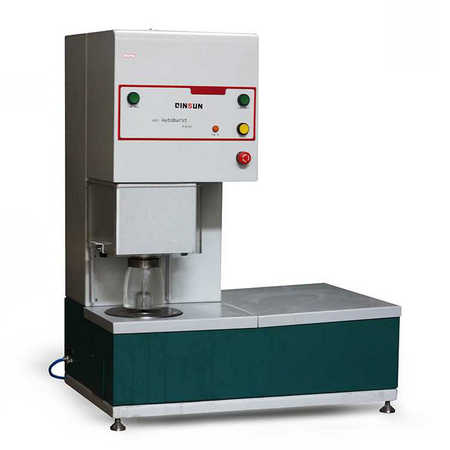
Functions and Applications of the Pneumatic Bursting Strength Tester
The Pneumatic Bursting Strength Tester is a specialized instrument used to determine the resistance of materials to rupture under uniformly applied pressure. It is widely utilized in industries such as packaging, paper, and textiles.
Main Functions
Bursting Strength Measurement
A rubber diaphragm driven by pneumatic pressure applies uniform force to the clamped specimen until rupture occurs. The maximum pressure at the point of failure is recorded as the bursting strength.
Multiple Unit Display and Conversion
Supports one-touch switching between units such as kPa, psi (lbf/in²), and kgf/cm².
Automatic Testing and Data Processing
Fully automatic models can perform clamping, pressurization, pressure release, and reset operations automatically after rupture. They can also calculate statistical parameters such as average value and standard deviation.
Real-Time Curve Display
Some advanced models provide real-time display of pressure–deformation curves during testing.
Safety Protection Mechanisms
Equipped with features such as full-scale alarms, specimen absence alerts, emergency stop buttons, and overload protection to ensure safe operation.
High-Precision Measurement
Utilizes high-precision pressure sensors and A/D converters, achieving resolutions as fine as 0.01 kPa and accuracy up to ±0.5% or better.
Data Output and Connectivity
Built-in thermal printer and support for data export via USB or network interfaces for further analysis and record-keeping.
Main Applications
Packaging Material Testing
Primarily used for measuring the bursting strength of corrugated board, cartons, and paper materials.
Non-Paper Material Testing
Also applicable to materials such as leather, fabrics, silk, cotton textiles, plastic films, and industrial fabrics.
Quality Control and R&D
Widely used in paper mills, packaging companies, quality inspection agencies, research institutes, and university laboratories to ensure compliance with international and national standards such as ISO, GB/T, ASTM, and TAPPI.
Production Line Inspection
Some models support high-throughput automatic sampling, making them suitable for continuous production monitoring and batch inspection.
Applicable Industries of the Pneumatic Bursting Strength Tester
The Pneumatic Bursting Strength Tester is a testing device based on pneumatic principles, used to measure the bursting strength of materials by applying pressure until rupture occurs. It is widely applied across multiple industries, including the following:
Paper and Packaging Industry
Used to test the bursting strength of corrugated board, cartons, base paper, art paper, and laminated paper, ensuring the safety and reliability of packaging during transportation and handling.
Textile and Apparel Industry
Suitable for determining the bursting strength and elongation of materials such as cotton fabrics, silk, knitted fabrics, elastic textiles, gloves, and socks.
Third-Party Testing and Research Institutions
An essential tool for market inspection, quality certification, and new material development. It supports data analysis, curve display, and report generation.
Food, Pharmaceutical, and Tobacco Industries
Applied to evaluate the mechanical properties of packaging materials (such as aluminum foil, composite films, and paperboard), ensuring product safety during storage and transportation.
Plastics, Rubber, and Film Industries
Used for testing the pressure resistance and bursting characteristics of plastic films, rubber sheets, industrial fabrics, and filter materials.
Technical Features of the Pneumatic Bursting Strength Tester
The Pneumatic Bursting Strength Tester is based on pneumatic driving principles and is used to determine the bursting strength of materials such as paper, paperboard, textiles, leather, and films. Its key advantage lies in replacing traditional hydraulic systems with pneumatic operation, resulting in simplified structure, reduced maintenance, and in some models, no need for electrical power.
Core Technical Features
Working Principle
Based on Pascal’s Law or pneumatic expansion, a rubber diaphragm applies uniform pressure to a clamped specimen until rupture occurs. The maximum pressure recorded at failure is defined as the bursting strength.
Driving Method
Pneumatic Drive: Some models rely entirely on compressed air and do not require electricity;
Hybrid Drive: Most commercial systems use AC 220V power, while clamping and pressurization are executed via pneumatic actuators.
Measurement Range
Paper: 50–2000 kPa;
Paperboard/Corrugated board: 250–5600 kPa (high-end models up to 10.000 kPa);
Pneumatic-specific models (e.g., patented designs): 0–400 kPa, suitable for low-pressure materials.
Accuracy and Resolution
Accuracy: ±0.5% or ±1% of full scale;
Resolution: up to 0.01 kPa or 0.1 kgf/cm².
Clamping System
Standard clamp ring inner diameter: Φ31.5 ± 0.05 mm (made of SUS#304 stainless steel);
Adjustable clamping force: 0–1200 kPa, with pneumatic clamping and anti-slip design to ensure secure specimen holding.
Pressurization Rate
Conventional (hydraulic type): 170 ± 10 mL/min;
Pneumatic type: pressure rate controlled by air pressure adjustment, with some models supporting programmable rates (e.g., 5–100 kPa/s).
Operation and Display
Equipped with touchscreen or LCD interface, supporting bilingual (Chinese/English) operation;
Features include peak value hold, automatic data storage (up to 20 sets), and built-in thermal printing;
One-touch unit conversion (kPa, psi, kgf/cm²).
Safety and Structural Design
Includes emergency stop button and overload protection;
Hydraulic models feature dual-sealed oil circuits, while pneumatic models typically use oil-free cylinders to reduce contamination.
Operating Procedure of the Pneumatic Bursting Strength Tester
Basic Operating Steps
1. Specimen Preparation
Cut flat specimens with a minimum size of 100 mm × 100 mm, ensuring no wrinkles or damage.
Condition the samples according to relevant standards (e.g., GB/T 10739-89) under controlled temperature and humidity, typically 23±1°C and 50±2% RH.
2. Power On and Preheating
Connect the power supply and press the green start button.
Confirm that the motor rotation direction matches the arrow indicated on the panel. If abnormal “clicking” noise occurs, immediately stop the machine and correct the motor phase sequence.
Some models require a 5–10 minute preheating period to stabilize the system.
3. Installation and Calibration
Select the appropriate diaphragm and clamping ring based on specimen type (paper, paperboard, textiles, etc.), with common sizes such as 30.5 mm and 35.7 mm.
Calibrate the system using standard aluminum foil or reference materials with known bursting strength to ensure measurement error within ±0.5%.
4. Specimen Clamping
Place the specimen between the upper and lower clamping rings, ensuring it is centered and free of slack.
Activate the pneumatic clamping system. Typical clamping force requirements:
Paper: ≥430 kPa
Paperboard: ≥690 kPa
5. Test Parameter Settings
Set parameters according to relevant standards (ISO, ASTM, GB/T), including:
Pressurization rate (e.g., oil flow rate of 170–175 mL/min or equivalent pneumatic control)
Test mode (automatic burst, constant speed, constant pressure, constant elongation, etc.)
Select measurement units via touchscreen or control panel (kPa, kgf/cm², psi, etc.).
6. Start Testing
Press the “Start” or “Automatic Burst” button. The instrument will automatically apply pressure until the specimen ruptures.
The system records the maximum bursting pressure and stores the data automatically.
7. Data Reading and Output
Results are displayed on the LCD or touchscreen interface.
Data can be printed or exported via USB/RS232 interface.
Most models support automatic calculation of statistical values such as average and standard deviation.
8. Reset and Shutdown
After testing, the system automatically resets (oil return or pressure release).
Clean the clamping rings and diaphragm, then turn off the power supply.
Important Notes
Safety Warning: Do not place hands near the clamping area during operation. The protective cover must remain closed at all times.
Maintenance: Regularly check the hydraulic fluid (e.g., glycerin or silicone oil) level and ensure system sealing integrity (pressure drop should be <10% FS within 1 minute).
Air Supply Requirement: For pneumatic models, an external compressed air source is required, typically at 0.4–0.7 MPa.
Importance of the Pneumatic Bursting Strength Tester
The Pneumatic Bursting Strength Tester serves as a critical standardized testing instrument, playing an indispensable role in ensuring packaging quality, improving product safety, optimizing manufacturing processes, and meeting regulatory compliance requirements.
1. Ensuring Packaging Quality and Product Safety
This instrument is primarily used to measure the bursting strength of packaging materials such as corrugated cardboard and cartons—defined as the material’s ability to resist internal pressure until rupture. This key parameter directly reflects the reliability of packaging under real-world conditions such as transportation, storage, and handling.
By accurately determining the maximum pressure at failure, it provides a scientific evaluation of a package’s resistance to vertical load, ensuring effective protection of internal goods and preventing damage caused by packaging failure.
2. Supporting Process Optimization and Product Improvement
The quantitative data generated by the tester is a crucial basis for quality control and process optimization in production. Modern models typically feature fully automated testing, automatic calculation, and data storage functions, enabling statistical analysis of multiple test results.
This allows manufacturers to monitor material consistency, analyze the influence of raw materials and process parameters on bursting strength, and accordingly optimize production workflows to enhance product quality and competitiveness.
3. Meeting International and National Standard Requirements
The design and testing principles of the Pneumatic Bursting Strength Tester comply with standards such as ISO 2759. GB/T 1539. and ASTM D3786. The results are widely recognized and serve as essential compliance evidence for industries such as paper, packaging, and printing during quality certification, market access, and third-party inspections.
Standardized testing conditions—such as fixed clamping ring dimensions and controlled pressurization rates—ensure the accuracy, repeatability, and authority of test results.
4. Advantages in Specific Application Scenarios
The pneumatic principle offers unique operational benefits. By using compressed air to drive a rubber diaphragm, the system applies uniform pressure without requiring continuous electrical power in some models, making it suitable for environments with limited power supply or where electrical interference must be avoided.
In addition, the pneumatic clamping system provides stable and adjustable holding force, ensuring secure specimen fixation during testing.
5. Improving Testing Efficiency and Data Reliability
Modern pneumatic bursting strength testers integrate a high degree of automation and intelligence, including automatic specimen detection, automatic pressurization, pressure release, and system reset after rupture. These features significantly improve testing efficiency.
At the same time, high-precision pressure sensors, digital A/D conversion technology, and microcomputer control systems ensure data accuracy and reliability. User-friendly interfaces such as touchscreens or LCD displays, one-touch unit conversion, real-time pressure–deformation curves, and built-in printing functions further enhance operational convenience and data completeness.
We sincerely welcome your inquiries regarding technical specifications, testing standards, operating procedures, or any related questions. Please feel free to leave a message or contact us directly. We will provide detailed product documentation, demonstration videos, or customized solutions to help you fully understand the system’s capabilities and advantages.