

What is a Bursting Strength Tester?
The Bursting Strength Tester is a precision testing instrument used to determine the bursting strength of materials. Its core function is to evaluate the maximum resistance of a material when subjected to uniform and continuous pressure applied perpendicularly until rupture occurs. It is widely used in key industries such as packaging materials, papermaking, textiles, and printing, and serves as an indispensable tool in quality control and product development processes.This article will systematically explain the working principle, operational procedures, application examples, and maintenance guidelines of the equipment, providing a comprehensive and in-depth reference to help industry practitioners better understand and effectively utilize this instrument.
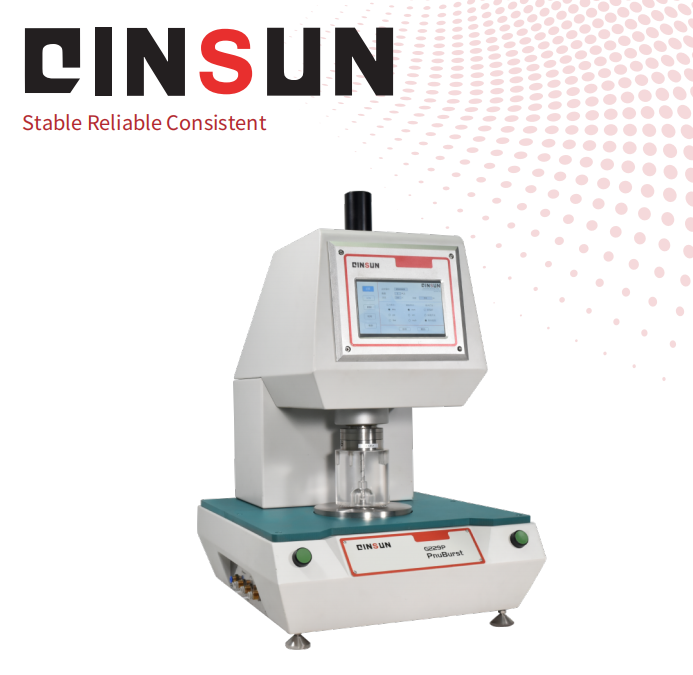
Bursting Strength Tester – Functions and Applications
Core Functions
1. Measurement of bursting strength:
The instrument uses a hydraulic or pneumatic system to drive an elastic diaphragm upward against the test specimen until rupture occurs. The maximum pressure at the point of failure is recorded as the bursting strength of the material.
2. Fully automatic / semi-automatic operation:
Supports one-key operation, automatically completing clamping, pressurization, pressure release, reset, and data storage processes, improving testing efficiency and repeatability.
3. Multi-unit display and switching:
Measurement results can be displayed in multiple units, including kPa, psi (pounds per square inch), and kgf/cm², allowing compatibility with different standards and user requirements.
4. Real-time curve display:
Some advanced models can display real-time pressure–deformation curves, providing visual analysis of material failure behavior during testing.
5. Data processing and output:
The system automatically calculates statistical results such as average value, standard deviation, maximum, and minimum values. Test reports can be printed via a built-in thermal printer.
6. Intelligent safety protection:
Equipped with emergency stop buttons, overload protection, full-scale alarm systems, and dual-seal hydraulic circuits to ensure safe and stable operation.
Main Applications
1. Packaging material testing:
Used for testing bursting strength of corrugated cardboard, cartons, paper sheets, whiteboard paper, linerboard, and similar packaging materials.
2. Non-paper material testing:
Applicable to materials such as silk, cotton fabric, synthetic leather, genuine leather, plastic films, and fiber-based textiles.
3. Quality control:
Widely used in paper mills, packaging and printing enterprises, quality inspection agencies, and third-party laboratories for product inspection and quality monitoring.
4. Research and education:
Used in universities and research institutes for studying the mechanical properties of materials.
5. Compliance with international standards:
Testing procedures comply with various national and international standards, including ISO, GB/T, ASTM, and JIS, ensuring global applicability and consistency.
Applicable Industries of Bursting Strength Tester
The Bursting Strength Tester is a specialized instrument used to determine the bursting resistance of materials. It is widely applied across multiple industries where material strength, durability, and packaging safety are critical.
Packaging Industry
Used to test the bursting strength of corrugated cardboard, cartons, paper bags, and composite paperboard materials. It ensures that packaging can withstand pressure during transportation, stacking, and storage, thereby preventing product damage.
Paper and Pulp Industry
Applied for quality control and factory inspection of raw paper, printing paper, and paperboard. Testing is typically conducted in accordance with standards such as GB/T and ISO to ensure consistent product performance and compliance.
Textile and Nonwoven Materials Industry
Used to evaluate the bursting strength of materials such as silk, cotton fabrics, leather, synthetic leather, and nonwoven fabrics (e.g., wet wipes, cleaning cloths). It helps assess durability and mechanical resistance under stress conditions.
Third-Party Testing and Quality Inspection Institutions
Widely used in certification laboratories, inspection agencies, and quality control organizations for market sampling, product certification, and issuance of authoritative test reports.
Scientific Research and Education
Used in universities and research institutes for material mechanics studies, new material development, and laboratory teaching demonstrations.
Food, Pharmaceutical, and Tobacco Industries
Applied to evaluate the bursting resistance of packaging materials used for food, pharmaceutical products, and tobacco, ensuring product safety during storage and distribution.
Electronics, Building Materials, and Furniture Industries
Used to test the bursting strength of heavy-duty packaging or special materials such as plastic sheets, hollow boards, and other structural materials used in protective packaging and construction applications.
The Bursting Strength Tester plays a vital role in ensuring material durability and packaging safety across a wide range of industries. Its application supports quality assurance, regulatory compliance, and product reliability in both industrial production and scientific research.
Testing Principle of Bursting Strength Tester
The testing principle of the Bursting Strength Tester is based on Pascal’s Law. It uses a hydraulic or pneumatic system to apply uniform pressure to a clamped specimen until rupture occurs, and the maximum pressure at the moment of failure is recorded as the bursting strength.
Core Testing Principle
Working principle:
The specimen (such as cardboard, paper, silk, or cotton fabric) is tightly clamped between upper and lower clamping rings. Beneath the specimen is an elastic rubber diaphragm. The system is filled with a pressure-transmitting medium such as methyl silicone oil or glycerin.
A motor-driven piston applies pressure at a constant rate, causing the diaphragm to bulge upward and exert uniform pressure on the specimen. When the applied pressure exceeds the material’s strength limit, the specimen ruptures.
Measurement Principle
The instrument records the maximum pressure value at the moment the specimen bursts. This value is defined as the bursting strength of the material.
Unit Conversion
The measured results can be displayed in multiple units, including kPa, kgf/cm², and psi, allowing compatibility with different international testing standards and user requirements.
Calibration Method
Calibration is typically performed using aluminum foil or standard calibration membranes to ensure measurement accuracy and system stability.
Operating Procedure of Bursting Strength Tester
Power-On and Warm-Up
Connect the device to an AC 220V ±10% power supply and press the green start button. Observe whether the motor rotation direction matches the arrow indicated on the control panel. If abnormal sounds such as “clicking” occur, immediately stop the machine and correct the phase sequence.
Specimen Preparation
Cut at least 100 mm × 100 mm flat specimens. A typical test requires 10 samples, with 5 tests performed on each side (front and back).
The specimens must be preconditioned under standard temperature and humidity conditions, such as (23 ± 1)°C and (50% ± 2%) relative humidity, in accordance with GB/T 10739. for at least 4 hours.
Specimen Clamping
Place the specimen between the upper and lower clamping rings, ensuring it is free of wrinkles and misalignment.
Clamping force requirements:
Paper: > 430 kPa
Paperboard / Corrugated board: > 690 kPa
Automatic models can complete clamping with one-button operation, while manual or semi-automatic models require a handle or button to apply clamping force.
Parameter Setting and Calibration Confirmation
Select the measurement unit via touchscreen or control buttons (kPa, psi, or kgf/cm²).
Confirm that recent calibration has been completed using aluminum foil calibration sheets or a standard pressure calibration device, with accuracy typically required to be ≥ 0.1%.
Start Test
Press the “Start” button. The instrument begins automatic pressurization, with the hydraulic system delivering oil at a rate of 170 ± 10 mL/min.
The rubber diaphragm expands upward to rupture the specimen. The system automatically records the maximum pressure at the moment of rupture, which is defined as the bursting strength.
Data Reading and Reset
After testing, the system automatically releases pressure and resets. The display shows the bursting strength value along with statistical results such as average value and standard deviation.
Test reports can be printed via the built-in thermal printer or exported to a computer.
Repeat Testing
Replace with a new specimen and repeat steps 3–6 until all samples are tested.
This operating procedure ensures accurate, repeatable, and standardized measurement of bursting strength, making the instrument suitable for quality control and compliance testing in paper, packaging, and textile industries.
Maintenance Recommendations for Bursting Strength Tester
To ensure accurate test results and long-term stable operation of the Bursting Strength Tester, a scientific and structured maintenance plan is essential.
Daily Operation and Basic Maintenance
Environmental and power requirements
The instrument should be placed on a stable, vibration-free workbench, away from dust, corrosive gases, and strong electromagnetic interference sources. The operating environment must meet the temperature and humidity requirements specified by the manufacturer or calibration standards.
A stable AC 220V power supply should be used to avoid voltage fluctuations that may affect system performance.
Startup preheating and cleaning
After daily startup, allow the system to preheat briefly to stabilize electronic components. Before and after testing, clean the instrument surface and clamping area using a soft cloth to prevent accumulation of debris or dust that may affect clamping accuracy or sensor performance.
Specimen handling and operational discipline
Prepare flat specimens of sufficient size (typically not less than 100 mm × 100 mm). Ensure specimens are free of wrinkles or deformation during placement.
Strictly follow standard operating procedures to avoid incorrect operations (such as starting the machine without a specimen), which may cause mechanical or sensor impact damage.
Pressure transmission medium management
Regularly inspect the hydraulic pressure transmission medium (typically methyl silicone oil or glycerin). Ensure the medium is clean and free of impurities, and replace it according to the manufacturer’s recommended schedule.
Special attention should be paid to glycerin concentration. Studies indicate that excessively high concentration (e.g., above ~90%) significantly increases viscosity, which may lead to delayed pressure transmission and non-uniform testing results. Air trapped in the hydraulic chamber should also be avoided, as it can reduce pressure stability and affect testing accuracy.
Diaphragm inspection and replacement
The elastic rubber diaphragm is a critical component responsible for applying pressure to the specimen. Its condition directly affects test accuracy.
Regularly inspect the diaphragm for wear, aging, cracks, or deformation. Replace it according to usage frequency and manufacturer recommendations to ensure consistent deformation height and pressure performance.
Fault Prevention and Maintenance Records
Maintenance log system
Maintain a detailed maintenance log recording daily inspections, calibration activities, component replacements (such as diaphragms and hydraulic oil), and any abnormal conditions. This helps track equipment status and predict potential failures.
Monitoring common issues
Pay attention to factors that may cause test variability, such as:
Changes in clamping pressure
Surface condition of clamping rings
Variations in test pressure rate
If unstable or inconsistent results occur, priority should be given to checking hydraulic medium condition, diaphragm integrity, and clamping system performance.
Professional servicing
For complex faults or annual deep maintenance, it is recommended to contact the manufacturer or authorized service provider for professional inspection, calibration, and repair using specialized tools and expertise.
Proper daily maintenance, periodic inspection, and structured record keeping are essential to ensure the reliability, accuracy, and service life of the Bursting Strength Tester, making it consistently dependable for quality control and laboratory testing applications.
Importance of Bursting Strength Tester
The importance of the Bursting Strength Tester is mainly reflected in its critical role in material quality control, product development, and industry compliance. Its core value can be summarized as follows:
Ensuring Safety and Reliability of Packaging and Materials
The instrument is used to determine the bursting strength of materials such as paperboard, corrugated cardboard, textiles, and leather. This refers to the maximum pressure a material can withstand under uniform pressure before rupture.
In the packaging industry, the bursting strength of cartons and corrugated board is directly related to their ability to protect contents during transportation. Insufficient strength may lead to packaging failure and product damage.
In the textile industry, bursting strength simulates stress conditions at areas such as elbows and knees in garments, making it an important indicator for evaluating fabric durability and wear resistance.
Improving Product Quality Control Efficiency
Modern models feature fully automatic operation, automatic data storage, statistical analysis, and report printing functions, enabling rapid acquisition of large volumes of test data and supporting Statistical Process Control (SPC).
They also support one-touch switching between multiple units (kPa, psi, kgf/cm²), making them suitable for different regional standards and customer requirements.
Supporting Material Research and Process Optimization
By accurately measuring advanced parameters such as energy absorption during rupture and diaphragm-compensated bursting strength, the tester helps researchers understand material failure mechanisms and optimize formulations or structural designs.
It is widely used in industries such as papermaking, packaging, textiles, leather, plastics, as well as in research and educational applications.
Meeting Regulatory and Consumer Safety Requirements
Many countries and regions have mandatory standards for mechanical performance of packaging and consumer products. Using a compliant Bursting Strength Tester is essential for passing third-party certifications such as ISO and CE, and for meeting regulatory requirements in the market.
In summary, the Bursting Strength Tester is not only a key instrument for physical performance testing of materials but also an indispensable technical device in modern industrial production and supply chain management. In the context of global trade, bursting strength testing in accordance with ISO, ASTM, and other international standards serves as an essential requirement for market access.It enables enterprises to achieve compliant production, expand overseas markets, and integrate into global supply chains.We sincerely welcome industry professionals and partners to contact us for more detailed information regarding equipment specifications, application cases, technical solutions, and procurement services.