

FAQs About Fabric Textile Martindale Abrasion and Pilling Tester
The Martindale Abrasion and Pilling Tester for Fabrics is a professional testing instrument specifically designed to evaluate the abrasion resistance and pilling performance of textile materials under simulated real-world usage conditions.By replicating the mechanical actions that fabrics are subjected to during daily wear, washing, or friction, the device enables a scientific and accurate assessment of material durability and surface pilling resistance.This article provides a comprehensive introduction to the instrument from several key perspectives, including its working principle, main structural components, standard test methods, result analysis, and application fields. The aim is to help readers gain a deeper understanding of the equipment’s functions and operational key points.We hope this content will serve as a valuable reference for textile quality inspection and evaluation. Readers are also warmly welcome to leave comments or raise questions for consultation, and we will respond promptly and engage in further discussion.
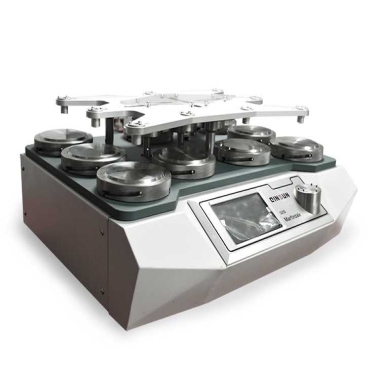
What is the purpose of the Fabric Textile Martindale Abrasion and Pilling Tester?
The Martindale Abrasion and Pilling Tester for textiles is primarily used to evaluate the abrasion resistance and pilling resistance of textile materials, leather, and related products under simulated real-use conditions.
Its main applications include:
Abrasion Resistance Testing
The instrument simulates the friction experienced by fabrics during actual wear or use. It measures the material’s resistance to wear under specified pressure and defined rubbing motion.
Evaluation is typically based on:
The number of abrasion cycles (Martindale cycles) required to cause fabric failure, or
The percentage of mass loss after testing
Pilling Resistance Testing
The tester is used to assess whether fuzzing or pilling occurs on the fabric surface after repeated friction.
The evaluation is carried out by comparing the tested specimen with standard reference images and grading it on a scale from 1 to 5. where:
Grade 5 indicates the best resistance to pilling
Grade 1 indicates severe pilling
What standards does the Fabric Textile Martindale Abrasion and Pilling Tester comply with?
The Martindale Abrasion and Pilling Tester is widely used for evaluating the abrasion resistance and pilling performance of textiles, leather, and synthetic leather. It complies with the following major international and national standards:
International and Foreign Standards
ISO 12947 – Textiles: Determination of the abrasion resistance of fabrics by the Martindale method
(Applicable to woven fabrics, knitted fabrics, nonwovens, etc.)
ASTM D4966 – Standard Test Method for Abrasion Resistance of Textile Fabrics (Martindale Abrasion Tester Method)
ASTM D4970 – Standard Test Method for Pilling Resistance of Fabrics (Martindale Tester Method)
BS 3424-24 – British Standard for abrasion and pilling testing of fabrics
JIS L1096 – Japanese Industrial Standard for testing abrasion resistance of woven and knitted fabrics
EN 530 – European Standard for abrasion resistance of protective clothing materials
Chinese National Standards (GB)
GB/T 21196 – Textiles: Determination of abrasion resistance by Martindale method (multiple parts, e.g., 2007. 2019 versions)
GB/T 4802.2 – Textiles: Determination of fabric pilling performance – Part 2: Martindale method
GB/T 13775 – Fabric abrasion resistance test (Martindale method)
Industry and Group Standards
FZ/T 20020 – Wool textile industry standard for abrasion resistance testing of wool fabrics
T/ZZB 0659-2018 – Zhejiang manufacturing group standard specifying technical requirements for Martindale abrasion and pilling testers
What is the working principle of the Fabric Textile Martindale Abrasion and Pilling Tester?
The working principle of the Martindale Abrasion and Pilling Tester is to simulate the multidirectional rubbing and flexing actions that textiles are subjected to during daily use. Through a standardized friction process, it evaluates the fabric’s abrasion resistance and pilling performance.
Friction Path
The specimen is rubbed against standard abradants such as wool felt or abrasive paper following a Lissajous figure motion pattern, enabling multidirectional and non-linear wear simulation.
Applied Pressure
The specimen is pressed against the abrasion surface under a constant pressure (typically around 12 kPa), ensuring controlled and repeatable test conditions.
Relative Motion
A circular specimen is fixed in a holder and comes into contact with a moving lower abrasive table. The table continuously drives the abradant to rub against the surface of the specimen.
Test End-Point Determination
The test can be evaluated based on different criteria:
Fabric failure:
The number of cycles at which yarn breakage or hole formation occurs is recorded.
Mass loss:
The difference in specimen mass before and after testing is measured using a high-precision balance.
Appearance change:
Pilling, fuzzing, or surface change is evaluated by comparison with standard reference images or grayscale scales such as ISO 105-A02.
How to operate the Fabric Textile Martindale Abrasion and Pilling Tester?
The operation of the Fabric Textile Martindale Abrasion and Pilling Tester follows standardized procedures in accordance with ISO 12947. GB/T 21196. and GB/T 4802.2. A typical operating process is as follows:
1. Preparation
Environmental conditioning:
Specimens should be conditioned in a standard atmosphere (20 ± 2°C, 65 ± 2% RH) for at least 16–24 hours.
Sampling:
Cut circular specimens (typically 38 mm or 140 mm in diameter, depending on the test purpose), with at least 3 samples required. Defective areas should be avoided. For fabrics with directional properties (warp/weft), samples should be taken in different directions.
Abrasion media preparation:
Standard abradants such as wool felt and silicon carbide sandpaper are mounted on the abrasion head.
2. Mounting and Setup
Specimen installation:
Place the specimen into the holder base, ensure it is flat and wrinkle-free, then secure it with a clamping ring.
Loading pressure:
Select the required pressure according to the standard (typically 9 kPa or 12 kPa) and apply the corresponding weights.
Parameter setting:
Friction motion: Lissajous figure pattern for multidirectional abrasion
Speed: approximately 47–48 rpm
End condition: preset cycle count (e.g., 5000 cycles), fabric breakage, or visible pilling/fuzzing
Start test:
Record the initial cycle count and start the automatic operation.
3. During Testing Inspection
Periodically stop the machine for inspection (typically every 500 cycles or according to the standard).
Observe the specimen condition and record changes.
4. Result Evaluation
Abrasion resistance:
Record the total number of cycles until fabric failure (e.g., “Martindale 20.000 cycles”).
Mass loss (optional):
Weigh the specimen before and after testing using a 0.001 g precision balance.
Mass loss rate is calculated as:
Mass loss (%) = (W₀ − W₁) / W₀ × 100%
where:
W₀ = initial mass
W₁ = final mass
Appearance rating:
Evaluated by 2–3 trained assessors under standard lighting conditions, with the average score recorded.
5. Important Notes
Abrasion media replacement:
Standard abradants should be replaced before each test. If total test cycles exceed 50.000. replacement is required.
Equipment configuration:
Modern instruments are typically available in 4/6/8-station configurations, with LCD or touchscreen control, independent counters, pause functions, and automatic stop capability.
How to maintain the Fabric Textile Martindale Abrasion and Pilling Tester?
Proper maintenance of the Fabric Textile Martindale Abrasion and Pilling Tester is essential to ensure testing accuracy and extend the service life of the equipment. Based on the instrument structure and operating requirements, the key maintenance points are as follows:
1. Cleaning
After each use, clean the abrasion table, abrasion heads, and specimen holders using a soft cloth to remove fibers, dust, or residual abrasive particles. This prevents buildup that may affect the friction path or pressure stability.
Special attention should be paid to the Lissajous motion mechanism to ensure no foreign particles interfere with the movement system or cause tracking deviation.
2. Inspection of Key Components
Regularly inspect abrasion heads, abrasion tables, and specimen clamps for wear. If visible deformation, surface indentation, or dimensional deviation occurs (e.g., Type A abrasion head diameter ≤ 28.8 mm), the components should be replaced promptly.
Check loading weights (e.g., 196 cN, 590 cN, 780 cN) for rust or deformation to ensure accurate force application.
3. Lubrication of Moving Parts
According to the manufacturer’s manual, apply appropriate lubrication oil (typically light machine oil) to guide rails, linkages, and motor shafts at regular intervals to prevent dry friction, which may reduce accuracy or cause mechanical jamming.
4. Calibration and Verification
It is recommended to perform system calibration every quarter or after every 5000 tests, including:
Friction speed: 47.5 ± 2.5 rpm
Stroke accuracy: 24 mm or 60.5 mm (tolerance ± 0.5 mm)
Load accuracy: verified using a calibrated force gauge
Functional verification can also be conducted using standard reference fabrics (e.g., reference samples provided in ISO 12947-1).
5. Environmental and Power Management
The instrument should be placed in a dry environment free from strong vibration and corrosive gases. Relative humidity should be kept at ≤70%.
A stabilized power supply is recommended to prevent voltage fluctuations from affecting the electronic control system.
Why is the Fabric Textile Martindale Abrasion and Pilling Tester so important?
The importance of the Martindale Abrasion and Pilling Tester lies in its ability to scientifically and objectively evaluate the durability and appearance retention of textiles under real-use conditions. It is a key instrument for ensuring product quality and compliance with international standards. Its core value can be summarized as follows:
Simulation of Real Wear Conditions
The instrument uses the Lissajous figure motion (multidirectional friction) under controlled pressure to simulate the wear experienced by fabrics during daily wearing, use, or contact. This makes the test results highly representative of real-world applications.
Dual Performance Evaluation
It not only measures abrasion resistance (e.g., number of cycles to fabric failure or mass loss), but also evaluates pilling performance through comparison with standard reference images. This provides a comprehensive assessment of fabric durability and appearance stability.
Compliance with International Standards
The tester is widely compliant with global standards such as ISO 12947. ASTM D4966. GB/T 21196. and EN 388. ensuring that test data is internationally recognized—critical for export trade and brand quality control.
Support for Full-Chain Quality Control
From fibers and yarns to weaving, garments, home textiles, and automotive interiors, the instrument is widely used for raw material screening, process optimization, and final product inspection, helping enhance overall product competitiveness.
Driving Technological Advancement in the Industry
With increasing consumer demand for durable textiles, the tester has become an essential tool in the development of high-performance fabrics such as antibacterial, waterproof, and anti-pilling materials.
In summary, the Martindale Abrasion and Pilling Tester is widely recognized as a “gold standard” in textile quality testing. It plays a critical role in evaluating fabric durability, surface pilling resistance, and overall quality, serving as a key link across R&D, mass production, and final market inspection.We sincerely welcome any inquiries regarding the instrument’s configurations, operating procedures, testing standards, technical parameters, or application scenarios. Every question will be carefully addressed by our technical team, providing detailed and professional support to help improve textile quality testing standards.