

What is a pendulum impact tester?
The Pendulum Impact Testing Machine is a precision mechanical testing device specifically designed to determine the impact resistance of various materials under dynamic loading conditions. By simulating instantaneous impact scenarios encountered in practical applications, the device can accurately evaluate key mechanical properties of materials, including toughness, strength, and fracture behavior under rapid loading.Its range of applications is extensive. It is widely used in the research and development of new materials, as well as in quality control of production processes. Moreover, it plays an indispensable role in structural safety assessment, component reliability testing, and product quality certification across multiple critical fields.This article will introduce the device from several aspects.
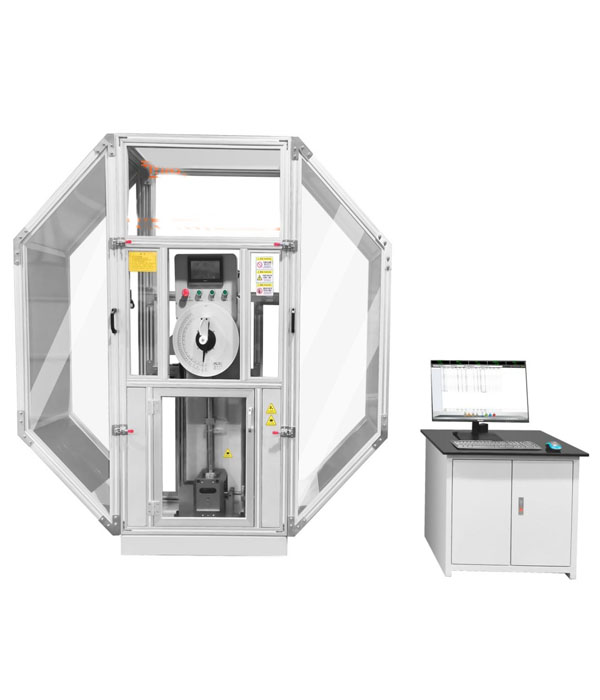
Applications of the Pendulum Impact Testing Machine
The Pendulum Impact Testing Machine is a specialized device used to determine the impact resistance of materials under dynamic loading conditions. It is widely applied in material research and development, quality control, and failure analysis. Its main applications include:
Measuring Material Impact Resistance:
By measuring the energy difference before and after the pendulum strikes the specimen, the absorbed impact energy (impact work) can be calculated to evaluate the material’s toughness or brittleness.
Compliance with Multiple Testing Standards:
The machine supports international and national standards, including ISO 179. ISO 180. ASTM D256. and GB/T 8809.
Applicable to a Wide Range of Materials:
Plastics, rubber, and composite materials
Metals and metal alloys
Films, paper, and metal foils
Wood, ceramics, fiberglass, and other non-metallic materials
Support for Different Test Methods:
Simply Supported Beam Impact (Charpy Method): The specimen is placed horizontally with supports at both ends.
Cantilever Beam Impact (Izod Method): One end of the specimen is fixed while the other end is free.
Environmental Simulation Testing:
Some machines are equipped with low-temperature chambers, enabling impact testing in the range of -80°C to room temperature.
Instrumented Data Acquisition:
High-precision sensors record force–time and displacement–time curves, from which detailed mechanical parameters such as maximum impact force and crack propagation energy can be derived.
Standards for Pendulum Impact Testing
The standards for Pendulum Impact Testers vary depending on the test object, material type, and application scenario. The main standards are as follows:
Core Standards by Material Type
Metal Materials:
GB/T 229—2020: “Metallic Materials — Charpy Pendulum Impact Test Method” (equivalent to ISO 148-1:2019)
ASTM E23: Standard Test Methods for Notched Bar Impact Testing of Metallic Materials
ISO 148-1: Metallic Materials — Charpy Pendulum Impact Test — Part 1: Test Method
Plastics and Non-Metallic Materials:
GB/T 1043—2008: Test Method for Impact Resistance of Rigid Plastics (Simply Supported Beam, corresponding to ISO 179)
GB/T 1843—2008: Determination of Izod Impact Strength of Plastics (corresponding to ISO 180)
ASTM D256: Standard Test Method for Determining the Izod Pendulum Impact Resistance of Plastics
Electrical and Electronic Products:
GB/T 2423.46—1997: Environmental Testing for Electrical and Electronic Products — Part 2: Test Methods, Test Ef: Impact (Pendulum)
Coatings / Paint Films:
GB/T 1732—2020: Determination of Impact Resistance of Paint Films (replaces GB/T 1732-93)
ASTM D2794: Standard Test Method for Resistance of Organic Coatings to the Effects of Rapid Deformation (Impact)
Standards by Test Method
Charpy Impact (Simply Supported Beam):
Specimens are supported at both ends, primarily used for metals. Relevant standards include GB/T 229. ASTM E23. and ISO 148.
Izod Impact (Cantilever Beam):
Specimens are fixed at one end, commonly used for plastics. Relevant standards include GB/T 1843. ASTM D256. and ISO 180.
Instrumented Impact Testing (High-Precision Energy–Time Recording):
GB/T 19748—2019: Metallic Materials — Charpy V-Notch Pendulum Impact Test — Instrumented Test Method (equivalent to ISO 14556:2015)
ISO 14556:2023: Latest version released in 2023. applicable for high-precision dynamic response analysis
Equipment Calibration and Verification Standards
JJG 931—1998: Calibration Regulations for Pendulum Torque Measurement Instruments of Impact Testers, specifying calibration methods for key parameters such as pendulum torque and energy.
Equipment should be regularly verified using NIST-traceable standard specimens to ensure the accuracy of energy readings.
Industries Applicable for the Pendulum Impact Tester
The Pendulum Impact Tester is a specialized device for determining the impact resistance of materials under dynamic loading conditions. It is widely applied across multiple industries:
Plastics and Rubber Industry:
Used to test the impact toughness of plastics, rubber, composites, and films, in accordance with standards such as GB/T 1843. ISO 180. and ASTM D256.
Metals and Metallurgy:
Evaluates the impact toughness of metals, such as steel and aluminum alloys, often applied to quality control of welds and structural components, following standards like GB/T 229 and ISO 148.
Automotive Manufacturing:
Verifies the impact resistance of automotive components, including bumpers and interior parts, ensuring vehicle safety.
Aerospace:
Tests the impact resistance of critical components such as lightweight composites and metal foils under extreme conditions.
Packaging Materials Industry:
Used for pendulum or drop impact testing of packaging materials like plastic films, aluminum foils, and composite films, compliant with ASTM D3420 and GB/T 8809.
New Energy Sector:
For example, testing the drop-impact resistance of lithium battery casings or evaluating the low-temperature toughness of aluminum frames for photovoltaic modules.
Construction and Building Materials:
Measures impact performance of materials such as concrete, fiberglass, and engineered stone.
Research and Quality Control Institutions:
Supports new material development, failure analysis, and standard compliance testing.
Additionally, by equipping the tester with an environmental chamber, low-temperature impact testing can be performed from −80°C to room temperature, enabling evaluation of material performance under extreme conditions.
How to Calculate Impact Energy in a Pendulum Impact Test
In a pendulum impact test, accurately calculating the impact energy requires measuring the angular displacement of the pendulum. Specifically, two key angles must be determined:
The post-impact angle of the hammer: The angle to which the pendulum rises after striking the specimen.
The reference angle without a specimen: The angle the pendulum would rise to if no specimen were present.
The difference between these two angles directly reflects the energy absorbed by the specimen.
Additionally, to ensure calculation accuracy, it is essential to account for and correct energy losses due to air resistance and friction in the pendulum bearings, as these factors can affect the final energy value.
How to Operate a Pendulum Impact Tester
Operating a Pendulum Impact Tester requires strict adherence to standard procedures to ensure accurate results and safe operation.
Basic Operating Procedure
Preparation:
Check that the equipment is level (use a spirit level to adjust the base).
Ensure the safety guard is closed and the electronic interlock system is functioning properly.
Select the appropriate pendulum energy range based on the specimen material (plastic, metal, composite, etc.), usually targeting 50–80% of the pendulum’s capacity for fracture energy.
Measure the specimen dimensions with a precision of ±0.02 mm and prepare notches (V-notch or U-notch) according to the relevant standard.
Specimen Installation:
Place the specimen in the support fixture:
Simply Supported Beam (Charpy): Specimen supported horizontally with both ends free.
Cantilever Beam (Izod): One end clamped, the other extending freely.
Ensure the specimen fits snugly and the position meets standard requirements (e.g., span of 40 mm or 70 mm).
Setup and Calibration:
Raise the pendulum to the pre-swing angle (typically 150° or 160°).
Perform a no-specimen trial to confirm the energy reading is zero or within the allowable error range (e.g., ≤0.1 J).
Performing the Impact Test:
Place the specimen and release the pendulum via touch screen, manual control box, or automated program.
The pendulum swings freely to strike the specimen; the device automatically records the absorbed energy (impact work).
Data Recording and Cleanup:
Read and record the impact energy (displayed directly on the digital screen or exported via a computer system).
Remove specimen remnants and switch off the equipment.
Safety Precautions
Never stand or reach into the pendulum swing range.
Always wear safety glasses and ensure the guard is closed before starting the device.
Operation must be performed by authorized personnel only.
Routine Maintenance
Regularly check pendulum bearing lubrication and pointer friction.
Calibrate periodically using NIST-traceable standard specimens.
When not in use, store the pendulum separately to prevent deformation of the pendulum arm.
Remove the pendulum before transporting the equipment to avoid damaging precision components.
Why the Pendulum Impact Tester is So Important
The Pendulum Impact Tester is a core instrument in materials science and engineering for evaluating the impact resistance of materials. It is widely applied in quality control, research and development verification, and safety assessment. Its significance can be summarized in the following aspects:
1. Quantifying Material Toughness and Brittleness
By measuring the energy absorbed during specimen fracture (the “impact work”), the tester provides a direct assessment of material toughness under high-speed loading. For example, the Charpy impact test for metals is a mandatory inspection for safety-critical components such as structural steel, pressure vessels, and pipelines.
2. Supporting Compliance with Multi-Industry Standards
The device conforms to major international standards, including:
ISO 179: Plastics — Charpy impact test (simply supported beam)
ISO 180: Plastics — Izod impact test (cantilever beam)
ASTM D256 / D3420: Plastics and films — impact testing
GB/T 8809. GB/T 3808: Chinese national standards
3. Broad Material Coverage
The tester is suitable not only for metals but also for plastics, rubber, composites, films, coatings, glass containers, and even emerging materials such as lithium battery casings.
4. Driving Material Development and Failure Analysis
In R&D, it is used to optimize alloy compositions, assess low-temperature toughness, and determine the ductile-to-brittle transition temperature (DBTT).
In failure analysis, force–time curves allow detailed study of crack propagation mechanisms and prediction of component service life.
5. Ensuring Industrial Safety and Reliability
The tester is extensively used in the automotive, aerospace, medical device, and energy sectors, ensuring components do not fail in a brittle manner under collisions, vibrations, or extreme temperatures.
6. Advanced Technology and High-Precision Data
Modern instrumented pendulum testers feature high-speed data acquisition (sampling rates up to 20 MHz), high-precision sensors, and automated systems, enabling separation and calculation of micro-mechanical parameters such as plastic deformation energy and crack initiation energy, greatly enhancing the information obtained from tests.
In summary, the Pendulum Impact Tester is far more than a basic material testing device. It plays an indispensable role in industrial production, quality control, and R&D innovation. It precisely evaluates material toughness and strength under impact loads, serving as a critical safeguard for product safety and reliability. Additionally, it drives advancements in materials science and engineering, helping researchers optimize material formulations and process design while meeting increasingly stringent quality standards and regulatory requirements.Thus, the pendulum impact tester is a key link connecting laboratory research, product safety, and industry standards. For further information on technical specifications, application cases, or the latest configurations, we invite you to visit our official website for comprehensive, professional insights.