

FAQs ABOUT Full-Body Garment Stress Tester
The Full-Body Garment Stress Tester is a precision testing device specifically designed to evaluate the overall performance of full-body protective clothing or suits under simulated real-world conditions.It subjects garments to mechanical, environmental, and chemical stresses to comprehensively assess their durability and protective effectiveness under stretching, friction, pressure, and exposure to extreme temperatures, humidity, or hazardous chemicals.According to publicly available industry data and research literature, the core value of this highly specialized testing equipment lies in its ability to systematically verify whether protective clothing can reliably and effectively provide critical safety barriers in real work scenarios.This is particularly important for high-risk or specialized work environments, such as firefighting, chemical handling, medical isolation, and nuclear industry operations, ensuring that external hazards are prevented from penetrating the protective garments and safeguarding the wearer’s life, health, and safety.
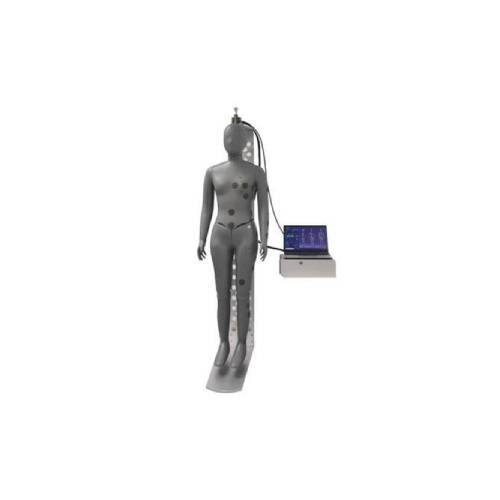
What is the purpose of a Full-Body Garment Stress Tester?
The Full-Body Garment Stress Tester is primarily used to evaluate the mechanical performance, comfort, and protective effectiveness of garments or protective suits under simulated real-world conditions. Its core applications include:
Assessing Protective Clothing Against Hydrostatic Pressure:
Tests protective garments (e.g., acid-resistant or chemical-resistant suits) under gradually increasing liquid pressure (such as 80% sulfuric acid).
Records the height of the liquid column at which three leak points occur to quantify the fabric’s resistance to liquid penetration.
Widely applicable in occupational safety, quality control, and commercial inspection.
Simulating Stress Distribution During Human Movement:
Uses integrated flexible pressure sensor arrays (e.g., Tekscan BPMS system) to measure the pressure distribution between the garment and the wearer.
Helps optimize garment cutting, support structures, and overall comfort.
Commonly applied in medical rehabilitation, seating/bed design, and sportswear development.
Verifying Thermal and Physiological Protection in Extreme Environments:
Works with thermal manikins (e.g., NEWTON manikin) to simulate human sweating, breathing, and other physiological responses.
Tests full-body protective suits (e.g., immersion suits) for thermal insulation and survival support in high/low temperatures, rain, or complex environmental conditions.
Testing Mechanical Integrity of Garment Accessories:
Uses devices such as button pull testers to apply vertical forces to fasteners, zippers, and other garment attachments.
Ensures compliance with safety standards (e.g., GB 6675. ASTM D7142) and prevents hazards such as accidental ingestion in children.
Supporting 3D Body Scanning and Garment Fit Optimization:
While not a direct stress test, 3D body scanning technology provides precise anthropometric data for garment design.
Combined with stress analysis, it enables personalized customization and virtual fitting, improving comfort and functional performance.
Do You Need to Wear Clothes During a Stress Test?
A stress test is conducted by certified technicians. You will need to remove clothing from the waist up and then wear a special testing gown.
The technician will place several small electrode patches (sensors) on your chest. These electrodes are connected to a machine that monitors your heart activity throughout the test.
What Should Women Wear for a Stress Test?
Women are advised to wear comfortable, loose-fitting two-piece athletic clothing, such as a T-shirt and sweatpants, along with supportive athletic shoes.
It is important to avoid wearing dresses, one-piece outfits, or underwire bras, as these may interfere with the proper placement of electrodes.
To ensure optimal test results, do not apply any lotions or creams to the chest area before the test.
What is the scope of application for the Full-Body Garment Stress Tester?
The Full-Body Garment Stress Tester is primarily used to evaluate the mechanical performance of full-body garments under simulated usage conditions. Its application scope can be summarized as follows:
Protective Clothing Performance Testing:
Applicable to garments such as medical disposable protective suits, chemical protective clothing, and body armor.
Used to test key indicators including tensile strength, tear resistance, and seam strength, ensuring wearer safety in high-risk environments.
Workwear and Functional Apparel Validation:
Includes firefighter suits, anti-static clothing, and cold-protective garments.
Evaluates material durability under repeated wearing, washing, or exposure to extreme environmental conditions.
Sportswear and Casual Apparel Development:
Tests garment performance under dynamic stretching, friction, and deformation conditions.
Supports optimization of garment design and material selection.
Retail and Display Garment Fit Evaluation:
Simulates different human body postures to analyze stress distribution in garments.
Helps prevent deformation or discomfort during wear and improves overall fit and user experience.
What is the operating procedure for the full-body garment stress tester?
Sample Preparation
Select complete garment samples such as full-body protective suits or safety harnesses, ensuring that the surface is free from pre-existing damage, defects, or visible flaws.
If specific testing of seam strength or fastener attachment strength is required, representative specimens containing the target seams or fasteners should be prepared in accordance with relevant standards such as GB/T 3923.1 or ASTM D5035.
All samples must be conditioned in a standard environment of 23°C ± 2°C and 50% ± 5% relative humidity for at least 24 hours to ensure material stability before testing.
Equipment Calibration and Setup
Turn on the tester and allow it to warm up for 10–15 minutes to ensure stable operation of key components such as load sensors and displacement encoders.
Select appropriate fixtures based on the test purpose:
For overall tensile performance, use wide clamping plates to secure major load-bearing areas such as shoulders or legs.
For localized connection points (e.g., D-rings or anchor points), use dedicated hook clamps or ring fixtures.
Set test parameters in the control system:
Tensile speed: typically set between 50–300 mm/min, in accordance with applicable standards.
Fatigue testing: define the number of cycles, usually in the range of 10⁴–10⁶ cycles.
Load range: must not exceed 80% of the equipment’s rated capacity to ensure safety and accuracy.
Sample Installation and Alignment
Clamp the conditioned sample symmetrically and evenly between the upper and lower fixtures, ensuring that the load axis is aligned with the sample center to avoid abnormal stress concentration or premature failure.
Perform a no-load trial run to verify system stability. Load fluctuation should be within ±1% of full scale to ensure an accurate testing baseline.
Test Execution
Start the test program. The equipment operates according to the preset parameters, while the operator monitors the force–displacement curve in real time.
For full-body harnesses or safety lines, it is often necessary to simulate real fall impact conditions. Dynamic loads (e.g., not less than 5 kN) should be applied in accordance with standards such as EN 361 or ANSI Z359.
For seam or fastener testing, record the maximum tensile force at the moment of failure (e.g., button detachment, webbing rupture, or seam slippage), typically requiring thresholds such as ≥7.72 kg or 75 N.
Result Evaluation and Recording
Determine compliance based on relevant product standards or technical specifications. Typical acceptance criteria include:
No rupture or structural failure of the garment.
Fastener holding force ≥ 75 N, maintained for at least 10 seconds without loosening.
No seam slippage, thread breakage, or fabric tearing.
Save all key data generated during testing, including force–time curves and displacement–time curves, and accurately record values such as breaking load and maximum elongation.
Post-Test Procedures
After testing, turn off the equipment and carefully clean any sample residues or fiber debris from the fixtures.
Record detailed information in the test log, including equipment status, sample batch number, and test date, to ensure data traceability and facilitate subsequent quality analysis and report archiving.
In what aspects is the importance of a full-body garment stress tester reflected?
The importance of the Full-Body Garment Stress Tester lies in its ability to comprehensively evaluate the performance of functional garments under extreme or simulated usage conditions, thereby ensuring wearer safety, comfort, and product reliability. Its significance can be summarized as follows:
1. Ensuring Personal Safety
Thermal Protection Evaluation:
Simulates high-temperature and flame environments to verify whether garments can effectively delay heat transfer and prevent second-degree burns (e.g., firefighter suits, chemical protective clothing).
Hydrostatic Liquid Protection:
Tests the garment’s resistance to chemical liquids such as acids and alkalis, ensuring a reliable physical barrier in industrial or emergency scenarios.
Reflectivity and Visibility:
For cycling apparel or workwear, reflectivity testing significantly reduces accident risks in low-light or nighttime environments.
2. Ensuring Durability and Reliability
Material Strength Testing:
Includes tear resistance, abrasion resistance, and tensile strength to ensure garments remain intact during prolonged use or intense activity.
Seams and Fastener Durability:
Evaluates seam strength, zipper cycling performance, and buckle locking reliability, which directly affect structural integrity at critical points.
3. Enhancing Comfort and Ergonomic Performance
Thermal and Moisture Management:
Assesses breathability, moisture permeability, and microclimate regulation to prevent overheating or excessive cooling, especially for full-body garments in variable environments.
Pressure Distribution and Dynamic Fit:
For load-bearing or tight-fitting protective suits, tests pressure concentration, strap slippage, and movement stability to reduce fatigue and injury risks.
Skin Contact Safety:
Detects allergens, formaldehyde content, and irritants to ensure materials are safe for human contact.
4. Meeting Regulatory and Market Access Requirements
Many regions worldwide (e.g., EU, China, USA) enforce mandatory standards for protective clothing and sportswear (such as EN, GB/T, NFPA). Stress testing is a critical step for product compliance and market entry.
Independent testing reports from third-party laboratories enhance consumer trust and improve brand competitiveness.
5. Supporting Innovation and Sustainability
By simulating extreme environments (e.g., high temperature, rain, sand/dust), the tester facilitates the development and application of advanced materials such as tri-layer fabrics and MXene conductive coatings.
Environmental testing (e.g., formaldehyde and phthalate detection) supports green manufacturing and compliance with international regulations such as REACH.
In summary, the Full-Body Garment Stress Tester is not only a highly efficient and precise quality control tool, but also a critical bridge connecting ergonomics, material science, safety standards, and market demands.By simulating various stress conditions encountered in real-world use, it enables manufacturers to gain deep insights into garment performance during dynamic wear, optimize design, improve comfort, and ensure compliance with stringent safety standards.This equipment plays an indispensable role in driving product innovation and enhancing market competitiveness. We sincerely invite you to visit our official website to explore more detailed product information, technical specifications, and application cases, and discover how it can bring tangible value and long-term benefits to your business.