

What is Protective Clothing Chemical Liquid Penetration Resistance Tester?
The Protective Clothing Chemical Liquid Penetration Resistance Tester is a precision testing instrument specifically designed to evaluate the performance of various protective clothing materials. It is primarily used to measure and assess the critical protective capability of fabrics in resisting liquid penetration and permeation when directly exposed to a wide range of chemical liquids.The core design objective of this equipment is to accurately simulate real-world hazardous working conditions or emergency response environments. Through standardized testing procedures, it quantitatively evaluates the barrier performance and protective reliability of protective clothing materials when exposed to substances such as strong acids, strong alkalis, organic solvents, as well as blood, body fluids in medical environments, and other potentially hazardous chemical agents. The results provide a scientific and objective basis for quality control, performance classification, and safe selection of protective clothing.
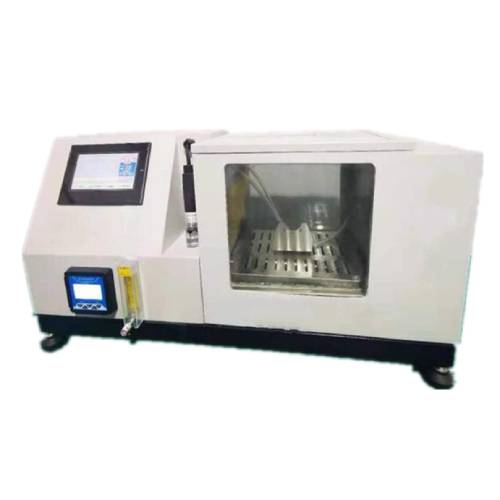
Current Technological Advantages and Industry Significance
At present, technologies used to test the resistance of protective clothing to chemical liquid penetration are primarily based on international and industry standards. These methods simulate real contact conditions to evaluate the barrier performance of materials against liquid chemicals, including acids, alkalis, blood, and pathogens.
Core Testing Principles and Technologies
Distinction Between Permeation and Penetration
Permeation: Refers to the process by which chemical substances pass through a material at the molecular level (e.g., diffusion). It is typically used to evaluate protective performance under long-term exposure conditions.
Penetration: Refers to the passage of liquid through physical pathways such as pinholes, seams, or capillary action. It focuses on short-term exposure or the structural integrity of the material.
Mainstream Testing Methods
ASTM F739 / ISO 6529: Used to evaluate the resistance of materials to permeation by liquids or gases under continuous contact conditions, measuring breakthrough time and permeation rate.
ASTM F1670 / ISO 16603: Uses synthetic blood under constant pressure (e.g., 13.8 kPa / 2.0 psig) to determine whether visible penetration occurs, mainly applied to medical protective clothing.
ASTM F1671 / ISO 16604: Utilizes Phi-X174 bacteriophage as a biological indicator to detect whether blood-borne pathogens can penetrate the material, offering higher sensitivity than visual methods.
YY/T 0699-2008: Equivalent to ISO 16603. applicable to domestic testing of protective clothing resistance to liquid chemical penetration.
Key Technical Features of the Equipment
Closed-loop circulation system: For example, the tester developed by Chuangsi (Shanghai) incorporates a closed-loop system composed of a micro flow pump, constant temperature water bath, and collection chamber, enabling precise control of chemical flow and temperature.
Multi-material test chambers: Supports chambers made of PTFE, glass, or stainless steel, allowing compatibility with various chemical types such as strong acids and organic solvents.
High-sensitivity detection: Can be integrated with electrochemical analysis, chromatography, or microbiological culture techniques to achieve quantitative detection of trace-level permeation.
Core Industry Applications and Functions
The protective clothing chemical liquid penetration resistance tester plays a vital role across multiple industries, mainly used to evaluate the resistance of protective clothing materials to liquid chemical penetration. Its key functions include:
Ensuring personnel safety: By quantitatively verifying whether protective clothing materials can effectively block hazardous liquid penetration, it ensures reliable protection for workers such as chemical industry personnel, healthcare workers, firefighters, and agricultural workers.
Supporting standards compliance: Test results can be used to verify whether products meet international or national standards such as ISO 6530. ASTM F1670. and ISO 17491. ensuring regulatory compliance and market access.
Guiding material development and selection: Helps manufacturers identify fabrics, coatings, or composite structures with superior chemical resistance, optimizing protective clothing design.
Evaluating service life and durability: By simulating conditions such as washing, aging, and abrasion, it assesses performance degradation during actual use.
Improving quality control: Serves as a critical inspection tool in the production process to ensure consistent and reliable performance across product batches.
Operating Procedure for Protective Clothing Chemical Liquid Penetration Resistance Tester
1. Specimen Preparation and Conditioning
First, carefully cut three standard circular specimens from the protective clothing to be evaluated (typically from the main protective area of the garment). The recommended nominal diameter is 32 mm. Use a dedicated cutting die or tool to ensure smooth edges without burrs.
Next, visually inspect the specimens to confirm that there are no visible wrinkles, scratches, or external contaminants (such as dust or oil stains) on the surface.
Afterward, the specimens must be conditioned in a standard laboratory environment (e.g., temperature (20 ± 2)°C, relative humidity (65 ± 5)%) for at least 24 hours. This step stabilizes the material properties and minimizes potential deviations caused by environmental factors.
2. Test System Calibration and Parameter Configuration
Before testing, perform a comprehensive functional check of the instrument, focusing on the pressure supply system, pipeline connections, and control unit to ensure proper operation, no leakage, and accurate pressure indication.
Then, according to the applicable testing standard (such as EN 14126. GB 19082) or specific application requirements, select an appropriate challenge liquid. Common options include:
Deionized water (for baseline evaluation)
Artificial saliva
Artificial sweat
Acid solutions (e.g., sulfuric acid)
Alkali solutions (e.g., sodium hydroxide)
Next, accurately set key test parameters on the control panel. The liquid rise rate is a critical parameter and must strictly comply with standard requirements (e.g., (60 ± 3) cm/min). Also confirm that the initial pressure, data acquisition frequency, and other relevant parameters are correctly configured.
3. Specimen Installation and Test Chamber Sealing
Place the conditioned specimen flat onto the designated test chamber of the instrument.
During installation, special attention must be paid to firmly securing the specimen edges using a uniform clamping mechanism or sealing ring to ensure effective sealing. This is a critical step to prevent leakage of the test liquid from the edges.
After installation:
Ensure the test surface of the specimen faces upward
The challenge liquid will contact the opposite side (inner surface) from below in a vertically upward direction
This design simulates the real scenario in which liquid chemicals penetrate from the inner side to the outer surface of protective clothing.
4. Test Execution and Data Acquisition
After completing preparation, start the test program.
The instrument will apply continuous and stable pressure to the liquid in the test chamber, causing the liquid column to rise at a constant rate and generate gradually increasing hydrostatic pressure on the back side of the specimen.
During the test, the operator must continuously observe the front surface of the specimen. When the third independent visible droplet or wet spot appears (defined as a “penetration event”), immediately record the corresponding hydrostatic pressure value using the instrument or manually.
This value is the breakthrough pressure, typically expressed in:
mmH₂O (millimeters of water column), or
kPa (kilopascals)
To ensure reliability, each specimen must be tested at least three times under identical conditions, and the arithmetic mean of the three breakthrough pressures is calculated as the final result.
5. Performance Analysis and Evaluation
After obtaining the average breakthrough pressure, evaluate compliance according to applicable standards or specifications.
For example, some standards may require:
Liquid repellency ≥ 95%, or
Penetration rate ≤ 5%
If the protective clothing claims compliance with a specific classification (e.g., Type 6 under EN 14126. which applies to limited liquid splash protection), a single hydrostatic pressure test alone is insufficient for final determination.
It must be combined with spray test results for a comprehensive evaluation of splash resistance performance.
6. Post-Test Handling and Documentation
After completing all tests:
Safely drain any residual chemical liquid from the test chamber into a designated waste container.
Clean and dry the test chamber, clamping device, and pipelines thoroughly using appropriate solvents (e.g., deionized water, ethanol), depending on the chemical used, to prevent corrosion or contamination.
Finally, prepare a detailed and accurate test report. The report should include, but is not limited to:
Test date
Environmental temperature and humidity
Instrument model and serial number
Applicable test standard
Challenge liquid details (name, concentration)
Specimen source description
Raw pressure values for each test
Average result
Final evaluation conclusion
All original records and reports must be properly archived for quality traceability and audit purposes.
7. Important Application Considerations
1. Product Applicability
Many protective garments on the market are labeled as single-use (disposable). These products are typically not washable or reusable, and their protective barrier may significantly degrade after initial exposure to liquids or physical wear.
Therefore, it is essential to confirm the product type before testing and avoid performing repeated tests that do not align with its intended use.
2. Limitations of the Test Method
This test method primarily evaluates the resistance of the fabric material itself (homogeneous material) to liquid chemical penetration.
It does NOT assess:
Leakage risks from seams, zippers, valves, or joints
The impact of garment design, fit, or wearing method
The overall protective performance of a full garment must be evaluated through more complex whole garment testing.
3. Special Considerations for High-Risk Substances
When protective clothing is intended for use against liquids containing high-risk biological agents (such as blood, body fluids, or pathogen-containing media), physical and chemical penetration tests alone are insufficient to demonstrate biosafety.
In such cases, it is strongly recommended that, after passing basic chemical penetration tests, the material undergo microbial challenge testing (e.g., using Phi-X174 bacteriophage) to evaluate its resistance to microbial penetration.
Selection Guide
When selecting a Protective Clothing Chemical Liquid Penetration Resistance Tester, it is essential to conduct a comprehensive evaluation based on testing standards, application scenarios, key performance parameters, and supplier qualifications.
1. Identify Applicable Standards
Different countries and industries adopt different standards for liquid penetration testing of protective clothing. Before purchasing, it is important to confirm the required testing standards:
ASTM F903: Used to evaluate the resistance of materials to liquid chemical penetration; widely applied in industrial protective clothing.
ASTM F1670 / ASTM F1671: Designed for penetration testing using synthetic blood and blood-borne pathogens (such as Phi-X174 bacteriophage); mainly applicable to medical protective clothing.
ISO 6530:2005: Evaluates the resistance of materials to low-volatility liquid chemicals, including penetration, absorption, and repellency.
EN 14126 / GB 19082-2009: Applicable to medical protective clothing, with specific classification requirements for resistance to viruses and blood penetration.
Recommendation:
Priority should be given to equipment that supports ASTM F903. ASTM F1670/F1671. or ISO 6530. as these standards cover both industrial and medical application scenarios.
2. Key Selection Parameters
Test liquid compatibility: Whether the equipment supports common chemical reagents such as sulfuric acid, sodium hydroxide, benzene, oils, etc.
Pressure and time control accuracy: Whether it can precisely set standard-required pressures (e.g., 1.75 kPa, 3.5 kPa) and test durations.
Level of automation: Whether it features automatic recording of penetration time, pressure curves, and other data to minimize human error.
Applicable sample types: Whether it is compatible with various materials such as protective clothing fabrics, gloves, and boot covers.
3. Recommended Supplier
Standard Group (Hong Kong) Co., Ltd. has been committed to promoting material testing standards since its establishment. The company provides comprehensive laboratory solutions for material testing and offers world-class testing instruments and equipment to quality inspection institutions, enterprises, and research organizations.
In conclusion,the Protective Clothing Chemical Liquid Penetration Resistance Tester plays a crucial role in the field of occupational safety and protection. Its core function is to accurately evaluate the ability of protective clothing materials to resist penetration by various hazardous chemical liquids, thereby providing a scientific basis and reliable assurance for personnel safety in hazardous environments.Therefore, when selecting such testing equipment, it is essential to carefully consider actual application scenarios, relevant testing standards, and specific protection requirements. A comprehensive and prudent evaluation will ensure that the selected instrument can accurately and efficiently meet specific testing needs and safety regulations.