

What is the guarded sweating hotplate method?
The Sweating Guarded Hotplate is a precision instrument used to measure the thermal resistance and evaporative resistance of textiles, apparel materials, or composite materials. Its core function is to simulate the heat and sweat exchange process of human skin, providing precise evaluation of the thermal and moisture comfort performance of textiles, clothing, and related materials. It is widely applied in the fields of textiles, apparel, and protective equipment for performance testing and evaluation.
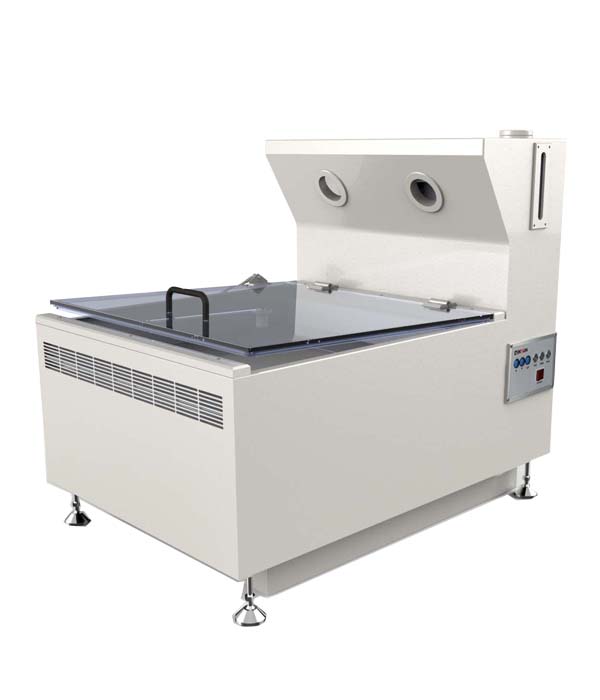
Working Principle
The working principle of the Sweating Guarded Hotplate is based on simulating the heating and sweating environment of human skin. By measuring a material’s resistance to heat and water vapor transfer, the device evaluates its thermal and moisture comfort. Key principles include:
Simulating Human Skin: The instrument uses a porous metal plate (commonly phosphor bronze alloy, e.g., 200 mm × 200 mm), which is heated and maintained at 35 °C ± 0.1 °C (close to human skin temperature). Distilled water is evenly released through micro-holes to simulate human sweating.
Guarded Heat Ring Design: A heat guard ring surrounds the metal plate, also maintained at 35 °C ± 0.1 °C, preventing lateral heat loss and ensuring that heat transfer is only vertical through the specimen, achieving one-dimensional steady-state heat flow.
Environmental Control: The system is placed inside a temperature- and humidity-controlled chamber, allowing precise control of air temperature, relative humidity, and airflow (typically according to ISO 139:2005 standards).
Measured Parameters
Thermal Resistance (Rct): Calculated from the heating power and temperature difference across the specimen, reflecting the material’s ability to resist dry heat transfer.
Evaporative Resistance (Ret): Calculated from the evaporation rate of water vapor through the specimen and the vapor pressure difference across it, reflecting the material’s resistance to sweat vapor diffusion.
Specimen Requirements
Typical dimensions: 300 mm × 300 mm (thickness < 5 mm) or 214 mm × 214 mm (thickness 5–70 mm)
Conditioned under standard atmospheric conditions prior to testing.
Basic Test Procedure
Environmental Preparation:
Place the device inside a temperature- and humidity-controlled chamber to meet standard requirements (e.g., ISO 11092 or ASTM F3628).
Typical test conditions: 35 °C ± 0.5 °C, relative humidity 30%–70%, airflow 1 m/s ± 0.05 m/s (specific parameters per standard).
Sample Preparation:
Cut the specimen to the required size (typically 200 mm × 200 mm or 300 mm × 300 mm).
Condition the specimen according to ISO 139:2005 (standard atmosphere: 20 °C ± 2 °C, relative humidity 65% ± 4%).
Device Calibration and Setup:
Preheat the system, ensuring the test plate temperature stabilizes at 35 °C.
Set airflow velocity (0–2 m/s adjustable, commonly 1 m/s).
Activate the automatic water supply system, ensuring uniform wetting of the test plate to simulate sweating.
Placing the Specimen:
Lay the conditioned specimen flat on the porous metal plate, avoiding wrinkles or gaps.
Some advanced models automatically adjust platform height according to specimen thickness.
Start Test:
Begin the steady-state test program. The system automatically records plate temperature, power input, humidity, and other parameters.
Test duration: 20–60 minutes, until heat flux and evaporation reach steady state.
Data Reading and Calculation:
The system automatically calculates:
Thermal Resistance (Rct, m²·K/W): Reflecting the material’s ability to resist heat transfer.
Evaporative Resistance (Ret, m²·Pa/W): Reflecting resistance to water vapor passage.
Results must meet device precision requirements (e.g., repeatability error ≤ ±2%).
Conclusion and Cleanup:
Stop water supply and drain residual water from the test plate.
Remove the specimen and power off the device.
Routine Maintenance
Clean Test Surface: Wipe the plate with a soft cloth after each test to avoid residue affecting precision.
Check Water Supply System: Ensure automatic supply and drainage are unobstructed; use deionized water regularly to prevent scale or microbial growth.
Calibrate Temperature and Humidity Sensors: Regularly (e.g., quarterly) calibrate the test plate temperature and chamber sensors for accuracy.
Check Airflow System: Clean airflow regulators to maintain uniform and stable air velocity (typically adjustable 0–1.2 m/s).
Lubricate Mechanical Components: Apply appropriate lubricant to platform mechanisms to prevent sticking.
Update Software and Data Systems: Keep control software and data acquisition systems up to date for compatibility and efficiency.
Main functions and advantages
The core function of the Sweating Guarded Hotplate (sweating guarded hot plate method) is to accurately measure thermal and evaporative resistance, allowing scientific evaluation of a material’s heat and moisture transfer performance.
1. Main Function
This method simulates the heat and moisture exchange between human skin and fabrics under strictly controlled conditions (temperature, humidity, and specific airflow), testing the material’s resistance to heat and water vapor. Key performance metrics include:
Thermal Resistance (Rct): Indicates the material’s ability to resist dry heat conduction; unit: m²·K/W. Higher Rct means better insulation.
Evaporative Resistance (Ret): Reflects the resistance to sweat evaporation; unit: m²·Pa/W. Lower Ret indicates better breathability.
Total Heat Loss (THL): Combines dry heat conduction and evaporative cooling to evaluate overall thermal comfort.
Applications: functional textiles, sportswear, protective clothing, military uniforms, insulating materials, and water- and vapor-resistant fabrics.
2. Core Advantages
High Accuracy and Repeatability: Features auto-leveling, PID temperature control, and uniform water supply; repeatability error ≤ ±2%.
Compliance with International Standards: Designed and calibrated according to ISO 11092:2014. ensuring globally recognized results.
Integrated Multi-function Design:
Automatic water supply/drainage for precise moisture control.
Adjustable airflow 0–2 m/s for various test conditions.
Guard ring (~127 mm width) prevents edge heat loss, ensuring accurate heat transfer through the specimen.
Wide Material Applicability: Single or multi-layer fabrics, films, coatings, foams, leather, etc.
Intelligent Data Management: USB/WiFi modules with professional software for automatic configuration, real-time data collection, and analysis.
Future Opportunities and Challenges
1. Future Opportunities
Standardization Expansion: Chinese standard GB/T 38473-2020 integrates the sweating hotplate method into dynamic drying rate testing, promoting its adoption in textiles and building materials.
Intelligent Integration: New devices integrate IoT sensors and AI algorithms for remote monitoring, automatic data analysis, and multi-environment simulation, improving efficiency and reproducibility.
Emerging Market Growth: Global demand for sweating hotplate testing is expected to grow by 2031. China, as a manufacturing hub, is accelerating the replacement of imported equipment, with domestic suppliers like Xilai Asia Atlas providing complete supply chains.
2. Main Challenges
High equipment cost, reliance on imported high-end models, limiting access for small and medium R&D institutions.
Complex calibration requiring precise control of temperature, humidity, and surface uniformity; high operator skill required.
Material adaptability limitations, especially for non-uniform structures (3D knits, laminated composites); dynamic wet conditions may reduce test accuracy.
In summary, the future development of the Sweating Guarded Hotplate will focus on: refined standards, dynamic testing, intelligent instrumentation, and diversified applications, consolidating and enhancing its role in functional textile R&D and quality control.