

What is MST Medical Compression Stocking Tester?
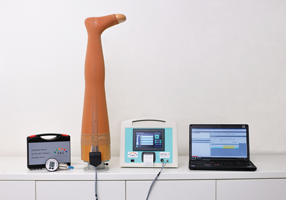
The MST Medical Compression Stocking Tester is a professional instrument designed to measure the static and dynamic pressure exerted by medical compression stockings at specific points on the human body. Its core purpose is to accurately measure and evaluate the pressure performance of medical compression stockings to ensure compliance with medical standards and clinical application requirements.
The instrument is widely used in textile manufacturers, testing laboratories, and research institutions, particularly in the field of medical varicose vein compression stockings and medical elastic stockings. It plays a crucial role in ensuring that the elasticity and pressure characteristics of compression products meet relevant standards, thereby guaranteeing product quality, safety, and therapeutic effectiveness.
Working Principle
The MST Medical Compression Stocking Tester is a specialized device used to measure the pressure distribution of medical graduated compression stockings at different positions. Its core working principle is based on high-precision pressure sensors and standardized measurement methods, ensuring that the products meet medical-grade pressure distribution requirements.
Pressure Distribution Measurement
The medical compression stocking is fitted onto a standardized measurement model (typically representing a calf or thigh). Built-in high-precision pressure sensors measure the surface pressure along the length of the stocking, point by point from the ankle upward.
Gradient Compression Verification
According to international standards such as ENV 12718 and CEN/TR 15831. the instrument verifies whether the stocking meets the graduated compression requirement—where the ankle pressure is the highest, gradually decreasing upward to approximately 50–80% at the calf and 20–40% at the mid-thigh relative to the ankle pressure.
Automated Data Acquisition and Analysis
The system automatically records pressure values at each measurement point and generates a pressure-position curve. It then determines whether the product complies with the tolerance limits required for medical certification, such as the RAL-GZ 387 series standards.
Features of the MST Medical Compression Stocking Tester2
The MST Medical Compression Stocking Tester allows users to set the required leg dimensions and features an automatic leg-shape adjustment function. This eliminates the need for custom-made leg molds, significantly reducing measurement steps and minimizing human influence on results, thereby improving test repeatability and reliability.
Product Features
Pressure testing for medical compression stockings and support stockings
Suitable for both standard production testing and customized product verification
Applicable to quality certification testing (e.g., RAL certification)
Multiple pressure detection points for detailed analysis of pressure gradient distribution
Ability to quickly simulate customized leg model sizes
Simple and fast operation
Cost-effective testing solution
Operating Procedure
1. Power On and Self-Check
Connect the power supply (90–260 V / 50–60 Hz) and turn on the instrument.
The system automatically performs a self-diagnostic check of the internal sensors and modules to ensure proper operation.
2. Environmental Parameter Setup
The instrument includes a built-in air sensor that automatically displays the current temperature and humidity. The standard testing environment typically requires:
Temperature: 23°C ± 2°C
Relative Humidity: 50% ± 10%
These conditions comply with standard testing requirements. If necessary, manual calibration can be performed via the touchscreen by entering the “Calibration” menu and using the internal reference air source for zero-point and range calibration.
3. Sample Preparation
Place the compression stocking evenly onto the standard measurement column (which simulates the human leg contour). Ensure the stocking is smooth, wrinkle-free, and properly centered. Select the appropriate measurement mode depending on the test type (static or dynamic).
4. Parameter Configuration
Using the 7-inch WVGA touchscreen, select the desired test item:
Static pressure test
Dynamic pressure test (simulating walking)
Pressure gradient distribution (multi-point measurement from ankle to thigh)
Interface pressure distribution (requires multi-point sensor array)
Set the stretch ratio (e.g., 0%, 10%, 20%) to simulate different wearing conditions and evaluate the corresponding pressure response.
5. Start Testing
Press the “Start” button. The instrument applies standardized pressure to the stocking via airbags or mechanical mechanisms. High-precision sensors (accuracy ±1 mmHg) collect pressure data along the axial direction of the column. The real-time pressure curve will be displayed on the screen, with support for multi-channel synchronous recording.
6. Data Recording and Analysis
After the test is completed, the data is automatically stored in the internal memory or exported to a PC via the USB interface (using dedicated Windows software).
The software generates a detailed report including:
Pressure values at key positions (ankle, calf, below knee, mid-thigh)
Pressure gradient compliance analysis
Static/dynamic pressure attenuation rate
Compliance with international standards such as EN 13649 or ISO 13405
7. Printing and Output
Test results can be quickly printed using the built-in thermal printer, including:
Timestamp
Sample identification
Test conclusion
Reports can also be exported in PDF or CSV format for documentation or submission to certification bodies.
8. Shutdown and Maintenance
After testing:
Turn off the power supply
Clean the measurement column and sensor surfaces
If the equipment will not be used for a long period, disconnect the power and cover it with a dust-proof cover
Main Functions and Advantages
1. Functions
The device is mainly used to accurately measure the compression force generated by compression stockings at key positions such as the ankle, calf, and thigh.
This ensures that compression stockings strictly follow the professional graduated compression design principle, where the ankle pressure is highest and gradually decreases upward along the leg, providing optimal therapeutic and supportive effects.
The device can also verify whether compression stockings comply with multiple international standards and industry regulations, including:
ENV 12718
CEN/TR 15831
RAL-GZ 387 certification
Chinese textile industry standard FZ/T 73031
In terms of medical device registration and certification, the equipment provides accurate and reliable compression performance data, supporting manufacturers in completing product registration and meeting market access requirements.
Additionally, it is widely used in clinical quality control in medical institutions, helping healthcare professionals ensure that compression stockings deliver the expected therapeutic effect and maintain patient safety.
2. Core Advantages
High Measurement Accuracy and Repeatability
The device uses advanced built-in air pressure sensors and professional detection belt technology, providing stable and reliable compression test results while minimizing operational errors.
User-Friendly Interface
The system is equipped with a 7-inch WVGA high-definition touchscreen supporting multiple languages, including Chinese and English, making it easy for users worldwide to operate and improving overall usability.
Comprehensive Data Management
The instrument can be connected to a computer via USB and analyzed using dedicated Windows software. Users can:
Perform detailed data analysis
Customize brand logos and address information within the test program
Print professional test reports using the built-in thermal printer
Excellent Environmental Adaptability
A high-sensitivity temperature and humidity sensor continuously monitors environmental conditions and compensates for environmental influences, ensuring accurate measurements under different temperature and humidity conditions.
Proven Global Reliability
Since its initial launch in 1977. the system has been widely used worldwide. Currently, more than 400 units are operating in compression stocking production and clinical testing fields.
The professional version MST PROFESSIONAL, introduced in 2006. has been adopted by authoritative testing institutions in countries such as the United States, Brazil, and China, establishing a strong reputation in the industry.
Purchasing Recommendations
Clarify Testing Requirements
When selecting a medical compression stocking tester, first determine your testing needs, including the type of samples and the required testing parameters.
Choose Reputable Brands
Select well-known brands and reliable suppliers to ensure product quality and after-sales service.
Focus on Performance Indicators
Pay attention to key specifications such as:
Measurement accuracy
Measurement range
Stability
These factors are essential for ensuring accurate and reliable testing results.
Consider Budget
Choose the appropriate instrument model and configuration according to your budget to avoid unnecessary costs.
Future Development Trends
Overall, the future development of medical compression stocking testing instruments will deeply integrate intelligent and personalized technologies.
Testing will evolve beyond simple static pressure measurement toward evaluating pressure performance under dynamic and complex motion conditions.
Dynamic testing systems integrating high-density flexible sensors, motion capture, and synchronized data acquisition will become essential technologies.
Furthermore, wearable real-time pressure monitoring and 3D body scanning technologies will promote the integration of testing systems with personalized compression prescription design.
In addition, testing instruments will increasingly incorporate Internet of Things (IoT) connectivity and artificial intelligence, enabling real-time monitoring, advanced data analysis, and personalized health feedback—supporting the future development of precision medicine and intelligent wearable healthcare devices.