

What is a High Speed Lockstitch Bar Tacking Machine?
High-speed lockstitch sewing machines are specialized sewing equipment widely used in the garment, textile, and industrial sewing sectors. They are primarily designed for reinforcing high-stress areas of garments, such as the crotch, pocket corners, and around buttons. Their core advantage lies in the precise coordination between the needle-thread system and the bobbin system, forming firm lockstitch patterns that effectively enhance stitch strength and durability.
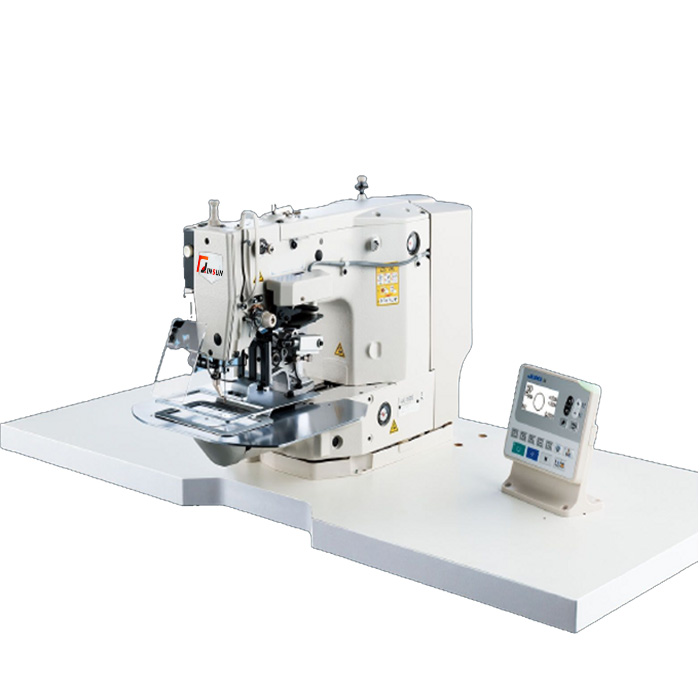
Core Working Principle
The operation of high-speed lockstitch machines relies on the synchronized coordination of four key mechanisms:
Needle penetration mechanism – the up-and-down movement of the needle.
Bobbin hook mechanism – rotation or oscillation of the rotary or oscillating bobbin.
Thread take-up mechanism – precise control of upper thread tension and feed.
Fabric feed mechanism – stable movement of the fabric.
Even at high speeds (typically 3.000–6.000 rpm), these mechanisms maintain precise phase synchronization, ensuring uniform and stable stitch formation.
Installation Steps
Check Work Environment and Accessories
Ensure the installation platform is stable and level, away from vibration sources; verify that the main machine, motor, bobbin, needle bar, presser foot, and other accessories are complete.
Install Bobbin and Rotary Hook
Insert the fully wound bobbin into the rotary hook, ensuring the thread unwinds in the correct direction (clockwise or as indicated on the machine); install the rotary hook into the hook case and ensure it rotates freely.
Install Sewing Needle
Loosen the needle clamp screw; insert the needle with the flat side facing right and the groove facing left, push to the top, and tighten the clamp screw securely.
Thread Upper and Lower Threads
Follow the thread path indicated on the machine (through tension discs, guides, and take-up lever); rotate the handwheel to lower and raise the needle, bringing the bobbin thread up to form a loop, and pull it out.
Install Special Attachments (e.g., Cap Frame)
For sewing caps or curved workpieces, remove the standard presser foot bracket; insert the cap frame bracket through the arm and tighten the screws to secure it.
Pre-Power Check and Test Run
Ensure all screws are tightened and no tools or components remain inside; turn off the power before connecting; perform an empty run to check for abnormal noise or skipped stitches, and test-stitch on scrap fabric to confirm proper stitch formation.
Operating Instructions
Preparation Before Operation
Safety check: ensure the power is off and hands are away from the needle and moving parts.
Lubrication: check the oil level to “H” mark; use white sewing machine oil. For new or long-unused machines, lubricate all points manually.
Install needle and bobbin: needle flat side facing back, groove aligned, clamp screw tightened; bobbin wound and inserted correctly.
Thread upper thread: follow the indicated path (spool → thread guide → thread take-up → needle).
Basic Operation Steps
Draw up bobbin thread: pull both threads, rotate handwheel one turn to bring up bobbin thread, place threads behind the presser foot.
Adjust parameters:
Stitch length: adjust via stitch length dial; for reverse stitching, press the reverse lever.
Thread tension: upper thread via tension knob, bobbin via adjustment screw.
Presser foot pressure: adjust according to fabric thickness.
Test stitch and adjust: sew on scrap fabric; if issues occur (skipped stitches, thread breakage), check needle type, threading path, or tension.
Core Functions and Main Applications
Core Functions
High-speed sewing: 2.500–5.000 stitches/minute, greatly improving efficiency.
Firm lockstitch formation: upper and lower threads interlock, highly durable, suitable for multi-layer fabrics.
Multi-fabric compatibility: can sew thin silk, synthetics, and thick leather.
Automation and intelligent control: servo motor drives precise feed, stitch length adjustment, and reverse stitching.
Touchscreen interface: stores programs, sets parameters, supports IoT connectivity.
Automatic trimming: reduces manual thread handling, improves continuous operation.
Low noise and vibration design: optimized structure improves operator comfort.
Main Applications
Widely used in garments, bags, and home textiles for basic stitching, decorative stitching, buttonholes, and reinforcement.
Ideal for high-volume, high-efficiency production lines, e.g., suits, trousers, and underwear.
Some models support specialized functions:
Multiple knife positions: adapt to different buttonhole sizes without changing blades.
Interlining stitching: handles difficult fabrics such as stretch knits.
Dry-head design: no oil required, avoiding product contamination.
Maintenance
Clean key components: remove needle plate, clean lint and debris from the hook and feed dog.
Inspect and replace needles: replace bent, worn, or improper needles.
Lubricate moving parts: apply quality sewing machine oil; high-speed models may use high-temperature stable oil to support 5.000 rpm operation.
Check presser foot, feed dog, and needle plate: ensure no excessive wear or misalignment.
Threading and tension checks: ensure proper threading, adjust upper/lower thread tension.
Motor and wiring inspection: check for normal operation, avoid current surges during idle operation.
Future Development Trends
High-speed lockstitch machines are critical to modern garment manufacturing and industrial sewing. Their future trends include:
Intelligent automation: integration of PLC control, vision systems, and sensors for automatic feeding, fault diagnosis, and adaptive parameter adjustment, improving efficiency and consistency.
Energy-saving and eco-friendly design: high-efficiency motors and drive systems reduce energy consumption, noise, and emissions.
Flexibility and modular design: quickly switch modes for different fabrics, processes, and product types, enabling multi-product, small-batch production.
Remote connectivity and IIoT integration: real-time monitoring, data analysis, and intelligent scheduling promote smart factory development.
In summary, high-speed lockstitch machines will evolve toward intelligent, energy-efficient, flexible, and connected systems, enhancing production efficiency, product quality, and customization capabilities, driving the garment industry toward smart and precise manufacturing.