

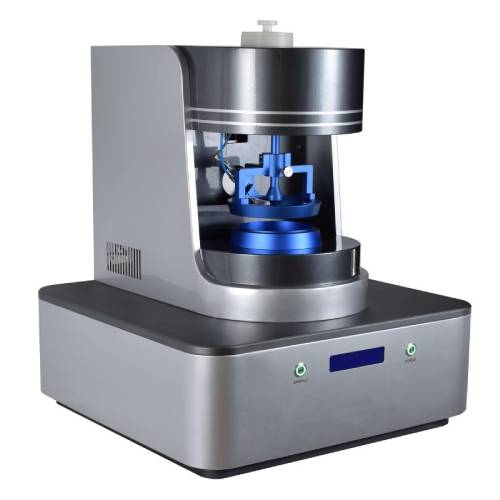
What is the Airflow Method Fabric Drying Rate Tester?
The Airflow Method Fabric Drying Rate Tester is a specialized instrument designed to quantitatively measure the drying rate of textiles under controlled airflow conditions. It is widely used in textile R&D, quality control, and compliance verification with industry standards.
Working Principle
The tester operates by simulating the effect of airflow on fabric drying, measuring the thermodynamic changes caused by moisture evaporation to determine the drying rate. Its core principles are as follows:
Simulated airflow environment: Under controlled conditions, a stable airflow is directed over a heated plate covered with a wet fabric sample, mimicking ventilation conditions during real-world use.
Thermal balance monitoring: Wet fabric is placed on a constant-temperature heating plate (usually set to 37°C to simulate human skin temperature). Evaporation absorbs heat, lowering the fabric surface temperature. High-precision sensors monitor the surface temperature in real time.
Drying endpoint determination: Once the fabric is completely dry, evaporation stops, and the surface temperature returns to the heating plate’s set temperature. The instrument automatically records the time elapsed from the start of the test until temperature stabilization, calculating the drying rate.
Automated operation: The device can automatically supply water, control airflow and temperature, record data, and generate drying rate curves or final values, such as total drying time or evaporation rate.
This method differs from traditional gravimetric testing as it is non-destructive, highly automated, and closely reflects actual usage scenarios. It is suitable for testing sportswear, medical textiles, home fabrics, and other textiles where drying performance is critical.
Operation Method
Preparation:
Check instrument appearance, power supply, sensors, and air source.
Ensure stable environmental conditions (typically 20±2°C, 65±2% RH).
Cut test samples to standard sizes (e.g., diameter 100 mm or 55 mm, per ISO 9237).
Condition samples under standard atmospheric conditions for at least 4 hours.
Installation and Calibration:
Secure the sample in the fixture, ensuring a sealed fit.
For permeability tests, select the appropriate nozzle or orifice plate.
Perform zero-point calibration or leak detection (e.g., test with a solid plate; pressure differential should approach zero).
Set testing parameters: airflow velocity, pressure differential, test duration, etc., according to relevant standards.
Testing:
Activate the airflow system, maintaining constant airflow through the sample.
Record pressure differences, flow, or time-mass curves, depending on the device type.
Perform at least three measurements per point and take the average for accuracy.
Data Processing and Recording:
Calculate drying rate or air permeability (e.g., drying rate = mass loss ÷ time ÷ area).
Record testing conditions (temperature, humidity, airflow rate, etc.).
Save or print results.
Completion:
Turn off the air source and power supply.
Clean fixtures and probes to prevent fiber residue from affecting subsequent tests.
Store the instrument in a dry, dust-free environment.
Notes:
For specialized fabrics such as medical protective clothing or firefighting suits, follow ASTM F1671 or other relevant standards.
For custom or non-standard lab devices, establish internal operation procedures and perform regular calibration. For specific operation manuals, contact the manufacturer or refer to the provided documentation.
Applicable Fields and Scope
Fields of Application:
Functional apparel R&D: Sportswear, outdoor gear, moisture-wicking and quick-dry garments.
Home textiles testing: Towels, bath towels, cleaning cloths, assessing water absorption and drying efficiency.
Industrial textiles: Medical dressings, filtration fabrics, geotextiles, and other materials requiring controlled moisture management.
Third-party testing agencies: Providing standardized drying rate certification data.
Academic and research institutions: Studying thermal-moisture comfort and microclimate transfer mechanisms of textile materials.
Applicable Scope:
Material types: Woven, knitted, and nonwoven fabrics; natural fibers (cotton, flax, silk, wool), synthetic fibers (polyester, nylon, acrylic), and blends.
Test indicators: Time to complete dryness; drying rate (moisture evaporated per unit time); moisture evaporation curves (mass vs. time).
Environmental conditions: Typically performed under standard atmospheric conditions (20±2°C, 65±4% RH); high-end devices can precisely control temperature, humidity, and airflow speed.
Core Impacts
Impact on fabric performance evaluation:
Quantifies drying rate: By simulating different airflow conditions (wind speed, temperature, humidity), it accurately measures the time required for fabrics to dry from wet to fully dry, providing critical data for material development.
Reflects moisture and breathability coordination: Drying rate depends on both moisture absorption and the ability of airflow to promote vapor diffusion, enabling comprehensive assessment of thermal-moisture comfort.
Impact on product development and quality control:
Guides material optimization: Helps manufacturers compare different fibers (cotton, bamboo, polyester) and fabric structures (mesh, tight weave) to optimize product design.
Standardized testing: Conducted according to ASTM E96. ISO 11092. and other standards to ensure repeatability and comparability, improving batch-to-batch product consistency.
Impact on end-user experience:
Enhances comfort: Fast-drying fabrics reduce sweat retention and discomfort, particularly for sportswear, sleepwear, and undergarments.
Improves functionality: In outdoor gear (tents, backpacks, jackets), rapid-drying fabrics inhibit mold growth and extend product lifespan.
Impact on scientific research:
Supports new material studies: For example, controlling solvent evaporation in organic semiconductor films to regulate crystal orientation and film morphology.
Validates theoretical models: Experimental data help verify heat and mass transfer models, deepening understanding of moisture migration in porous media.
Advantages
The Airflow Method Fabric Drying Rate Tester stands out for its scientific, precise, and efficient testing capabilities. It standardizes airflow, temperature, and humidity to simulate natural air or dryer conditions, objectively and continuously recording drying rate curves. This provides quantifiable, repeatable results while avoiding subjective errors.
The instrument allows rapid comparison of different fibers (cotton, blends, functional fabrics) and fabric structures (towels, knits), providing scientific guidance for material selection and optimization. Test data can inform fabric structure and fiber composition improvements, enhance drying efficiency, and serve as a critical quality control tool for consistent production performance.
Moreover, its broad applicability extends beyond everyday textiles to functional apparel, medical fabrics, and industrial textiles requiring rapid drying or specific moisture management, offering significant value for R&D and practical applications.
The airflow method fabric drying rate tester, as a professional instrument for evaluating textile moisture evaporation, delivers critical data across multiple industries. In medical applications, it measures drying rates of surgical gowns and protective clothing to maintain dryness and safety, reducing infection risks. In outdoor and sports gear, it evaluates tents, jackets, and other fabrics to ensure moisture resistance and user comfort. In packaging, similar airflow and permeability testing ensures barrier properties for product protection. By providing precise, quantitative drying performance data, this instrument supports material selection, product optimization, and adherence to specific functional requirements.