

What is an automatic rubber band connecting machine?
Rubber bands are commonly used elastic fastening components in daily life and industrial production. They are primarily made of rubber or latex and feature elastic contraction properties, making them suitable for fixing, bundling, and tying applications. With the development of automated production and mass manufacturing, traditional manual operations for connecting, splicing, and forming rubber bands and elastic tapes can no longer meet the requirements for precision, consistency, and efficiency. Particularly in industries such as garments, footwear, medical elastic bands, and packaging straps, higher standards are imposed on processing speed and product quality. To improve productivity, reduce labor costs, and enhance product uniformity, the Automatic Rubber Band Connecting Machine has emerged as an indispensable piece of industrial automation equipment.
An Automatic Rubber Band Connecting Machine (also known as an automatic elastic band joint machine) refers to industrial equipment specifically designed to automatically complete the feeding, cutting, splicing, and connecting processes of rubber bands or elastic tapes. These machines typically integrate functions such as automatic feeding, automatic cutting, automatic positioning, automatic splicing, and automatic sewing or bonding. They transform rubber bands from raw material form into finished products suitable for subsequent use or assembly. Compared with traditional manual connection methods, automatic rubber band connecting machines offer significant advantages in production capacity, precision, and operational stability.
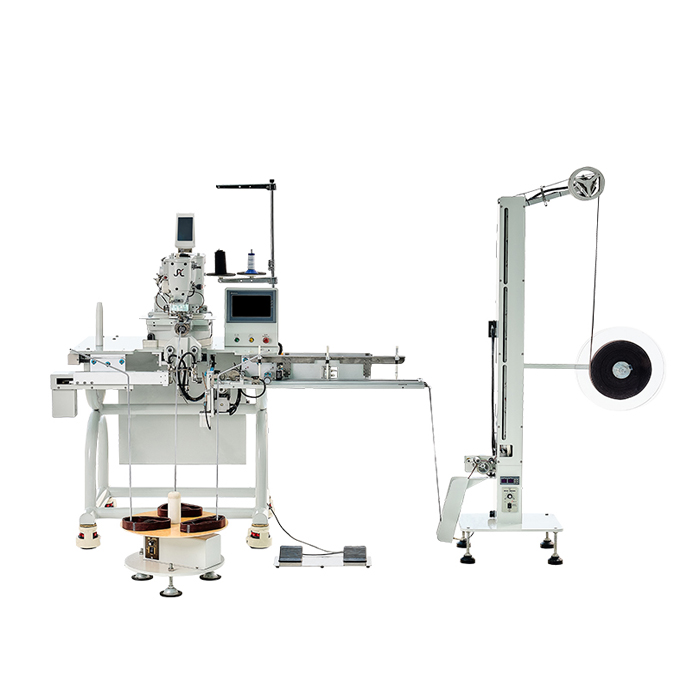
Basic Concept and Working Purpose
Basic Definition
An automatic rubber band connecting machine is an industrial automation device primarily used for mechanized processing of rubber bands or elastic tapes. Through automated feeding, detection, cutting, splicing, and sewing processes, the machine completes fixed-length processing, joining, loop forming, or fastening operations, converting raw elastic materials into standardized finished forms ready for direct application in end products.
During operation, the machine typically replaces manual tasks such as:
Automatic feeding: Pulling out elastic material to a preset length.
Automatic cutting: Cutting the rubber band to a specified length.
Fixed-length joining: Connecting the two ends after cutting or forming a loop.
Sewing or splicing: Securing the two ends using sewing, heat sealing, ultrasonic bonding, or mechanical pressing methods.
Automatic collection: Collecting, counting, or conveying finished products automatically.
The development of this equipment addresses issues such as low efficiency, inconsistent precision, and high labor costs associated with manual processing, playing a critical role in elastic material manufacturing.
Core Functional Modules
Automatic rubber band connecting machines generally integrate the following core modules to achieve fully automated production:
Automatic Feeding Device
The machine is equipped with a feeding mechanism that continuously and stably delivers rubber bands or elastic tapes into the processing area according to the preset length. This feeding system may incorporate photoelectric sensors or dual optical sensors for precise positioning, ensuring accurate cutting and splicing during processing.
Automatic Cutting and Length Control
After feeding, the rubber band is cut to the required length. The machine uses mechanical blades or thermal cutting devices to perform automatic cutting, while the control system ensures consistent and precise cutting positions for each segment.
Automatic Positioning and Sensor Recognition System
To enhance splicing accuracy, modern machines often include visual sensors and electronic eye positioning systems. These systems can detect markings, colors, or positions on the elastic material, enabling precise alignment before cutting and joining.
Automatic Splicing and Connecting Module
This is the core functional component of the machine. It connects the two cut ends through sewing, stitching, heat bonding, or mechanical pressing. Some advanced models support multiple splicing methods and can automatically adjust based on elastic band width and material type.
Automatic Collection and Counting System
After processing, the machine automatically collects, counts, stores, or outputs the finished rubber bands. The automated collection system ensures continuous production flow, reduces manual handling, and improves overall efficiency.
Working Principle
To understand how an automatic rubber band connecting machine operates, it is helpful to examine its typical workflow:
Raw material loading: The operator places rubber band material into the feeding hopper or spool holder.
Length setting: The required rubber band length is entered through the control panel.
Feeding execution: The feeding mechanism pulls out the elastic material and passes it through positioning sensors.
Automatic cutting: When the material reaches the designated position, the cutting device trims it to the specified length.
Alignment and positioning: The cut ends are aligned using sensor systems in preparation for joining.
Splicing and connection: The machine performs the connection using the preset method (such as sewing or mechanical pressing).
Output and organization: The finished rubber bands are automatically conveyed to the collection area for batch storage or counting.
The entire process is coordinated by a central control system that synchronizes each execution mechanism, enabling fully automated operation from feeding to finished product output without manual intervention.
Equipment Classification and Technical Differences
Depending on processing methods, connection techniques, and application scenarios, automatic rubber band connecting machines can be categorized into several types:
Multifunctional Automatic Splicing and Sewing Machines
These machines integrate feeding, cutting, positioning, and sewing functions, making them suitable for high-volume standardized production. They typically feature high-precision servo control systems and image recognition calibration technologies to ensure production stability.
Automatic Elastic Loop Forming Machines
These machines specialize in automatically connecting elastic tapes into closed rubber loops for use in garments, medical elastic straps, and packaging bands. They are sometimes referred to as automatic rubber band loop machines.
Automatic Rubber Ring Application or Assembly Machines
Some machines not only connect rubber loops but also automatically assemble them into products, such as attaching elastic bands to hardcover books or packaging products. These systems often integrate size calculation and automatic insertion functions.
Advantages of Automatic Rubber Band Connecting Machines
Compared with traditional manual and semi-automatic methods, automatic rubber band connecting machines offer several advantages:
Significantly Improved Production Efficiency
Automated equipment can operate continuously, greatly increasing output per unit time. Certain models are capable of processing dozens of pieces per minute or more.
Enhanced Precision and Consistency
Automation reduces human error, ensuring uniform length, cutting position, and splicing quality for each rubber band, thereby improving product consistency and quality stability.
Reduced Labor Costs and Work Intensity
By replacing repetitive manual tasks, enterprises can significantly reduce labor requirements and minimize fatigue-related errors and occupational health risks.
Support for Customization and Flexible Production
Modern machines allow rapid adjustment of length and splicing methods via control panels, enabling flexible adaptation to various product specifications.
Major Application Fields
Automatic rubber band connecting machines are widely used across various industries:
Garment Manufacturing
Elastic bands are essential components in clothing, sportswear, underwear, and waistbands. Automatic connecting machines are crucial for cutting and splicing elastic materials, improving automation in garment factories.
Packaging and Bundling Industry
Elastic loops are used for bundling products, organizing printed materials, and packaging solutions. Automated connecting machines enable fast production of large quantities of rubber loops.
Stationery and Finished Product Assembly
Products such as hardcover books and diaries often require elastic bands to be attached. Automated insertion and connection equipment are suitable for large-scale industrial production.
Medical Supplies Manufacturing
Medical elastic bands and straps require high precision and hygienic standards. Automatic rubber band connecting machines ensure stable output and consistent quality.
Development Trends and Technological Innovation
With the advancement of Industry 4.0. intelligent manufacturing, and digital control technologies, automatic rubber band connecting machines continue to evolve. Future development trends include:
Integration of Intelligent Vision Recognition
Through visual sensors and laser detection systems, machines can identify printed markings or logos on elastic materials, enabling more precise alignment for cutting and splicing.
Digital Control and Remote Monitoring
High-performance touchscreens, PLC control systems, and remote monitoring capabilities enhance equipment visualization, programmability, and fault diagnosis.
Human-Machine Collaboration and Flexible Production
Future equipment will better integrate into flexible production lines, supporting on-demand manufacturing and rapid product switching.
Higher Speed and Extended Service Life Design
Improvements in servo control systems, wear-resistant cutting components, and long-life sensors will enable higher throughput and improved operational stability.
The Automatic Rubber Band Connecting Machine is an industrial device designed for automated processing, connecting, and forming of rubber bands and elastic tapes. Its development has significantly enhanced production efficiency, product consistency, and automation levels. It plays an important role in garment manufacturing, packaging, stationery assembly, and medical product production. As intelligent manufacturing technologies continue to advance, these machines will increasingly incorporate digitalization, flexibility, and smart control features, expanding their applications across a broader range of industries.