

What is an automatic rubber band connecting machine?
In modern manufacturing and automated packaging, the Automatic Rubber Band Connecting Machine is a specialized piece of equipment designed to automatically connect, tie, or bundle rubber bands. It significantly replaces manual labor, improving production efficiency, stability, and product consistency. This machine is widely used in electronics packaging, cable organization, food packaging, and elastic band processing in the apparel industry. With the development of industrial automation and intelligent production, this machine has become an essential tool for improving production efficiency and quality control.
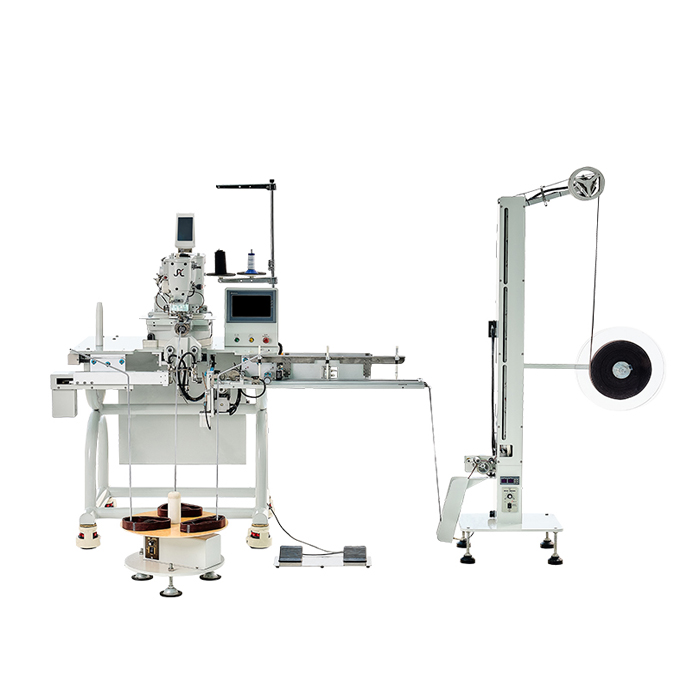
What is an Automatic Rubber Band Connecting Machine?
An automatic rubber band connecting machine uses mechanical structures, pneumatic components, or electronic control systems to automatically take rubber bands (also called elastic bands or rubber loops) from bulk or roll material, stretch them, connect, tie, or bundle them onto target objects. Compared to traditional manual methods, this machine automates the process, achieving faster and more consistent results.
Modern automatic rubber band connecting machines have multiple functional capabilities, including:
Automatic stretching and looping, accurately fitting rubber bands onto the target object.
Automatic sewing or splicing of rubber bands to form loops or desired lengths.
Automatic binding and packaging, such as for cable bundling or food packaging.
Rubber bands themselves are highly elastic ring-shaped rubber products widely used in packaging, bundling, securing, and making elastic components.
Working Principle
The ability of automatic rubber band connecting machines to replace manual labor relies on precise mechanical design tailored to rubber band elasticity, size, and looping requirements, along with sophisticated control systems coordinating the automation process. The general working steps include:
Feeding and band pickup
The machine contains a rubber band supply mechanism (e.g., a continuous loop or coil dispenser), which feeds bands to the processing area. This step determines the production pace and connection efficiency.
Stretching and positioning
Using mechanical arms or cylinders, the rubber band is stretched to a preset size and positioned at the installation point. Different machines may use pneumatic or electric drives to perform this step.
Looping operation
The stretched rubber band is placed onto the workpiece or target position, such as over cables, straps, or product surfaces. Precise control ensures correct placement and tension.
Fixing and completion
After looping, the machine secures the rubber band in place and prepares the next band, forming a continuous automated cycle.
Some advanced machines also integrate rubber band splicing, cutting, and sewing, enabling the production of finished elastic bands or pre-formed rubber loops.
Main Applications
The applications of automatic rubber band connecting machines have expanded across industries, simplifying the use of rubber bands and enhancing efficiency and consistency.
Electronics bundling and cable organization
In electronics manufacturing, such as USB cables or DC power lines, cables often need bundling for packaging and shipping. Automatic rubber band machines can:
Automatically wrap and install rubber bands;
Secure cables or bundles firmly;
Operate at high speed, significantly reducing manual bundling time.
Some machines can process thousands of cable bundles per hour, saving both labor and time.
Food packaging and elastic fastening
In food production or packaging, rubber bands are used to seal bags, secure produce, or maintain product shape. Automatic machines:
Allow fast, adhesive-free, and heat-free packaging;
Comply with food hygiene standards;
Improve packaging speed and reduce labor intensity.
Apparel and elastic band production
In clothing, rubber bands are used in waistbands, cuffs, and hems. Automatic rubber band connecting machines, such as elastic band splicing machines, can:
Automatically feed, sew, and cut elastic bands;
Precisely position bands, identifying marked points for processing;
Increase production efficiency and reduce human error.
General material bundling and organization
Any application requiring elastic band fixation—such as coils, hoses, paper products, or light industrial lines—can benefit from automated processing and packaging.
Technical Advantages
Compared with manual methods, automatic rubber band connecting machines offer several advantages:
High efficiency and output
Automation reduces manual work, ensures a stable working rhythm, and is ideal for large-scale standardized production. Some cable bundling machines can handle over a thousand bundles per hour, far exceeding manual efficiency.
Reduced labor intensity and cost
Manual stretching and looping of rubber bands are labor-intensive. Automated machines decrease human effort and fatigue, improving overall efficiency.
High stability and consistency
Precise mechanical operation ensures accurate stretching and placement, independent of human variability, ensuring product uniformity.
Strong integration capability
Machines can be connected with automated production lines, including feeding, packaging, and inspection systems, enabling fully automated workflows.
Flexibility for various specifications
Adjustable mechanisms, fixtures, or control programs allow processing of different sizes, widths, and elastic properties of rubber bands.
Classification
Automatic rubber band connecting machines can be categorized based on purpose and working mode:
Automatic rubber band tying machines
Used for bundling products or multiple items, such as cables and tubing.
Automatic elastic band splicing/sewing machines
Used to produce elastic bands or connect rubber bands into loops or finished products. These machines integrate feeding, recognition, and sewing functions.
Continuous rubber band feeding and looping devices
Focused on automatically transporting and looping bands, often as part of a larger packaging line.
With higher automation, integrated machines increasingly include visual recognition, front-end sensors, and centralized PLC control, making the equipment smarter and more efficient.
Application Cases and Industry Value
The machine’s applications span multiple industries and provide key benefits:
Production line automation
High-volume, repetitive bundling and connecting tasks in electronics, medical, and consumer goods industries are best handled by automation, increasing output.
Standardized quality control
Automated operation ensures stability and precision, reducing defects and ensuring consistent product quality.
Reduced labor costs and risk
Less human involvement reduces fatigue and occupational hazards associated with repetitive manual tasks.
Future Development Trends
With the advancement of smart manufacturing and Industry 4.0. automatic rubber band connecting machines are trending toward:
Smart control and visual recognition
Integration of vision systems allows complex positioning and automatic adaptation to various band sizes and shapes.
Integration with intelligent production lines
Deeper integration with automated feeding, inspection, and handling systems enables fully unmanned production.
Data collection and remote monitoring
Cloud-connected systems provide real-time status analysis, predictive maintenance, and digital management, enhancing production transparency and efficiency.
Multi-function integrated machines
Future machines may integrate band inspection, automatic material replacement, and coordination with other packaging devices, offering modular, intelligent, all-in-one solutions.
Automatic rubber band connecting machines are an essential component of modern automated production. They help enterprises improve efficiency, reduce labor costs, and maintain consistent quality in large-scale manufacturing. With the development of control systems, sensors, and robotics, these machines will become even more intelligent and efficient, delivering greater value across a wider range of industrial applications.