

Clamp Force Test Machine,ASTM D6055-2019
In the fields of mechanical manufacturing, assembly, fastener design, workpiece clamping, and quality control, clamping force is a critical parameter. It directly affects the reliability of connections, the stability of workpieces, safety, and product quality. For example, bolts require sufficient clamping force to prevent loosening or separation, while machine tool fixtures need proper clamping force to prevent workpieces from shifting. Accurately measuring clamping force is not only an essential part of engineering design but also a key component of on-site monitoring and quality control. This article provides a comprehensive overview of clamping force, including its definition, measurement principles, common methods, instruments, practical applications, and important considerations.
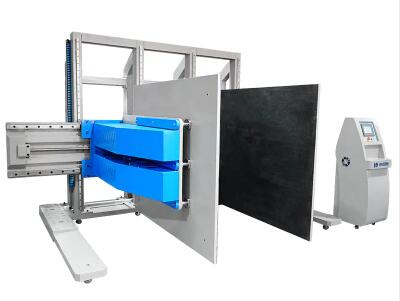
What Is Clamping Force?
Clamping force refers to the compressive force applied by fixtures, bolts, jaws, or other devices to secure workpieces or connected components. Mechanically, it fixes two or more objects together firmly. For instance, the preload generated during bolt tightening is essentially a clamping force, which stabilizes the connection by stretching the bolt and compressing the connected components. The magnitude of the clamping force directly affects the stability, safety, and load-transmitting capacity of the connection.
Basic Principles
The fundamental principle of measuring clamping force is to convert the physical quantity of force into measurable signals, such as voltage, current, or displacement, and then infer the clamping force from the sensor response. Common measurement principles include:
1. Strain Gauge Principle
Strain gauges are widely used force sensors. When attached to a load-bearing component, deformation caused by force changes the electrical resistance of the strain gauge. By using a Wheatstone bridge or similar circuits to measure the resistance change, the clamping force can be calculated. This method is commonly applied in force sensors and integrated measuring units within fixtures.
2. Load Cell Principle
A load cell is a sensor that converts force directly into an electrical signal, often incorporating strain gauge technology. Load cells integrate precise mechanical structures and signal amplification circuits, providing more stable and accurate measurements. They can directly measure axial pressure, representing the actual clamping force.
3. Hydraulic or Pneumatic Pressure Sensing
In certain clamping devices, such as hydraulic clamps, the clamping force is transmitted through liquid or gas. Measuring the system pressure can indirectly estimate the clamping force, since there is typically a linear relationship between fluid pressure and force. This method is suitable for large-scale machinery or high-load applications.
4. Other Indirect Methods
In some cases, clamping force can be estimated from the relationship between torque and clamping force or inferred from deformation or displacement measurements. While less precise than direct measurement, these methods may be used for preliminary evaluation or design validation.
Common Methods for Measuring Clamping Force
Different measurement targets and field conditions require different methods. Common approaches include:
1. Direct Measurement with Load Cells
This is the most direct and accurate way to measure clamping force. A load cell or dedicated clamping force sensor is installed along the load path to directly measure the force applied to a workpiece or fixture.
For example, in bolt clamping force measurement, a thru-hole or donut load cell can be placed between the bolt head and nut. As the bolt is tightened, the sensor measures the axial load in real-time, representing the clamping force.
Advantages of this method include:
Direct measurement of force: More accurate than estimating from torque
Real-time data output: Suitable for dynamic monitoring
Integration with automation systems: Enables recording, feedback, and control
Load cell outputs can be connected to digital displays, data acquisition systems, or computer interfaces for real-time monitoring and recording.
2. Tool-Based Force Gauges and Fixture Sensors
For simpler clamps or fixtures, such as machine vises, small load sensors or load buttons can be installed within the fixture to measure clamping force. For instance, a sensor placed on the clamping surface of a vise can measure the pressure generated as a screw is tightened.
Advantages include:
Ability to evaluate overall clamping effectiveness
Suitable for on-site shop-floor measurement
Data can be read via display or recorded for analysis
Proper fixture design is necessary to ensure the load path passes through the sensor body.
3. Dedicated Clamp Force Gauges
Specialized instruments, such as clamp force gauges, can measure the force distribution in clamping devices. For example, a four-point clamp force gauge can simultaneously measure forces at multiple contact points on a large fixture and calculate the total clamping force. These devices are ideal for large equipment, transport fixtures, or multi-point measurement scenarios. They usually feature digital displays and can output data to computers or print reports.
4. Deformation/Displacement-Based Estimation
In research or design validation, clamping force can be inferred by measuring elastic deformation or displacement of fixture components. For example, strain gauges on load-bearing parts detect minute deformations, and mechanical models are used to calculate the corresponding force.
Instruments and Tools for Measuring Clamping Force
Common tools and instruments include:
Load Cells and Force Sensors
Load cells are widely used in industry due to their high precision and durability. They utilize strain gauge technology to measure compressive force and can handle forces of thousands of newtons or more.
Force Display Units and Data Acquisition Systems
Signals from sensors are usually very small and require signal conditioning, digital displays, or data acquisition systems for accurate reading and recording. Professional systems can provide real-time digital readings and store data for analysis.
Specialized Clamp Force Measurement Devices
These include multi-point force measurement instruments and four-point clamp gauges, which provide comprehensive measurement of large or complex clamping structures.
Applications of Clamping Force Measurement
Clamping force measurement is widely applied in industrial settings, including:
Bolt Preload Verification and Fastener Testing
Measuring clamping force verifies that bolt preload meets design requirements, preventing loosening or overload failures and ensuring connection reliability.
Machine Tool Fixtures and Workholding Pressure Control
In CNC machining or assembly, insufficient clamping force may allow workpiece slippage, while excessive force can cause deformation or damage. Measuring clamping force ensures appropriate fixture pressure, guaranteeing machining accuracy and safety.
Structural Connections and Industrial Safety Validation
In large structure assembly, pressure vessels, or safety-critical components, measuring clamping force can detect potential risks early, reducing failure likelihood and improving overall safety.
Precautions and Common Misconceptions
Torque is Not Equivalent to Clamping Force
Torque is often used to estimate clamping force, but friction and lubrication significantly affect the relationship. Direct force measurement is more reliable.
Proper Sensor Installation and Calibration
Sensor placement, orientation, and preload conditions affect accuracy. Installation must follow specifications, and sensors should be periodically calibrated.
Alignment of Force Direction and Measurement Path
The sensor must measure force along the actual force direction to avoid errors.
Clamping force measurement is an indispensable part of engineering design, manufacturing, and quality control. Accurate measurement enhances fastener reliability, ensures fixture stability, improves product safety, and optimizes production efficiency. Currently, direct measurement using load cells, combined with digital displays and data acquisition systems, provides real-time, controllable, and traceable results. With the advancement of intelligent measurement technology, higher-precision, more integrated, and automated solutions will further expand the application of clamping force measurement in smart manufacturing and quality management.