

What is an anti-synthetic blood penetration tester?
In the testing of medical protective equipment, textile materials, and personal protective equipment (PPE), liquid barrier performance is one of the key safety indicators. To evaluate a material’s resistance to liquid splashes, such as blood or other bodily fluids, a specialized testing device—the Synthetic Blood Penetration Tester—is widely used in laboratories and quality control systems. This type of tester simulates blood splash scenarios to determine whether a material can function as an effective liquid barrier, and is particularly applied in the performance assessment of masks, medical protective clothing, and similar products. (Nelson Labs)
This article systematically introduces the technical principles and industry significance of the Synthetic Blood Penetration Tester, covering its definition, technical principles, international standards, typical applications, testing procedures, technical advantages, and future trends.
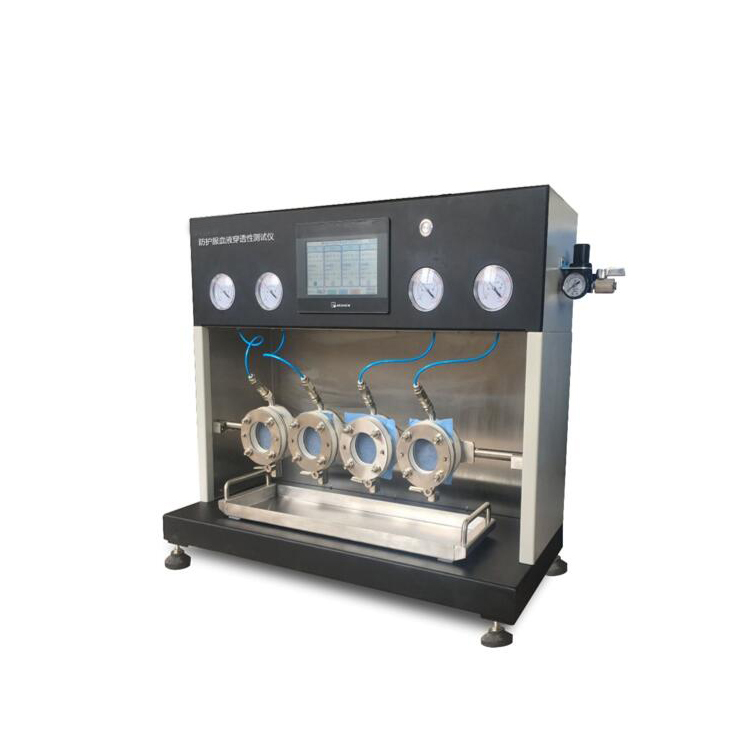
What is a Synthetic Blood Penetration Tester?
A Synthetic Blood Penetration Tester is an experimental device used to measure the ability of materials—such as medical masks, protective clothing, and coated fabrics—to resist liquid penetration under specific conditions. The basic principle involves spraying a fixed volume of synthetic blood at the sample at set speeds and pressures, and then observing whether the liquid penetrates the material. If no liquid passes through the sample, it is considered to have good liquid barrier performance. (Nelson Labs)
Synthetic blood is formulated to simulate the physical properties of real blood, such as surface tension and fluidity, making the test results closely approximate the behavior of actual human fluids. (Nelson Labs)
Technical Principles
1. Physical Property Simulation of Synthetic Blood
The formulation of synthetic blood is adjusted to have surface tension, viscosity, and flow behavior similar to real blood. This ensures that the test accurately reflects the material’s barrier performance against liquid splashes. For example, in standard tests, synthetic blood surface tension is typically set at approximately 0.042 ± 0.002 N/m, closely matching that of human blood and body fluids. (ASTM International | ASTM)
2. Pressure and Velocity Settings for Simulated Blood Spray
The test requires spraying a fixed volume of synthetic blood onto the sample under known speed and pressure conditions. This simulates the impact of liquid splashes in real-world scenarios, such as blood splatter during surgical procedures or exposure to other liquids. Typical pressure settings correspond to different human blood pressure levels:
10.6 kPa (~80 mmHg)
16.0 kPa (~120 mmHg)
21.3 kPa (~160 mmHg)
These pressures correspond to different spray velocities, such as 450 cm/s, 550 cm/s, and 635 cm/s. The instrument uses a constant-pressure spray system to maintain consistent speed and volume, ensuring reproducibility and comparability. (Imimg)
3. Experimental Setup and Sample Fixation
A typical Synthetic Blood Penetration Tester consists of the following key components:
Sample fixture: Secures the material (e.g., mask) in a manner that simulates actual use, preventing deformation that could affect results. (Imimg)
Constant-pressure spray device: Sprays a fixed volume (usually 2 mL) of synthetic blood over a controlled time while maintaining stable pressure, spray distance (typically 300–305 mm), and nozzle parameters. (textiletestingmachine.sell.everychina.com)
Jet-locking target plate: Blocks high-pressure edges of the spray, allowing only a stable jet to impact the sample center, improving test accuracy and repeatability. (textiletestingmachine.sell.everychina.com)
Relevant International Standards
Synthetic blood penetration testing is conducted according to internationally recognized standards to ensure consistency and comparability:
ASTM F1862 / F1862M
Specifies a method to measure the resistance of masks to synthetic blood penetration at defined velocities, using a fixed volume horizontal spray. It evaluates the material’s ability to block high-speed liquid penetration. (ASTM International | ASTM)
ISO 22609
Another standard for testing medical mask resistance to synthetic blood penetration, commonly used in international testing systems. (torontech.com)
EN 14683 and regional standards
European standard EN 14683 includes similar liquid barrier performance tests for medical masks, providing clear requirements for products entering the European market. (torontech.com)
Application Scenarios
The Synthetic Blood Penetration Tester has broad applications, including:
Medical masks and face shield testing
In healthcare environments, masks and face shields must prevent blood and body fluid splashes from reaching the wearer. Synthetic blood penetration testing is a critical performance indicator and an essential part of pre-market regulatory compliance. (Nelson Labs)
Personal protective equipment (PPE) quality control
Beyond masks, this testing evaluates protective clothing, splash suits, and other materials to ensure effective liquid barrier performance in hazardous environments. (M19 Lab)
Textiles and coated materials evaluation
The tester can also assess textile or coated materials, particularly functional fabrics and liquid-resistant materials that may be exposed to fluid contamination. (M19 Lab)
Standard Testing Procedure
A complete test process generally includes the following steps:
Sample preparation and fixation
Prepare samples to standard dimensions and secure them in the tester’s sample fixture to maintain conditions consistent with actual use. (Imimg)
Parameter setup
Set spray pressure, spray volume (typically 2 mL), spray velocity, and spray distance according to the material type and applicable standard. (textiletestingmachine.sell.everychina.com)
Conduct synthetic blood spray test
Activate the spray device to project the synthetic blood at the sample surface. The spraying occurs under controlled time to ensure consistent velocity and pressure. (Imimg)
Observation and assessment
After testing, visually inspect the reverse side of the sample for penetration. If no liquid is observed, the material passes at that test pressure; if penetration occurs, it fails. (Nelson Labs)
Technical Advantages
Introducing synthetic blood penetration testing provides a scientific, objective, and repeatable method for evaluating liquid barrier performance:
Realistic simulation of liquid splashes
By simulating blood surface tension and spray velocity, test results closely reflect actual material performance. (ASTM International | ASTM)
Standardized, comparable results
Compliance with ASTM, ISO, EN, and other standards allows results to be compared across laboratories and used as a basis for quality control and product performance claims. (Nelson Labs)
Enhanced safety and reliability assessment
For medical PPE manufacturers, this test is a key quality metric, improving product safety and providing users with verified protection performance. (Nelson Labs)
Future Trends
With advances in testing technology and increasing performance requirements for protective equipment, synthetic blood penetration testing is expected to evolve as follows:
Automation and digital control
Future equipment will emphasize intelligent control systems and software, improving test efficiency and precision through digital data acquisition and analysis.
Integration with big data and statistical analysis
Accumulating and analyzing large volumes of test data will help establish scientific performance evaluation models to guide product design optimization.
Multi-parameter integrated testing
Combining with other protective performance tests, such as bacterial filtration efficiency and particle resistance, allows comprehensive evaluation of PPE performance, supporting more complete safety ratings.
Overall, the Anti Synthetic Blood Penetration Tester is a professional testing device that plays a critical role in evaluating material liquid barrier performance. By simulating liquid splash scenarios and adhering strictly to international standards, it provides key performance indicators and quality assessment for medical, PPE, textile, and coated material industries. With the continuous improvement of testing standards and advances in technology, these instruments are becoming more intelligent, data-driven, and integrated, offering robust technical support for product development, safety assurance, and regulatory compliance. (Nelson Labs)